
Blogs, Bevel Gear
Applications and Design of Bevel Gears
Nov
1.Introduction
At Wenlio Gear, our focus is simple: precision transmission, proven reliability. As a precision gear manufacturer and custom gear supplier, we engineer bevel/right-angle gearsets for five sectors—Agriculture, Heavy Truck, Construction Equipment, EV e-axles, and Industrial Automation. In bevel programs, results depend on the full stack: tooth geometry, material, heat treatment, finishing, and verification. This guide consolidates practical know-how on applications, design methods, calculations, and failure control—so you can specify the right bevel pair and get parts that run smoothly in the field.
2.Applications
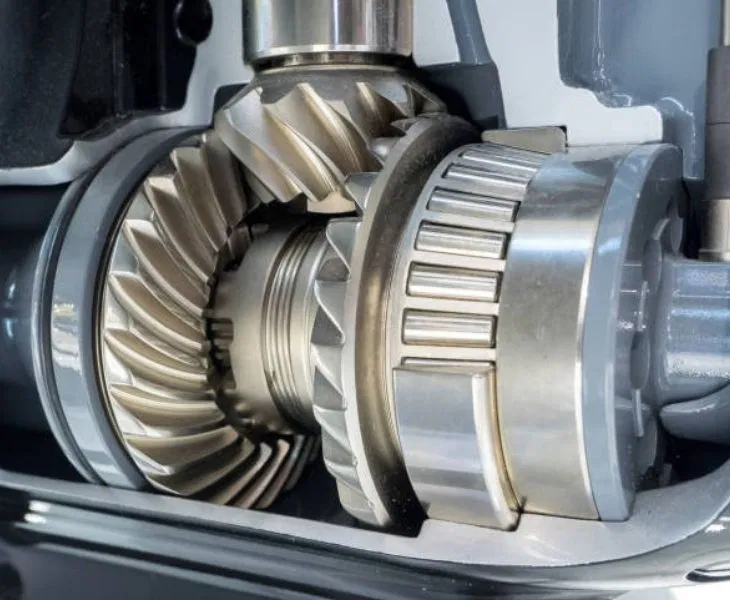
Bevel gears redirect motion between intersecting shafts, usually at 90°. The best choice (straight vs. spiral) depends on load, speed, smoothness, envelope, and cost. Below we map Wenlio’s five markets to typical uses and what they demand.
3.Where bevel gears fit
| Sector | Typical applications | What the application demands | Bevel choice & notes |
| Agriculture | Tractor/harvester axles; transfer stages | Long service life, shock tolerance, easy service | Spiral bevel for higher capacity; straight bevel acceptable on moderate duty; protect roots with adequate case depth |
| Heavy Truck | Axle ring & pinion; power-take-off stages | Stable contact over long mileage; efficient power transfer | Spiral bevel preferred for smooth running; confirm mounting distance and backlash windows |
| Construction Equipment | Loaders, cranes, excavators right-angle stages | High load, dust, bidirectional duty, compact housings | Spiral bevel with robust core; tight stock split for finishing; sealing & lubrication discipline |
| EV e-Axles | Right-angle stages inside compact 3-in-1 layouts | Quiet running at higher shaft speeds; tight packaging | Spiral bevel; consider low-distortion heat treatment and consistent finishing to preserve geometry |
| Industrial Automation | Gearheads, transfer mechanisms, pick-and-place | Accurate motion, repeatable positioning, low backlash | Straight bevel for moderate duty/space; spiral bevel when capacity or smoothness must rise |
Quick rule: when the same envelope must carry more load or run more smoothly, move from straight to spiral and tighten material + heat-treat + finishing control.
4.Design & Calculations—A Custom Gear Supplier’s Checklist
The goal is contact where you intended, across life and real mountings. Start with the geometry that sets behavior, then lock materials, heat treatment, and finishing so the design survives production and service.
4.1 Core geometry
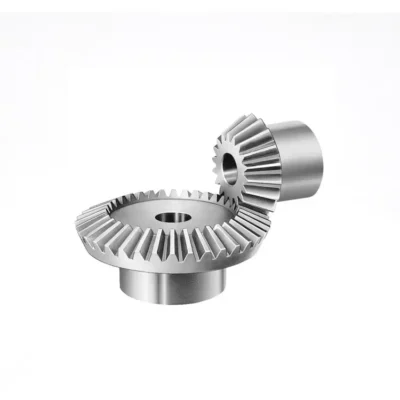
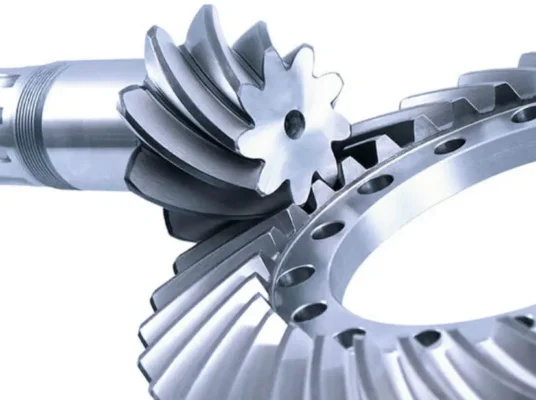
First, choose the gear type—straight vs. spiral—based on envelope constraints, required smoothness, and the target load profile.
Next, confirm the ratio (teeth_crown ÷ teeth_pinion). At the same time, verify bearing spans, housing stiffness, and lubrication so the contact pattern stays centered under real operating deflection.
Then, select the module (or DP) as the primary tooth-size lever, balancing torque capacity against space claim.
In parallel, lock the pressure angle (e.g., 20°), since it directly affects tooth strength and contact behavior—and importantly, it must remain consistent across the mating pair.
After that, finalize the shaft angle: 90° is most common, but other angles are feasible provided that the layout, bearing arrangement, and alignment strategy are robust enough.
Finally, define a realistic backlash window—not only the assembly target, but also the expected range before and after heat treat.
To close the loop, apply profile/lead modifications (such as crowning and tip/root relief) so that you avoid edge loading and stabilize contact under deflection.
4.2 Strength & life
Surface durability: keep flank finish, case hardness, and effective case depth aligned with your duty cycle.
Bending resistance: ensure tooth thickness and root transitions match peak loads.
Contact ratio: raise when you need smoother running and better load sharing.
Verification set: plan the inspection evidence you need (profile/lead/pitch charts, contact photos at mounting distance, hardness maps).
4.3 Simplified calculation touchpoints
Tooth form checks: confirm minimum pinion teeth to avoid undercut; pick module/DP from torque and space targets.
Backlash setting: specify a window that your assembly can hold; confirm pre- and post-heat treatment.
5.Manufacturing Flow
Precision isn’t one machine—it’s a route:
Blank preparation: forged/rolled blanks for strength and consistent stock.
Tooth cutting (CNC): stable setups, correct tools/coatings, and chip evacuation to control flank form.
Finishing pre-heat treat: lapping/honing as required to improve surface and sizing.
Heat treatment: carburizing with quench & temper (for hard flanks/tough cores), nitriding (for lower distortion cases), or Q&T/normalizing where appropriate.
Post-HT precision: hard machining and grinding with burn-free windows; verify with profilometry, etch, and Barkhausen as needed.
Assembly checks: light-load roll tests confirm contact at the specified mounting distance.
Documentation: deliver the inspection pack your QA needs for incoming checks and PPAP.
6.Failure Modes—Causes, Prevention, and Monitoring
Even good designs can fail without clean lubrication, disciplined assembly, or honest inspection. Use the table below as a troubleshooting and prevention map.
| Failure mode | Typical causes | Prevention (design/production) | Monitoring |
| Tooth wear | Poor lubrication, contamination, high sliding, misalignment | Choose the right oil/grease; filtration & cleanliness; control flank finish | Oil analysis; visual checks for polish marks and abrasive traces |
| Pitting / spalling | High contact stress; inadequate case depth/hardness; rough flanks | Adequate effective case depth; refined finishing; correct mounting distance | Vibration trend changes; inspection for micro-pits |
| Chipped/broken teeth | Overload, shock events, inclusions | Size module & root fillets for peaks; material cleanliness; controlled heat treat | Shock sensors; teardown after events |
| Noisy/rough running | Misalignment, poor contact pattern, inconsistent backlash | Set shim strategy; confirm contact pattern; stabilize finishing | Contact checks at assembly; periodic roll tests |
| Axial thrust issues | Unbalanced forces; bearing or housing issues | Verify alignment and bearing selection; consider paired forms if applicable | Temperature rise at bearings; axial vibration |
| Fatigue cracking | Cyclic loading beyond design; wrong material route | Match duty to material + case; shot peen root where needed | Eddy current/UT where permissible; teardown audits |
Maintenance playbook: keep lubricant type/viscosity within spec; monitor temperature and vibration; schedule inspection windows; clean breathers and seals; align shafts carefully; and document adjustments so contact pattern history is traceable.

7.Selection & Sourcing—How Wenlio Gear Makes It Practical
You can move quickly without cutting corners when responsibilities are clear:
Define targets: torque, duty cycle, ratio, space claim, and expected life.
Choose the route: material + heat treatment + finishing consistent with the duty.
Lock mounting: mounting distance, shim range, backlash window, and the contact-pattern method.
Agree evidence: profile/lead/pitch charts, contact photos, hardness and case-depth maps with each lot.
Move fast: drawing review in 1 day, quote in 2 days, prototype in 15 days, mass production in 30 days; flexible MOQ from 1 set (matched pairs available).
8.Quick Reference—Design & Process Maps
8.1 Geometry → outcome
| Aim | Prioritize | Notes |
| Smooth running | Higher contact ratio; accurate mounting | Use crown/lead modifications to keep contact centered |
| Load in a tight envelope | Module selection; pressure angle; spiral bevel | Balance tooth thickness with housing clearances |
| Consistent field behavior | Backlash window; pitch diameter & cone discipline | Define shim strategy and verify after heat treat |
8.2 Process → risk control
| Step | What protects the part | What to avoid |
| Cutting | Rigid setup, correct tooling/coatings, chip flow | Flank waviness and tool wear running unchecked |
| Heat treat | Documented recipes; effective case depth | Distortion that shifts mounting settings |
| Finishing | Proper stock split; burn-free grinding windows | Thermal damage that looks “polished” but shortens life |
| Inspection | Charts + contact photos + hardness maps | Pass/fail without evidence for incoming QA |
9.Conclusion
Bevel gears succeed when design decisions and manufacturing discipline line up. As a precision gear manufacturer and custom gear supplier, Wenlio Gear focuses on the right-angle power paths that matter in agriculture, heavy truck, construction equipment, EV e-axles, and industrial automation. We help you choose the proper type, ratio, material, heat treatment, and finishing—and we prove it with inspection evidence. Share your target torque, ratio, and space claim to begin a fast, confident path from drawing to parts. Contact Us.
