
Blogs, Bevel Gear
Bevel Gear Heat Treatment for Quiet, Durable Powertrains
Oct
1.Introduction
At Wenlio Gear, our focus is simple: precision transmission, proven reliability. We engineer bevel/right-angle and high-precision gearsets for agricultural machinery, heavy truck, construction equipment, electric vehicle (EV), and industrial automation. In these programs, the heat-treatment stack often decides whether a launch is quiet and durable—or drifts into rework.
This guide explains the major routes—surface quenching, carburizing & quenching, nitriding, quench-and-temper (Q&T), and normalizing—and maps them to real operating profiles in our markets. If you need a precision gear manufacturer and custom gear supplier that engineers heat treat for NVH, durability, and cost, read on.
2.Heat-Treat Fundamentals
Great gears pair a hard, wear-resistant surface with a tough, ductile core.
Selection balances
Flank hardness & case depth → pitting/scuffing resistance, contact strength
Core toughness → bending fatigue and shock tolerance
Distortion control → predictable finishing and low NVH scatter
Throughput & cost → cycle time, consumables, and rework risk
Common routes
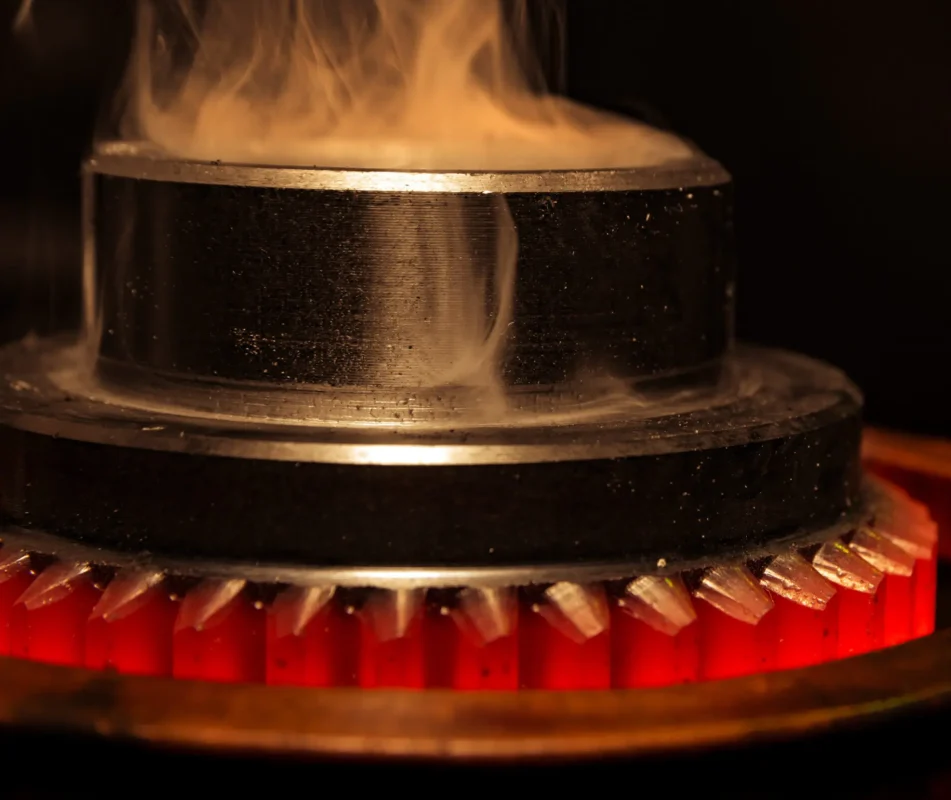
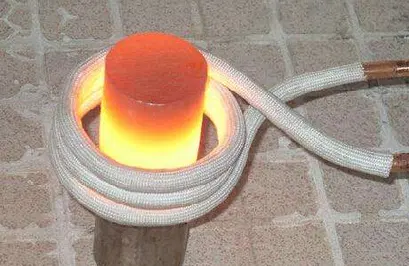
Surface quenching (induction/flame): Selectively harden teeth and roots while keeping a tough core (best with medium-carbon steels).
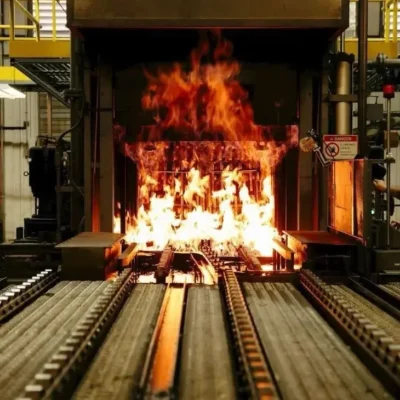
Carburizing & quenching: Diffuse carbon, quench, temper → hard case over tough core (low-carbon/low-alloy steels).
Nitriding: Diffuse nitrogen at low temperature → very hard surface with minimal distortion.
Quench & temper (Q&T): Through-hardness for modest duty and fast flow.
Normalizing: Stress relief and grain refinement—often a pre-treat or for low-strength gearsets.

3.Process Cards
3.1 Surface Quenching (Induction / Flame)
Steels: 45 / 1045, 40Cr / 5140
Flank/root hardness: ~HRC 45–50 (higher with tuned recipes)
Choose when: Localized hardening, short cycle times, good impact toughness (PTO stages, medium-duty bevels)
Watch-outs: Coil-to-tooth uniformity; control root hardening; plan grind stock after quench
3.2 Carburizing & Quenching (Atmosphere or LPC + Gas)
Steels: 20, 20Cr, 20CrMnTi families & modern equivalents (e.g., 20MnCr5)
Surface hardness: HRC 56–62; effective case depth (Eht) per duty
Choose when: Highest contact strength and wear life, with strong bending if a root case is specified
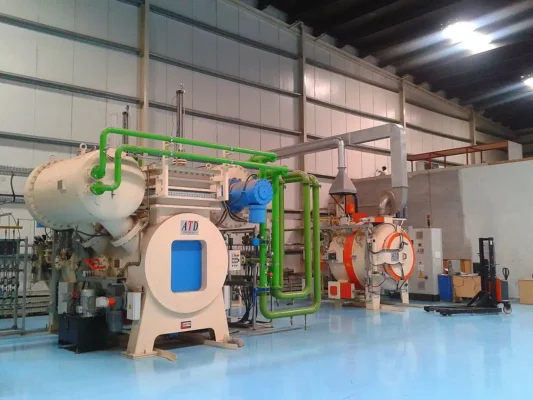
Watch-outs: Distortion; prefer vacuum carburizing (LPC) + gas quench for cleaner surfaces and tighter scatter; atmosphere + oil for broad sections and legacy cells
3.3 Nitriding (Gas / Ion)
Steels: 38CrMoAlA and select Cr-Mo / Ni-Cr-Mo grades
Surface hardness: HRC ≥65 (often specified in HV) with very low distortion
Choose when: Finish-first geometry, tight NVH budgets, light-to-moderate loads, timing trains, automation drives
Watch-outs: Thinner case than carburized; control the compound layer to avoid brittleness and flaking
3.4 Quench & Temper (Q&T)
Steels: 45 / 1045, 40Cr / 5140, 42CrMo4 / 4140
Tooth hardness: ~HB 200–280 (≈ low-mid HRC 30s if converted)
Choose when: Simple, fast, economical; easy finishing for auxiliaries and cost-sensitive gears
Watch-outs: Lower flank hardness—check contact stress and lubricant (EP package)

3.5 Normalizing
Outcome: HB 160–220, refined grains, stress relief
Choose when: Improve machinability and stabilize response before hardening routes; baseline for large forgings
Watch-outs: As-normalized gears suit lower mechanical strength unless followed by hardening
4.Application Reference
Below are illustrative defaults Wenlio often recommends. Your drawing (module, size, geometry) and volume will tune the details.
4.1 Agricultural Machinery (tractors, harvesters, PTO gearboxes)
Duty reality: Long hours, contamination, shock; NVH matters but uptime dominates.
Preferred routes:
A. Surface quench for PTO straight/spiral bevels and spur/helical stages with moderate impact—hard flanks, tough cores, short cycles.
B. Carburize + quench for primary torque paths in right-angle boxes or high-load final drives—best contact life under shock/misalignment.
Finishing & QA: Grind critical fits; pattern check for bevel pairs; verify profile/lead/pitch on high-ratio stages.
Tip: In dusty service, specify a slightly thicker case and an anti-scuff additive in oil.
4.2 Heavy Trucks (on/off-highway; differentials, power dividers, auxiliaries)
Duty reality: High torque, high mileage, strict pass-by/cabin NVH; rebuild economics matter.
Preferred routes:
A. Carburize + quench + temper (often LPC + gas) on ring & pinion and high-load gearsets for quiet highway whine and long life.
B. Nitriding for precision auxiliaries with tight geometry that shouldn’t move after finish-machining (e.g., sensor-indexed wheels).
Finishing & QA: Hard-grind flanks and roots; optional superfinish; provide Eht and microhardness traverses in PPAP.
4.3 Construction Equipment (cranes, excavators, winches, slewing drives)
Duty reality: Transient peaks, shock, bidirectional duty; field serviceability and robustness first.
Preferred routes:
A. Carburize + quench for slewing/rotation bevel stages and high-torque reducers—deep case + tough core absorb shocks.
B. Surface quench for large-module spur/helical stages where localized hardening is practical and fast.
C. Q&T for cost-sensitive auxiliary gears with modest duty; normalize as pre-treat for stable machining.
Finishing & QA: Balance grind stock for distortion; document contact patterns at spec mounting distance.
4.4 Electric Vehicles (e-axles, differentials, high-speed angle stages)
Duty reality: High rpm, continuous torque, no engine masking—gearbox acoustics are exposed.
Preferred routes:
A. LPC + gas quench + temper for bevel and helical sets—clean surfaces, tighter distortion band, less grind variability, lower gear whine.
B. Nitriding for precision timing trains or light-load stages where minimal movement and high surface hardness matter.
Finishing & QA: Hard-grind; superfinish optional for cabin-quiet targets; verify profile/lead micro-geometry (crowning/bias) for noise stability.
4.5 Industrial Automation (robotics, AGVs, machine tools, conveyors)
Duty – Automation needs high accuracy and frequent start–stop, with tight backlash/NVH; heat soak is lower than EVs, but geometry stability is critical.
Routes – So choose:
A) Nitriding for precision right-angle/bevel sets and compact actuators (low distortion, finish-first).
B) LPC carburize + gas quench for higher-load, quiet bevel stages, then hard grind/hone to control tonal noise.
C) Q&T + selective induction for cost-sensitive conveyors/fixtures where lead time and serviceability come first.
Why – Nitriding helps lock geometry, while LPC carburizing carries higher loads.
Finishing & QA – Define backlash windows and cumulative pitch; verify profile/lead charts, contact pattern at operating mounting distance, and flank Ra ≤ 0.8 μm. For robot joints/AGVs, also check torsional backlash and noise at working speeds.
5.Cross-Route Comparison
| Attribute | Surface Quench | Carburize + Quench | Nitriding | Q&T | Normalizing |
| Surface hardness | HRC 45–50† | HRC 56–62 | HRC ≥65 (HV common) | HB 200–280 | HB 160–220 |
| Case depth | Shallow / local | Tunable (deep) | Thin | Through | N/A |
| Core toughness | High | High | High (unchanged) | Medium | Medium |
| Distortion | Low–Medium | Medium (lower with LPC+gas) | Very low | Low | Low |
| NVH potential | Good | Excellent (post-grind) | Excellent | Fair | Fair |
| Typical use | Ag PTO, mid-duty | Trucks, EVs, heavy stages | Precision, finish-first | Cost-sensitive, modest duty | Pre-treat/low-strength |
Can be higher with deeper induction patterns and a tuned temper.
6.Selecting the Route: Five Practical Questions
What’s the duty map? Continuous vs. peak torque/speed defines case depth, hardness, and micro-geometry.
How strict is NVH? Tighter noise → favor carburized + hard grind (+/- superfinish) or nitriding with minimal movement.
What distorts in heat? Slender parts and thin webs steer you to LPC + gas quench or nitriding to reduce scatter.
What’s the finish plan? Nitriding prefers finish-first; carburizing expects post-hard grind/hone; surface quench depends on coil path and stock plan.
What’s the value equation? Consider furnace time and scrap/rework risk, post-grind time, NVH audits, and field service.

7.Example Build Recipes
Ag PTO bevel stage (medium impact)
40Cr (5140) → induction harden flanks & root → temper → grind fits & verify contact pattern → EP oil with anti-scuff package.
Truck differential ring & pinion
Case-hardening steel → LPC + gas quench + temper → hard-grind flanks & root → optional superfinish → spin NVH audit at speed.
Excavator slewing drive
Case-hardening steel → carburize + oil/gas quench (section-dependent) → temper → grind → pattern check; slightly thicker case for shock loads.
EV e-axle bevel set
Case-hardening steel → LPC + gas quench + temper → hard-grind → micro-geometry validation (profile/lead charts) → superfinish if cabin-quiet target.
8.Quality Artifacts You Should See in Every Part
-
Geometry through heat – First, confirm runout, concentricity, and helix/profile before and after hardening stay within spec.
-
Tooth accuracy – Next, report profile/lead/pitch with clear charts.
-
Case integrity (if applicable) – In addition, document Eht, surface carbon, microhardness traverse, and retained austenite where required.
-
Functional checks – Then verify light-load contact patterns and backlash windows at the design mounting distance.
-
Traceability – Finally, lock steel heats, furnace loads, quench media, and finishing recipes for repeatability.
9.Conclusion
There’s no single “best” heat treatment—only the best fit for your duty, NVH targets, geometry, and budget. In practice, agriculture often favors induction or case hardening; meanwhile trucks and EVs tend to set the benchmark with carburizing (often LPC + gas quench) for quiet strength. For construction duty, deeper cases with tough cores help absorb shock, whereas precision assemblies frequently lean on nitriding to protect geometry while improving wear.
Have a print or target case depth? Then let’s align the route, quench, and finishing stack that gets you to production with confidence— Contact us.
