
Blogs, Bevel Gear
Bevel Gears in Five Industries How to Choose
Apr
Introduction
On a drawing, a bevel gear set looks straightforward: two shafts change direction and transmit torque through the gear mesh. In actual equipment, things are rarely that simple. Gear performance is affected not only by geometry, but also by load impact, lubrication condition, housing rigidity, mounting distance, backlash, and heat treatment variation. These factors often decide whether a gear set runs smoothly or ends up noisy, overheating, or difficult to assemble.
At Wenlio Gear, many bevel gear projects become much clearer once the team agrees on two basics early on: the real operating condition and the inspection method used to verify stable contact. In this article, we will first look at common bevel gear types, then review five industries where bevel gears are widely used: agricultural machinery, heavy-duty trucks, construction equipment, electric vehicles, and industrial automation.
What a bevel gear is
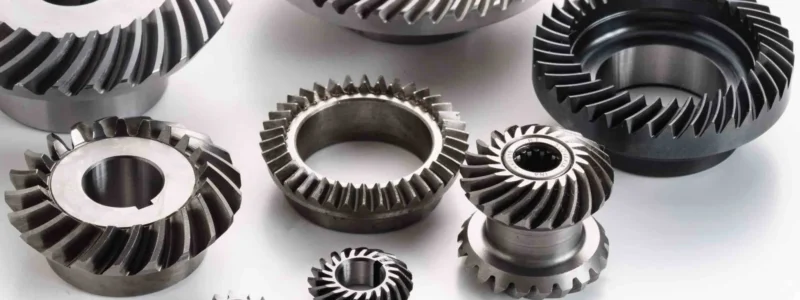
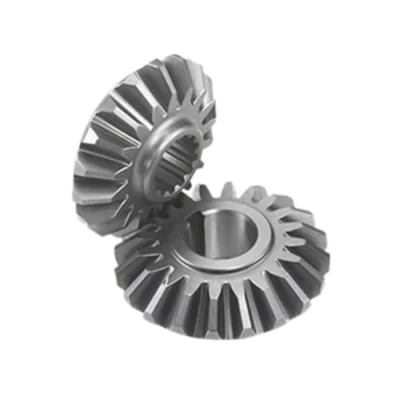
A bevel gear is a conical gear used to transmit torque between intersecting shafts, most commonly at a 90-degree angle.
Why bevel gears matter in real applications
The bevel type changes how the teeth actually carry load
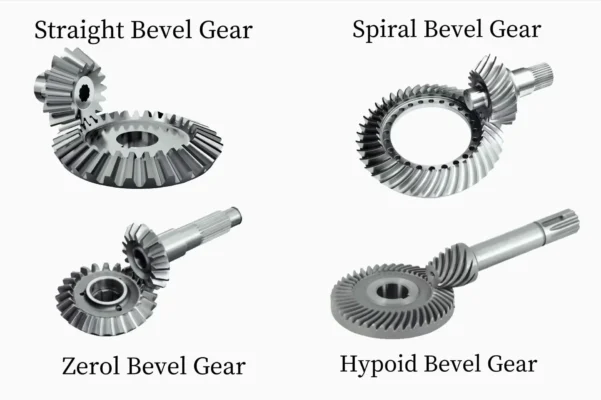
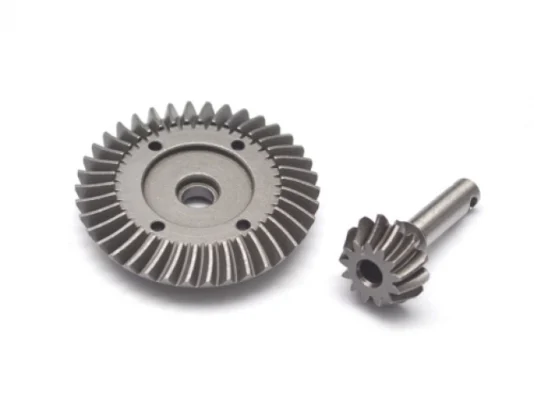
Straight, spiral, hypoid, and zerol designs do not behave the same way. Their tooth forms change contact ratio, sliding level, and sensitivity to mounting distance or backlash, which directly affects heat, noise, and durability.
The gearset only works as well as the system around it
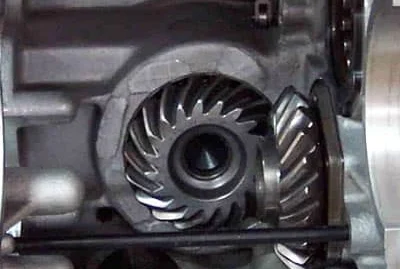
A bevel pair does not run in isolation. Housing stiffness, bearing preload, lubrication method, and assembly variation can shift the contact pattern enough to change field performance, even when the gear tooth geometry looks acceptable on paper.
Selection mistakes usually show up late and expensively
If the wrong bevel type is chosen, the system may still assemble but then fail through noise, pitting, scuffing, or pattern instability. That is why bevel gear selection should start from duty cycle, not from shape alone.
Four common bevel gear types at a glance
| Type | Tooth behavior | Best fit | Main caution |
| Straight bevel | Straight teeth, more abrupt engagement | Simple right-angle drives, moderate speed | More sensitive to shock and misalignment |
| Spiral bevel | Curved teeth, smoother engagement | Differentials, compact right-angle reducers | Requires tighter contact-pattern control |
| Hypoid | Offset shafts, more flank sliding | Differential-style and offset layouts | Lubrication and flank finish become more critical |
| Zerol | Near-zero spiral angle, between straight and spiral | Angle drives needing smoother mesh without strong spiral thrust | Still setup-sensitive |
A practical point is that the correct choice is not only about torque. It also changes axial thrust, bearing load, lubrication risk, and how tightly the housing and setup must be controlled.
Five industries where bevel gears matter most
- Agricultural machinery – PTO drives, transfer cases, angle gearboxes, harvester drives
- Heavy-duty trucks – auxiliary drives, differential-related gearsets, PTO interfaces
- Construction equipment – swing drives, pump drives, compact right-angle reducers
- Electric vehicles – e-axle reducers, compact drive modules, angled transmission paths
- Industrial automation – servo angle drives, robot joints, compact right-angle gear units
Each field uses bevel gears differently, so the best tooth form and control plan should follow the application rather than a generic catalog assumption.
What each industry usually needs from a bevel gear
| Industry | Typical demand | Why it matters |
| Agricultural machinery | Shock resistance, contamination tolerance, long field duty | Mud, dust, and torque spikes challenge surface life and pattern stability |
| Heavy-duty trucks | Stable load sharing, durability, noise control | Drivetrain applications need repeatable contact under load |
| Construction equipment | High torque, compact packaging, reliability | Machines run under heavy duty and harsh working cycles |
| Electric vehicles | Compact design, lower noise, high precision | NVH, efficiency, and packaging are critical in e-drive systems |
| Industrial automation | Accuracy, smooth motion, predictable backlash | Servo control depends on stable meshing behavior |
This five-industry view helps explain why one bevel gear drawing cannot serve every application equally well. The target should reflect the machine’s real environment and performance priorities.
What good bevel gear control improves in production
| Control area | What improves | Why it helps |
| Geometry and micro-geometry | Stable contact pattern and backlash | Fewer assembly corrections and more consistent running |
| Material and heat treatment | Surface durability and root strength | Better resistance to pitting, scuffing, and tooth failure |
| Finishing route | Smoother meshing and matched flank quality | Better lubrication behavior and lower NVH risk |
| Fixturing and datums | Better alignment during machining and inspection | Less scatter from one batch to the next |
| Inspection plan | Comparable approval evidence | Easier prototype validation and batch release |
In practice, bevel gears become easier to launch when manufacturing, heat treatment, and inspection all point to the same functional target: a repeatable contact pattern in the final assembly.
Supplier selection tips
- Ask for more than a claimed gear grade. Request geometry evidence, runout, hardness, case depth if relevant, and contact-pattern reference.
- Confirm the heat-treatment and distortion plan. Bevel gears often need careful control after hardening, especially when tolerances are tight and finishing is required.
- Define assembly targets early. Mounting distance, backlash window, bearing preload, and mating datums should be part of the RFQ if you want stable contact behavior.
- Match supplier experience to the bevel type. Spiral, hypoid, and zerol designs usually demand more setup discipline than straight bevel gears.
- Check repeatability, not just prototype capability. Batch records, control plans, and prototype-to-production transition methods matter more than one successful sample.
Why Choose Us
Wenlio Gear supports precision bevel gear projects with a focus on clear geometry definition, repeatable inspection evidence, and application-driven selection.
We help teams connect bevel gear type, duty cycle, lubrication assumptions, and assembly targets into one manufacturable and verifiable plan.
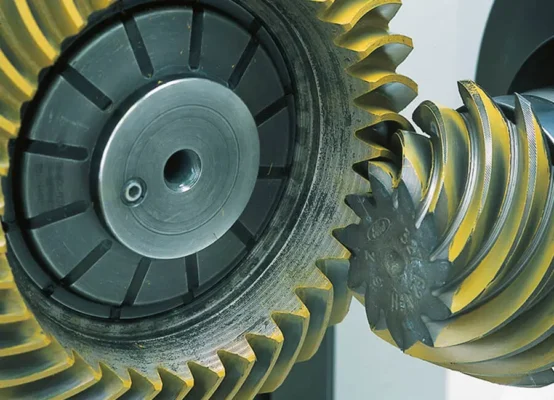
For projects in agriculture, trucks, construction, EVs, and industrial automation, we place special attention on the items that most often affect field behavior: contact-pattern stability, mounting distance and backlash control, heat treatment consistency, and runout tied to functional datums.
FAQ
Q1: Are spiral bevel gears always better than straight bevel gears?
A: Not always. Spiral bevel gears usually run smoother and share load better, but straight bevel gears can still be suitable in moderate-speed, simpler right-angle drives.
Q2: When should I consider hypoid gears instead of spiral bevel gears?
A: When the layout needs shaft offset or packaging flexibility. However, more sliding means lubrication and flank finish become more important.
Q3: What makes bevel gears fail early in the field?
A: Common causes include unstable contact pattern, poor lubrication, heat-treatment scatter, misalignment, and insufficient control of mounting distance or backlash.
Q4: What should I include in a bevel gear RFQ?
A: Drawing, target ratio, duty cycle, lubrication method, expected life, mounting distance or backlash targets, and the inspection evidence you expect.
Q5: Why do five industries need different bevel gear solutions?
A: Because they load and use the gear differently. A tractor, truck, excavator, EV reducer, and servo angle drive do not stress the mesh in the same way.
10. Conclusion
Bevel gears are widely used in five major industries because they are a practical way to change power direction in limited space. In real projects, however, selection is not just about gear shape. It depends on operating conditions such as torque, speed, lubrication, assembly method, and housing design.
If you are working on a bevel gear project for agricultural machinery, heavy-duty trucks, construction equipment, electric vehicles, or industrial automation, feel free to Contact us with your drawings and operating conditions. We can help you evaluate the right gear type, manufacturing process, and inspection approach for your application.
