
Blogs, Bevel Gear, Custom Gear
Custom Bevel Gear Services: A Practical Guide

Jan
1. Introduction: what “custom bevel gear service” really means
Custom bevel gear services help transmit power between intersecting shafts, most commonly to change direction in compact right-angle drives. In real machines, off-the-shelf gears often miss the details that decide performance: mounting distance, tooth contact pattern under load, noise targets, housing constraints, or a non-standard shaft angle. That is why many OEM and rebuild programs move to custom bevel gears—to make the gearset fit the application, not the other way around.
Wenlio Gear focuses on high-precision bevel gears for agricultural machinery, heavy-duty trucks, construction equipment, EV drivetrains, and industrial automation. This guide explains what you should prepare, what you should expect from a supplier, and how to keep quality repeatable from prototype to batch production.
2. When you should choose custom bevel gear
You usually need custom bevel gears when at least one of these is true:
- Non-standard geometry:shaft angle is not 90°, limited center distance, special mounting distance, or a tight housing envelope.
- Noise / vibration targets:the gearbox must run quieter, especially at higher speed.
- High torque density:limited space but high torque, long duty cycles, shock loads.
- Matched gearset requirement:you need stable backlash and contact pattern across multiple assemblies.
- Reverse engineering:the original gear is discontinued, or you only have a sample/OEM part.
3. Bevel gear types (simple selection table)
These are the common choices in custom projects.
| Type | Best for | Typical trade-offs |
| Straight Bevel | Simple right-angle drives, moderate speed | More noise risk at higher speed |
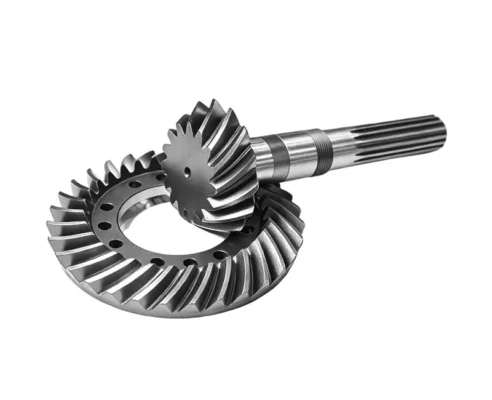
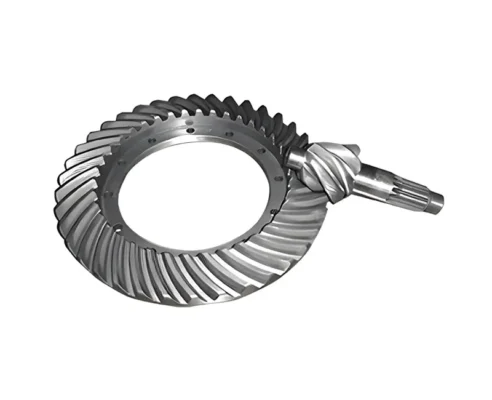
| Spiral Bevel | Smoother meshing, better NVH, higher speed | Needs stronger process control + pairing |
| Zerol Bevel | “Between” straight and spiral behavior | Still needs correct contact setup |
| Hypoid (offset) | Packaging needs pinion offset; common in axles | More sliding → lube and heat control matter |
Practical note: Type selection is not only “strength”. It is also packaging, noise, and how stable the contact pattern remains after heat treatment and assembly.
4. What you should send to start a bevel gear project
To quote fast and control risk, a supplier needs clear inputs. At minimum, send:
- Drawing (preferred) or sample + key dimensions
- Target torque/speed, duty cycle, shock factor
- Shaft angle / offset (for hypoid), ratio, rotation direction
- Space limits: OD, face width, mounting distance range
- Material preference (if any), heat treat preference (if any)
- Accuracy requirement or functional target (noise, backlash window, life)
Many customers reference ISO standards during internal reviews:
- ISO 17485 for bevel gear accuracy communication
- ISO 10300 series for load capacity calculation framework
5. What a reliable custom bevel gear service should include
A “good price” is not enough. A reliable supplier should provide a controlled route from design to inspection—and be able to explain why each step protects your assembly performance.
5.1 DFM review (before cutting)
Confirm datums, tolerances, and what really controls assembly: runout, mounting distance, backlash window
Confirm finishing plan (lapped or ground) and what is realistic for your volume/cost target
Identify “risk points” early: thin sections, long faces, aggressive heat treat targets, or tight bore/face relationships
5.2 Manufacturing route (typical)
Most projects follow this logic:
- Blank preparation (forging or bar stock) + turning
- Bevel gear cutting (process chosen by type and volume)
- Heat treatment (case harden / through harden / nitriding as needed)
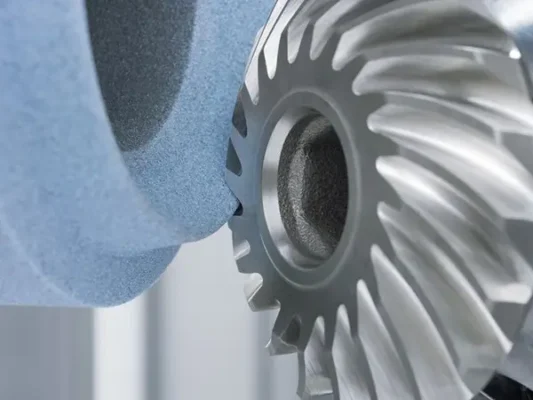
- Hard finishing (lapping or grinding) to stabilize tooth geometry
- Final inspection + matching (gearset paired, marked, packaged)
Why lapping/testing matters: In bevel and hypoid programs, testing and lapping are widely used to tune mesh behavior and understand how changes (including heat treatment) affect contact.
5.3 Inspection deliverables that matter (beyond dimensions)
Bevel gears are “system parts”. Besides size checks, you should care about functional checks that predict assembly results:
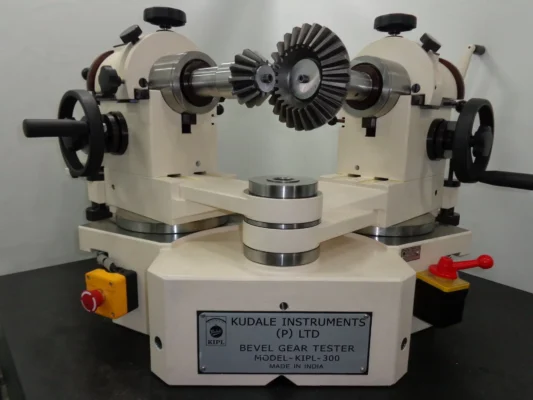
- Tooth contact pattern (rolling test):confirms the gearset contacts where it should.
- Backlash & mounting distance confirmation:reduces assembly variation.
- Runout / concentricity vs mounting datums:protects quiet running and stable contact.
- Material & heat treat reports:hardness, case depth, etc., when required.
NASA’s gear handbook notes that for bevel and hypoid gears the contact pattern can be determined from tooth contact analysis (TCA), and contact pattern checks are used to verify mesh quality in practice.
5.4 Validation plan
If you want repeatable production, ask your supplier how they validate the route:
- Prototype stage:confirm geometry, contact pattern, backlash window, and assembly fit
- Pilot batch:confirm heat treat stability, distortion control, and unit-to-unit consistency
- Mass production:lock the control plan: datums, key inspections, traceability rules, and packing standard
This is where projects “win” or “fail”. Many problems show up only after heat treatment and assembly, not in the first machining check.
6. Where custom bevel gears are commonly used
Agricultural machinery: tractor front axles, harvesters, right-angle drives—long duty cycles and mixed loads
Heavy truck: axle/differential gearsets, transfer cases—torque and life targets matter
Construction equipment: swing drives, reducers—shock loads and reliability dominate
EV drivetrain: compact e-axle packaging, NVH and efficiency targets
Industrial automation: right-angle gearboxes, robotic systems—repeatability and smooth motion
7. Common failure modes (and how to prevent them)
This section is short, but it saves months of iteration.
A: Contact pattern looks OK in no-load test, but shifts under load
- Root cause: housing/shaft deflection, bearing preload, thermal growth
- Prevention: define the load condition for pattern check and confirm assembly datums; use TCA/functional checks to predict pattern shift.
B: Unit-to-unit noise scatter in assembly
- Root cause: runout drift vs datums, mounting distance variation, inconsistent finishing
C: Backlash changes after heat treatment
- Root cause: distortion and residual stress release
- Prevention: set realistic allowance, plan hard finishing, and validate with pilot batch.
D: Hypoid sets run hot
- Root cause: sliding contact is higher than spiral bevel; lube and surface finish matter
- Prevention: confirm lubrication condition, finishing method, and contact pattern position.
8. RFQ checklist
| Item | What to provide | Why it matters |
| Gear type | Straight/Spiral/Zerol/Hypoid | Drives process + inspection plan |
| Ratio | tooth count or ratio | Defines geometry and contact |
| Shaft angle / offset | degrees / hypoid offset | Critical for fit and mesh |
| Torque & speed | min/nom/max | Defines strength and heat |
| Duty cycle | hours/day, shock | Real life target |
| Space envelope | OD, face width limits | Avoid redesign loops |
| Mounting datums | bore/face/shaft | Controls runout and assembly |
| Backlash target | range at temp | Assembly stability |
| Material | preferred or “recommend” | Cost + heat treat window |
| Heat treatment | case/through/nitriding | Life and distortion control |
| Finishing | lapped / ground | NVH + cost |
| Inspection report | what you need | Prevents disputes at receiving |
9. FAQ
Q1: What is your MOQ for custom bevel gears?
MOQ depends on gear size, type, and whether dedicated tooling is needed. We support prototypes and small-to-mid batches, then scale up after validation.
Q2: What affects lead time most?
New design confirmation, heat treatment route, finishing method (lapping vs grinding), and required report pack. If you share your target date early, the supplier can propose a manufacturable route.
Q3: Can you supply matched gearsets (paired bevel gears / ring & pinion)?
Yes. Matching and marking help keep contact pattern and backlash consistent in assembly.
Q4: What standards can you work to?
Customers commonly reference ISO 23509 (geometry), ISO 17485 (accuracy), and ISO 10300 series (load capacity) during reviews.
Q5: Can you support reverse engineering from a sample?
Yes. Send the sample and application data (speed/torque/space). We confirm what can be measured directly and what must be validated by rolling/contact checks.
10. Conclusion
Bevel gears are hidden inside housings, but they are central to how modern machines move. Whether they are turning torque in a tractor axle, a truck differential, a construction final drive, an EV e-axle or a factory right-angle gearbox, they have to work reliably, day after day.
If you are planning a new bevel gear project, localising an existing design or solving issues with axles, final drives or right-angle gearboxes, you are welcome to Contact Us to share your drawings, samples and operating conditions with our engineering team.
