
Spur Gear
Straight Cut Gears: Basics and Applications
Dec
1. Introduction
In many machines, the key question is not only “which gearbox should we use”, but also which gear type should work at each stage: straight cut gears, helical gears or other forms.
As a precision gear manufacturer and custom gear supplier, Wenlio Gear focuses on bevel gears, straight cut gears and shafts for five main sectors: Agricultural Machinery, Heavy Truck, Construction Equipment, Electric Vehicles (EV) and Industrial Automation.
This article looks at straight cut gears (spur gears) in a simple, practical way: what they are, why they can be the better choice in some stages, and how Wenlio Gear applies them across these five sectors.
2. What are straight cut gears?
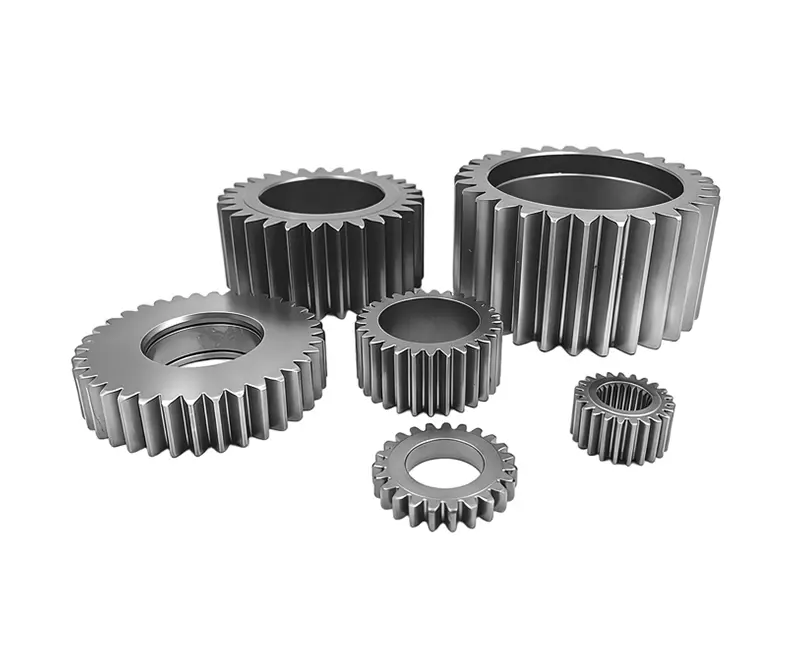
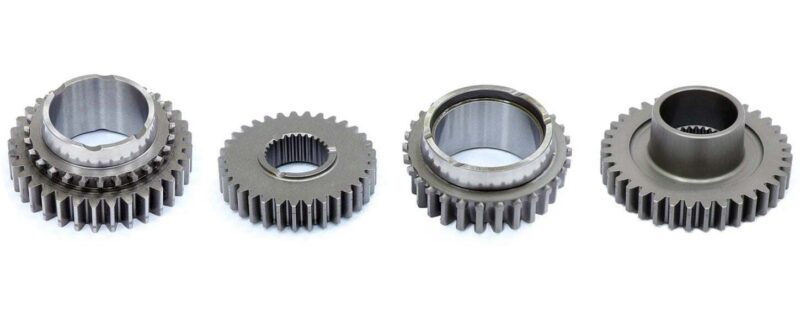
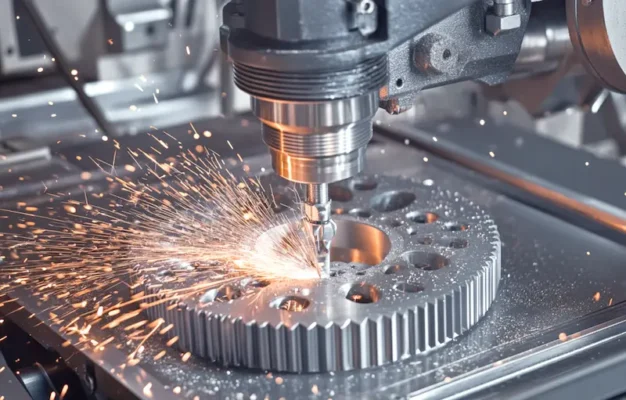
Straight cut gears (often called spur gears) are cylindrical gears whose teeth are:
cut straight, and parallel to the shaft across the whole face width.
When a pair of straight cut gears runs on parallel shafts, they:
transmit torque and speed between the shafts
give a fixed, precise gear ratio based on tooth count
work mainly with rolling contact along the involute tooth profile
Compared with helical gears, straight cut gears create almost no axial thrust. That means bearings and housings mainly see radial forces, and shaft shoulders and spacers can be simpler.
3. Why choose straight cut gears?
Straight cut gears are not “better” everywhere, but they are often the best choice where torque, efficiency and simplicity matter more than very low noise.
Key advantages of straight cut gears
| Aspect | Behaviour of straight cut gears | What it means in design |
| Mechanical efficiency | Mostly rolling contact with limited sliding | Slightly higher efficiency than similar helical stages in many cases |
| Load capacity | Robust tooth form, easy-to-check stresses | Very suitable for high-torque, low–medium-speed stages |
| Axial thrust | Almost no axial force from the tooth mesh | Bearing layouts can be simpler and more compact |
| Manufacturing & QC | Simple tooth shape, mature hobbing and grinding processes | More predictable cost and lead time, easier inspection |
In real machines, these benefits are often more important than small differences in noise, especially for gears buried deep in the gearbox or axle that mainly need to be strong, efficient and easy to service.
4. The main trade-off: noise and smoothness
The main limitation of straight cut gears is noise and smoothness at higher speeds:
Teeth come into and out of contact more suddenly
Mesh stiffness changes more sharply than in helical gears
At higher pitch-line speeds, gear whine is more likely
For high-speed, noise-sensitive positions – for example, the main EV reduction stage close to passengers – helical gears are usually preferred.
But for many torque-carrying stages located deeper inside housings, good tooth geometry, a decent surface finish and proper lubrication can keep noise at acceptable levels. In these positions, the efficiency, strength and simplicity of straight cut gears often make them a smart choice.
5. Straight cut gear applications in Wenlio Gear’s five sectors
Straight cut gears appear in different positions and with different roles across Wenlio Gear’s five focus sectors.
5.1 Agricultural Machinery
Typical positions:
Main drive, intermediate and output stages in tractor and harvester gearboxes
Straight cut gears in balers, forage harvesters and feed mixers
PTO drive and driven gears connecting power to pumps or implements
Why is it applicable here:
Work is usually low–medium speed, high torque
Machines run in dust and mud, so gears must be strong and easy to service
A certain noise level is acceptable; uptime and durability are more important
For agriculture, Wenlio Gear uses straight cut gears with suitable alloy steels, carburizing or nitriding and controlled backlash that balances noise with tolerance for contamination.
5.2 Heavy Truck
Typical positions:
Straight cut gear pairs used in reverse gear
Low-speed, high-torque spur stages in transfer drives or PTO drives
Small spur and intermediate gears in auxiliary drive units
Why is it applicable here:
Reverse and some auxiliary functions are used at low speed, so higher noise is acceptable
For high-torque stages, straight teeth give clear load paths and strong tooth roots
Inspection and replacement of individual gears are relatively simple
For these truck applications, Wenlio Gear focuses on strong materials, stable heat treatment and accurate gear grinding to keep performance consistent over long mileage.
5.3 Construction Equipment
Typical positions:
Straight gear stages on drive shafts in travel and reduction gear trains
Drive pinions and intermediate gears in hoists and winches
Straight cut gears in slew drives and other auxiliary power modules
Why is it applicable here:
Duty cycles include frequent start–stop and shock loads
Gears operate in dusty, sandy environments where robust teeth matter more than noise
Many gear stages are far from the operator, so sound is less critical than reliability
Wenlio Gear provides straight cut gears for construction equipment with high-strength alloy steels, deep case hardening and micro-geometry tuned for shaft deflection and uneven loads.
5.4 Electric Vehicles (EV)
In EVs, helical gears dominate the high-speed main reduction stages, but straight cut gears still have clear roles.
Typical positions:
Prototype straight cut gears in early EV drive development to test ratios and layouts
Straight cut parking lock gears and small auxiliary drives with intermittent duty
Test gears in motor and inverter rigs, where cabin noise is not a concern
Why is it applicable here:
Fast to manufacture and adjust during early design steps
Simple contact pattern makes it easier to analyse issues during testing
In test benches and auxiliary mechanisms, noise is often not the main limit
Wenlio Gear can provide quick-turn spur prototypes for EV projects, and later help customers migrate from straight cut to helical or other tooth forms once the design is fixed.
5.5 Industrial Automation
In industrial automation and robotics, straight cut gears are widely used in medium-speed, positioning and auxiliary functions.
Typical positions:
Spur gear stages in conveyor gear units and feeding mechanisms
Straight cut gears in AGV/AMR drives and transfer units
Internal gear trains in machine tools, packaging machines and handling systems where speed is moderate
Why is it applicable here:
Many automation drives work at medium speed, where straight gears can still run smoothly enough
Engineers value simple geometry and easy inspection during maintenance shutdowns
In some positions, torque and backlash control matter more than minimum noise
For automation and robotics, Wenlio Gear designs spur gears and shafts with controlled backlash and stiffness so that positioning stays repeatable over long operating hours.
6. How Wenlio Gear supports straight cut gear projects
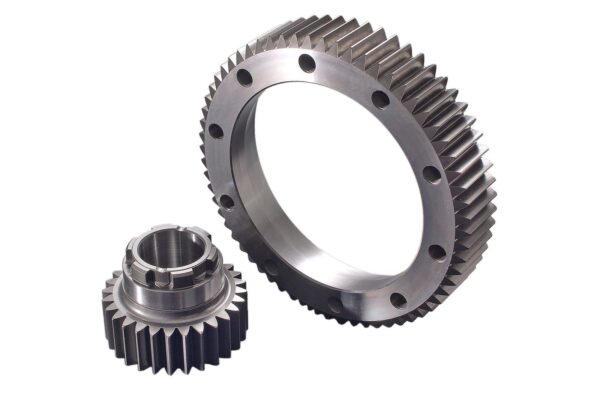
Wenlio Gear offers support across the full life cycle:
Concept and design review
Tooth count, module, pressure angle, face width and safety factors
Initial checks for bending strength and surface fatigue
Material and heat treatment selection
Carburizing, nitriding or through-hardening chosen according to load and life targets
Steel grades matched to your standards and supply chain
Manufacturing and quality control
From blanks and hobbing/shaping to shaving, grinding, deburring and inspection
Control of tooth profile, lead, runout and backlash to relevant ISO / AGMA classes
Validation and optimisation
Tuning contact patterns and backlash based on test or field feedback
Supporting the move from prototypes to stable, repeatable series production
By looking at straight cut gears inside the whole drivetrain rather than as isolated parts, Wenlio Gear helps OEMs choose where spur gears are the right tool and how to design around them.
7. Conclusion
Straight cut gears are not meant to replace helical gears everywhere. Instead, they are often the right choice for the right gear stages – especially where torque, efficiency, robustness and simple bearings are more important than ultra-low noise.
Across Agricultural Machinery, Heavy Truck, Construction Equipment, Electric Vehicles and Industrial Automation, Wenlio Gear works with OEMs and system suppliers to define where straight cut gears make sense, and where other gear types are a better fit.
If you are planning or upgrading spur gear drive stages, you are welcome to talk with Wenlio Gear. Share your drawings to Contact Us , and our engineering team will help you build a practical, reliable straight cut gear solution.
FAQ
Q1. Are straight cut gears always noisier than helical gears?
They can be noisier at higher speeds because teeth engage more suddenly. However, in many low- to medium-speed, high-torque stages inside the machine, careful design and lubrication keep noise at a reasonable level.
Q2. When should I choose straight cut instead of helical gears?
Choose straight cut gears when you need high torque, simple bearing layouts, good efficiency and easy service, and when noise is not the main limit—for example in internal stages of agricultural, construction or truck drivelines.
Q3. Can Wenlio Gear help if I only have a sample gear and no drawing?
Yes. Wenlio Gear can measure and reverse-engineer spur gears, then propose materials, heat treatment and a process route that meet your actual working conditions.
Q4. Do you also supply shafts and related parts?
Yes. We often supply gear plus shaft combinations, including splines and bearing seats, so the whole gear stage can be assembled more easily and run with better alignment.
