
Bevel Gear, Spur Gear, Helical Gear, Crown Wheel and Pinion Gear, Worm Gear
What Types of Precision Gears Are There?
Dec
1. Introduction
When people talk about precision gears, they usually mean gears that run accurately, repeatably and reliably under demanding conditions. These gears are used where backlash, noise, torque capacity and lifetime all matter, not just in simple, low-duty mechanisms.
As a precision gear manufacturer and custom gear supplier, Wenlio Gear focuses on bevel and cylindrical gears, gear shafts and related components for five sectors: agricultural machinery, heavy-duty truck, construction equipment, electric vehicle and industrial automation. This article gives a simple overview of the main precision gear types we work with and where they are typically used.
2. What is a precision gear?
A precision gear is not a separate “special” gear type. It is a normal gear type that has been designed and manufactured to a higher level of control. It combines:
-
Proper geometry and tooth profile
-
Suitable material and heat treatment
-
Controlled tolerance and surface finish
-
Stable performance under the required load, speed and duty cycle
In practice, a precision gear is a gear you can trust in a real machine: it transmits torque smoothly, maintains its accuracy over time and fits into a controlled manufacturing and quality system.
3. Main precision gear types
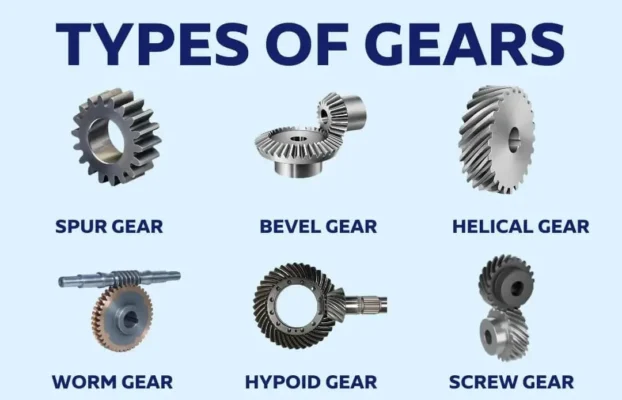
The table below summarizes some common precision gear types and their typical characteristics.
| Gear type | Shaft relationship | Typical strengths |
| Spur gear | Parallel shafts | Simple, economical, easy to manufacture |
| Helical gear | Parallel shafts | Smooth running, higher load capacity, lower noise |
| Straight bevel gear | Intersecting shafts (often 90°) | Simple right-angle drives, moderate speeds |
| Spiral bevel gear | Intersecting shafts (often 90°) | Smooth right-angle drives, higher load and speed |
| Hypoid gear | Non-intersecting, offset shafts | High torque in axles, very compact |
| Worm gear | Non-intersecting shafts | High ratio in one stage, self-locking in some cases |
Wenlio Gear mainly focuses on bevel gears (straight and spiral), helical and spur gears, and the gear shafts that carry these gears in real transmissions.
4. Spur and helical gears
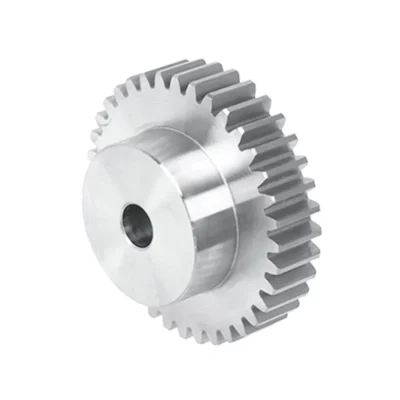
Spur gears have teeth cut straight across the gear face and are used between parallel shafts. They are easy to design and manufacture and are widely used in moderate-speed, moderate-load applications. In precision drives, spur gears are still valuable when noise is not critical or when you need a simple, robust transmission in a compact package.
Helical gears have teeth cut at an angle (the helix angle) to the shaft. Because of this angle, the teeth come into mesh gradually: contact starts at one side of the tooth and spreads across the face width. This gives smoother running and lower noise at higher speeds compared with spur gears. At any moment, more than one tooth pair is sharing the load, which increases load capacity and reduces local stress.
For these reasons, helical gears are a standard choice in:
-
Tractor and harvester transmissions and PTO drives
-
Truck and bus gearboxes and PTO units
-
Construction machinery reducers and working drives
-
EV reduction gearboxes and auxiliary drives
-
Industrial automation gearboxes for servo and conveyor drives
Wenlio Gear designs and manufactures spur and helical gears to match the torque, speed, life and noise targets of these applications.

5. Bevel and hypoid gears
When power needs to turn a corner, bevel gears and hypoid gears are the most common precision solutions.
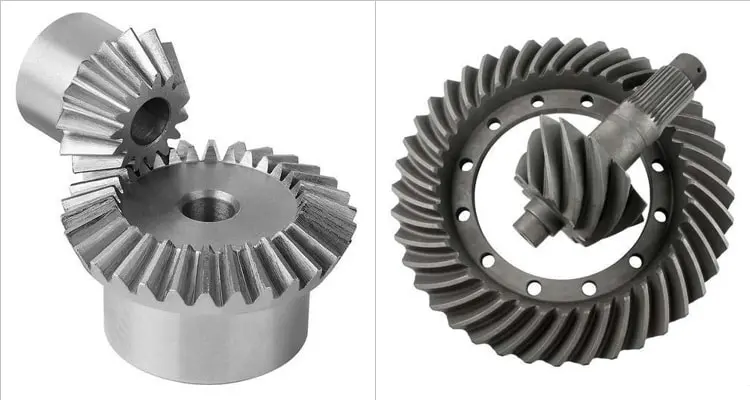
Straight bevel gears use straight teeth on a conical surface. They are suitable for right-angle drives at moderate speeds and loads, such as simple axle drives or right-angle gearboxes where cost and simplicity are more important than ultimate smoothness.
Spiral bevel gears have curved teeth on conical surfaces. This curved tooth form gives smoother engagement and higher load capacity than straight bevel gears, especially at higher speeds. Spiral bevel gears are widely used in:
-
Agricultural differentials and axle drives
-
Off-highway and construction equipment axles and right-angle drives
Hypoid gears are similar to spiral bevel gears, but the shafts are offset and do not intersect. This offset allows a larger pinion diameter for a given axle size, giving higher torque capacity and smoother running in very compact housings. Hypoid gear sets are commonly used in truck and bus axles and in some agricultural and construction axles where high torque, low noise and compact packaging are all important.
Bevel and hypoid gears are core products for Wenlio Gear, especially in our agricultural machinery, heavy-duty truck and construction equipment programs.
6. Worm gears
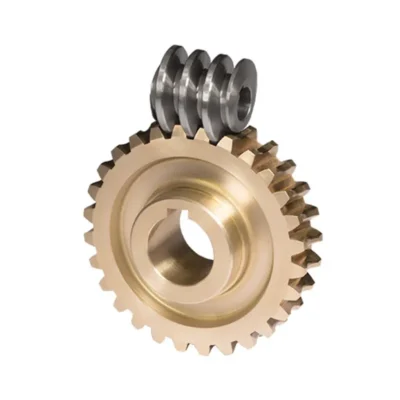
Worm gears combine a worm (similar to a screw) and a worm wheel. The shafts are usually at 90 degrees and do not intersect. Worm drives can provide very high reduction ratios in a single stage, which is useful when you need slow, powerful motion from a high-speed input. In some designs, worm gears can also provide a self-locking effect that helps hold loads in place.
The trade-off is efficiency. Because worm gears have a lot of sliding between tooth surfaces, they usually run less efficiently and generate more heat than bevel or helical gear sets. For precision applications, worm gears are often used where:
-
A very high reduction ratio is required in one stage
-
Backdriving should be limited or prevented
-
The duty cycle and power level make lower efficiency acceptable
Examples include certain lifting mechanisms, positioning systems and low-speed drives in industrial automation. Wenlio Gear can integrate worm gear stages with bevel or helical stages where this combination makes sense for the overall system.
7. Gear shafts and integrated precision gear systems
Gears never work alone. In a real machine, they sit on shafts, run in bearings, live inside a housing and rely on oil for cooling and lubrication. When you put all of this together, the shaft quickly becomes the backbone of the transmission.
A precision gear shaft takes this idea one step further. Instead of pressing a loose gear onto a plain shaft, we machine the gear, splines and bearing seats on the same piece. This integrated design makes assembly faster, reduces the number of loose parts and keeps the geometry locked in place. As a result, alignment and stiffness improve and the system runs more reliably over its lifetime.
At Wenlio Gear, we design and manufacture these precision gear shafts together with the matching spur, helical and bevel gears. Because we look at the drivetrain as a whole, we can tune gear positions, shaft diameters and bearing locations as one complete system, rather than a collection of isolated components.
8. How to think about gear type selection
A simple rule of thumb is:
-
Use helical or spur gears for parallel shafts
-
Use bevel or hypoid gears for right-angle drives where efficiency and load capacity matter
-
Consider worm gears when a very high reduction in one stage or a self-locking characteristic is important
In many real transmissions, you will see combinations: for example, helical plus bevel, or bevel plus worm. Wenlio Gear’s role is to help you translate your layout and performance targets into a practical gear system, choosing appropriate types, modules, materials and heat treatments.
9. Conclusion
Precision gears cover several familiar gear types: spur and helical gears for parallel shafts, bevel and hypoid gears for right-angle drives, and worm gears for high single-stage reductions and special locking behaviour. Each type has its strengths and typical roles, and real machines often use more than one type in the same drivetrain.
If you are planning or upgrading a gearbox, axle or drive unit and want to choose the right precision gear types for your application, Wenlio Gear is ready to support you with design input and manufacturing capability. You can Contact Us share your project details , and our team will help you turn your requirements into a practical, manufacturable gear solution.
10. FAQ – Quick questions about precision gear types
Q1. Is a “precision gear” a separate product type?
No. Precision gears are usually normal gear types (spur, helical, bevel, hypoid, worm) that are designed and manufactured to tighter tolerances, better materials and more controlled processes to achieve stable performance.
Q2. Are helical gears always better than spur gears?
Not always. Helical gears are smoother and quieter at higher speeds, but spur gears are simpler, easier to manufacture and often strong enough for lower speeds or less demanding duty cycles. The choice should be based on actual requirements.
Q3. When should I use bevel or hypoid gears instead of worm gears?
If efficiency, continuous duty and energy use are important, bevel or hypoid gears are usually preferred. Worm gears are more suitable where very high ratios or self-locking are required and where the lower efficiency is acceptable.
Q4. Can I mix different gear types in one gearbox?
Yes. Many gearboxes mix different types—for example, helical stages for parallel-shaft reduction combined with bevel or hypoid stages for right-angle direction changes. The key is that each stage is properly designed and the overall system is well integrated.
