
Blogs
Gear Blank Distortion Control: Start with Forging

Jan
1. Introduction
Does heat-treatment distortion start at forging? In many gear-blank projects, yes—because the furnace doesn’t “reset” a blank; it often releases and amplifies what already exists: residual stress, microstructure gradients, and geometry sensitivity. Wenlio’s forging guidance also highlights that pre-heat treatments (including isothermal normalizing, when cost permits) can improve machinability and heat-treatment deformation stability.
Why does that happen? Because quenching distortion is strongly tied to non-uniform heat transfer and the resulting residual-stress evolution, and those stresses interact with upstream conditions.
2. What is heat-treatment distortion?
Heat-treatment distortion is an unwanted size or shape change caused by thermal gradients, phase-transformation stresses, and stress release during processes such as carburizing and quenching.
3. Why distortion control should start before the furnace
(1) Late-stage distortion is expensive and hard to “buy back.”
When distortion appears after rough machining, you pay twice: rework/scrap plus schedule risk.
(2) Upstream residual stresses can drive distortion during heat-up.
Industry discussions on heat-treated gears note that normalizing can relieve residual stresses from steelmaking and forging that could otherwise cause distortion during carburizing.
(3) Quenching stress is not random—uniformity is the lever.
A widely cited review states that nonuniform heat transfer between the part and quench medium is a key source of residual stress development; geometry/section thickness and cooling uniformity affect distortion.
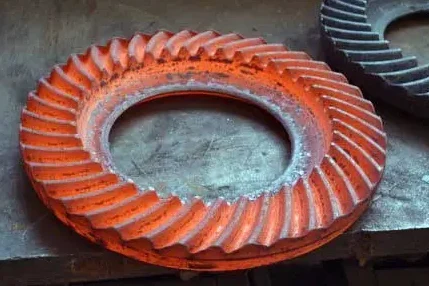
4. Types of distortion you’ll actually see on gear blanks
| Type | What it looks like | Typical triggers | First control point |
| Size change | growth/shrink of key dimensions | transformation volume change + gradients | HT spec + measurement method |
| Shape change | bow/banana, dish, twist, ovality, runout shift | uneven cooling, gravity sag, stress release | forging stress + pre-HT plan + support/loading |
| Scatter (variation) | same route, different results | inconsistent blank stress/structure; inconsistent quench boundary | blank release gate + traceability + loading discipline |
Industry standards and technical manuals on gear materials and heat treatment commonly address process controls, inspection documentation, and distortion/residual stress topics to align design, manufacturing, and heat-treat teams.
5. Who cares most about this
Distortion control matters most in programs where geometry stability directly affects assembly fit, noise, life, and finishing cost. At Wenlio, we see this across five key application sectors:
Agricultural machinery: long duty cycles; stable geometry supports gearbox reliability
Heavy-duty truck: high torque density; runout/position stability matters in axle and driveline parts
Construction equipment: shock loads and long duty cycles; stability under load is critical
Electric vehicles (EV): high-speed drivetrains; tight finishing windows make distortion scatter expensive
Industrial automation: reducers and precision drives where repeatable geometry reduces rework and downtime
6. Key features of a “distortion-ready” process chain
| Feature | What to define (RFQ/drawing/process plan) | What evidence to keep | Why it works |
| Blank stability gate | forging route + cooling/straightening discipline | route records + batch map | reduces upstream stress scatter |
| Pre-heat option (normalizing) | when to normalize / when not | microstructure + hardness window | reduces internal stresses; improves homogeneity |
| Allowance & datum strategy | recovery stock by feature; stable datums | CMM + allowance map | distortion becomes recoverable |
| Quench boundary control | loading orientation, spacing, support/fixtures | furnace load photos + logs | heat-transfer uniformity reduces stress |
| Inspection gates | pre/post HT comparison plan | reports + trend charts | “measurable → controllable” |
Wenlio also specifically recommends isothermal normalizing (when budget allows) to improve machinability and heat-treatment deformation stability for transmission gears and shaft components.
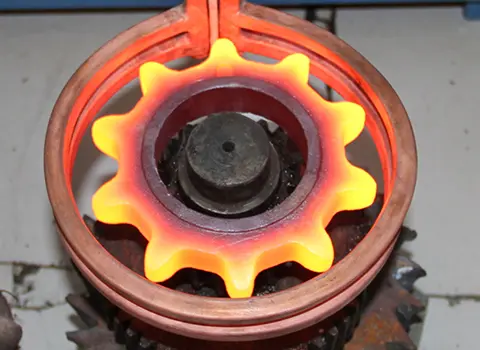
7. what improves when you control upstream
| Benefit | What improves | What it reduces |
| Lower distortion scatter | repeatability across lots | “random” out-of-tolerance parts |
| Less finishing pain | predictable grind/true-up | rework loops + bottlenecks |
| Higher launch yield | stable acceptance criteria | scrap + SOP delays |
| Faster supplier alignment | measurable RFQ & gates | debate over “quality” |
| Lower total cost | fewer surprises late | expediting + overtime |
8. Supplier selection tips
Ask for a blank release checklist, not only a quotation.
Traceability + geometry gates + microstructure checks must be visible.
Confirm they understand residual stress from forging and why it matters.
Normalizing is widely used to reduce internal stresses induced by forging and improve downstream stability.
Check their “pre-heat decision logic” not just capability.
They should justify when normalizing/isothermal normalizing is needed and how they validate results.
Demand a boundary-condition plan for heat treat (loading/fixturing/logs).
Quench distortion is highly sensitive to heat-transfer uniformity.
9. Why Choose Us
Engineering Review (DFM before cutting teeth)
Distortion risk map (what moves / how to recover)
Datum + allowance plan aligned to finishing
Process Chain Control (forging → pre-HT → machining → HT → finishing)
Blank stability gate with batch traceability
Normalizing / isothermal normalizing option planning when appropriate
Inspection & Acceptance Package (measurable outputs)
Pre/post HT geometry comparison
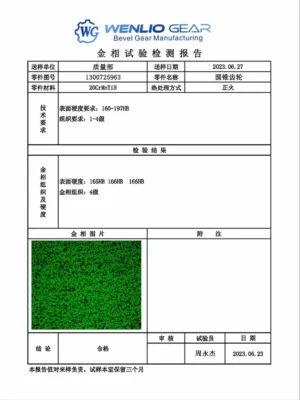
Report set: CMM, hardness, microstructure, case depth (if applicable)
Communication & Project Management
Prototype → pilot → SOP milestones
Change control for material/process route changes Export Readiness
Batch labeling + protective packing aligned to receiving workflow
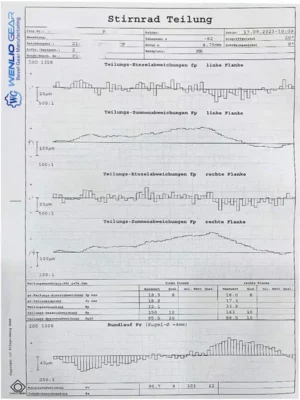
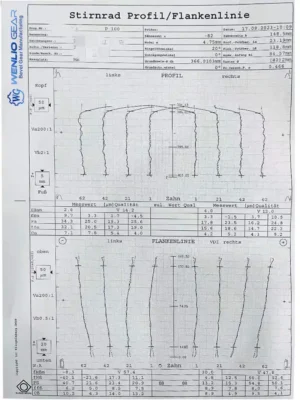
10. FAQ
(1) Does distortion always start at forging?
Not always, but forging often sets the baseline stress and microstructure. Heat treat and quench boundary conditions can amplify that baseline into measurable distortion.
(2) Will normalizing always reduce distortion?
Normalizing commonly reduces internal stresses and improves homogeneity, but it should be validated by part geometry, section thickness, and finishing plan.
(3) What should we measure to control distortion?
Measure the features your assembly cares about: runout, concentricity, mounting face flatness, key datums, and (where relevant) tooth geometry.
(4) Why do parts distort differently in the same furnace load?
Blank-to-blank stress/structure differences plus local heat-transfer differences (spacing, shielding, flow) can change residual-stress evolution.
(5) What’s the simplest upstream action to reduce distortion scatter?
Implement a blank release gate (traceability + geometry + structure) and define a pre-heat strategy (often normalizing options), then lock down loading/fixturing discipline.
11. Conclusion
If you want predictable post-heat-treat geometry, don’t treat distortion as a furnace-only issue. In many gear-blank projects, distortion control starts at forging: stabilize stress and structure, plan allowance/datums for recovery, and control heat-treat boundary conditions with disciplined loading and verification. This matches both industry consensus on quench-residual-stress behavior and Wenlio’s own upstream-quality logic.
Contact us to send your drawing, material, and heat-treat route. We’ll recommend a forging + pre-heat + inspection plan to reduce distortion risk and protect your final tolerance.
