
Blogs, Bevel Gear, Planetary Gear
The Differences Between Bevel Gears And Planetary Gears

Feb
Introduction
Bevel gears and planetary gears both transfer torque, yet they solve different design problems. Bevel gears are built for intersecting shafts and for changing the direction of power. Planetary gears, in contrast, are often chosen for compact coaxial layouts, flexible ratios, and strong torque density.
At Wenlio Gear, we focus on measurable, manufacturable bevel gear solutions (straight bevel, spiral bevel gears, zerol bevel, and hypoid gears). This guide shows how to compare bevel gears vs planetary gears using practical decision points: shaft layout, ratio targets, torque density, gear noise, assembly sensitivity, and cost.
Quick comparison in one line
- Choose bevel gears when the key need is a shaft angle change (direction change).
- Choose planetary gear trains when the key need is compact ratio and torque density (load sharing).

Types you’ll typically specify
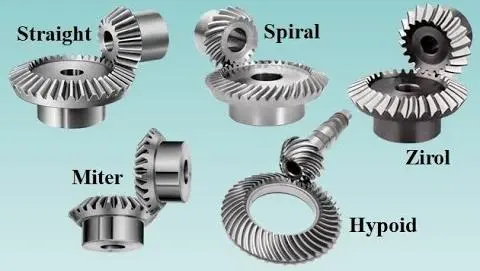
Bevel gear families
- Straight bevel gears: simple tooth form, economical; often chosen for lower speed or less strict noise targets.
- Spiral bevel gears: smoother engagement and typically lower noise at higher speed; higher manufacturing complexity.
- Zerol bevel gears: an “in-between” concept that can balance smoothness and complexity.
- Hypoid gears: bevel-family gears with offset axes (not intersecting); can help packaging and load distribution, with more sliding considerations.
Planetary gear train families
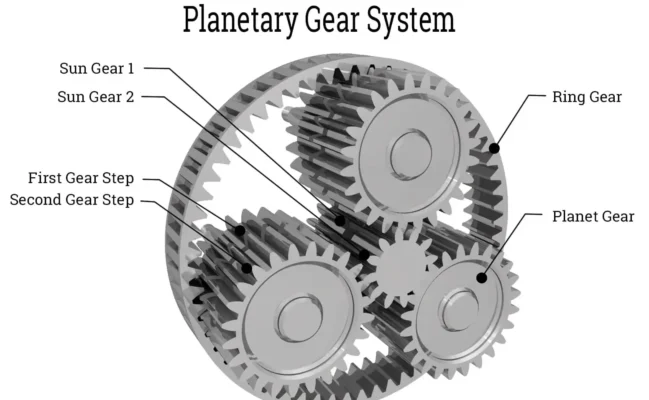
Planetary is a gear arrangement (not a single gear): sun gear + planet gears + ring gear + carrier.
- Single-stage planetary: compact ratio stage with load sharing across planets.
- Multi-stage planetary: higher ratios in compact length (stacked stages).
- Compound/stepped planetary (design-dependent): used for special ratio or packaging targets.
Where they’re commonly used
- Bevel gears: right-angle direction change stages, compact intersecting-shaft layouts, differential-style angle transfer needs.
- Planetary gear trains: compact reducers, high torque density stages, robotics/automation joints, drive modules where coaxial packaging helps.
- Combined solutions: a bevel stage for direction change plus a planetary stage for ratio is common in many machines.
Key characteristics that drive the decision
| Decision point | Bevel gears | Planetary gear trains |
| Primary function | Change power direction between intersecting shafts | Provide ratio + torque density via load sharing |
| Typical shaft layout | Intersecting shafts (often 90°); hypoid adds offset | Often coaxial input/output (depends on which member is fixed) |
| Part count | Usually a matched gear pair (two main gears) | Multiple gears + carrier + ring (more parts) |
| Load sharing | Single mesh pair carries most load at a time | Multiple planets can share load (when designed/assembled correctly) |
| Noise & smoothness | Spiral bevel is typically smoother than straight | Can be smooth, but sensitive to carrier rigidity and tolerance stack-up |
| Efficiency drivers | Sliding/rolling balance, contact, lubrication | Mesh + bearing losses + load-sharing accuracy |
| Manufacturing/assembly sensitivity | Contact pattern and mounting distance are critical | More sensitive to tolerance stack-up and planet load balance |
| Cost tendency | Often lower for simple direction-change stages | Often higher due to part count and precision assembly needs |
Practical outcomes you can expect
| Your priority | Bevel gears help when… | Planetary gear trains help when… |
| Direction change in tight space | You must turn power by 90° (or another angle) with minimal parts | Direction is already aligned; ratio/torque density is the main need |
| Higher ratio in compact size | Not the main strength unless combined with other stages | Multi-stage planetary achieves high ratios compactly |
| High torque density | Limited by single mesh pair and face width | Planets share load, improving torque density per volume |
| Simpler assembly | You want fewer parts and straightforward setup | You can support tighter tolerance stack-up and assembly control |
| Noise-sensitive designs | Spiral bevel is feasible and well specified | Precision carrier/planet control supports smoother multi-mesh behavior |
Supplier selection tips
- Start from layout: Do you need a shaft angle change (bevel), a compact ratio stage (planetary), or both?
- Define the top 1–2 targets first: noise, temperature rise, efficiency, service life, or packaging.
- Share real operating conditions: speed range, torque range, duty cycle, shock loads, and temperature window.
- Clarify scope: a matched bevel set vs planetary components vs an integrated gear stage, and what acceptance checks are required.
- Ask how repeatability is controlled: key datums, runout/alignment controls, and any contact or load-sharing validation approach.
Why Choose Us
Wenlio Gear provides precision gear solutions for industrial power transmission needs, including bevel gear sets and gear components used in planetary gear trains (sun/planet/ring gears as required by project design).
We support customers with:
- Clear specification alignment (geometry, targets, and acceptance checks)
- Manufacturing route recommendations matched to performance goals
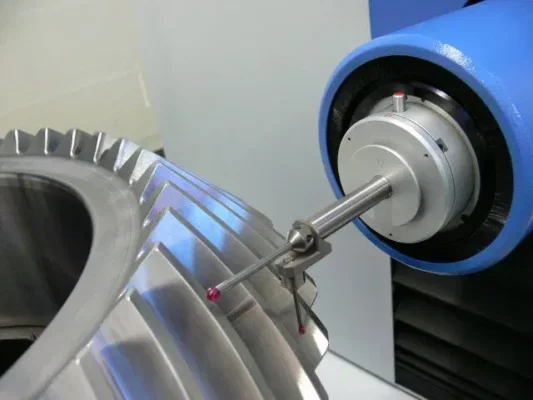
- Inspection planning that reflects real assembly needs
- Practical RFQ support to reduce back-and-forth and speed up decision-making
FAQ
Q1: Are bevel gears only for 90-degree drives?
No. 90° is common, but bevel gears can be designed for many intersecting shaft angles.
Q2: Why do planetary gears deliver high torque density?
Multiple planets can share load, and the coaxial layout packs torque capacity into a compact space.
Q3: Which is quieter: bevel gears or planetary gears?
It depends on tooth form, accuracy, surface finish, and alignment. Spiral bevel gears or zerol bevel gears can be quiet, and well-built planetary gearsets can also be low-noise when load balance is controlled.
Q4: What should I send for an accurate quote?
A drawing or 3D model, torque/speed range, duty cycle, lubrication method, mounting constraints, noise target, and material/heat-treatment expectations.
Q5: What commonly reduces bevel gear life early?
Misalignment or incorrect mounting distance that shifts the contact pattern and concentrates stress.
Conclusion
Bevel gears are typically the most direct solution when you need angle transmission and a clean change in drive direction. Planetary gears are often a better fit when compact coaxial packaging, high torque density, and flexible ratios are the priority—while also requiring tighter control of tolerances and assembly alignment.
If you’re evaluating a project, Contact Us to share your drawings and operating conditions (torque, speed, duty cycle, lubrication, mounting constraints, and noise target) so the gear form, tolerances, heat-treatment route, and lubrication assumptions can be aligned early—before changes become expensive.
