
Bevel Gear
Zerol Bevel Gears for Quiet Right-Angle Drives

Jan
Introduction
Right-angle gear stages show up everywhere: differential and axle systems, industrial reducers, printing presses, packaging lines, machine tools, and compact robotic joints. When the shafts intersect (often at 90°), bevel gears are usually the most space-efficient choice.
But bevel gears are not “one-type fits all.” A straight bevel set can be cost-effective, yet it may become noisy at higher speeds. Spiral bevel gears run smoother, but they introduce thrust forces that may affect bearings and housing design. Zerol bevel gears sit in a useful middle position: they use curved teeth like spiral bevel gears while keeping a 0° spiral angle at the middle of face width—often making them easier to integrate into designs that were originally built around straight bevel gears.
At Wenlio Gear, we manufacture Zerol bevel gears and other bevel gear types for automotive, industrial, and automation customers, supporting both prototype validation and scalable supply programs.
What is a Zerol bevel gear?
A Zerol bevel gear is commonly described as a special form of spiral bevel gear where the spiral angle is zero at the mid-face. The teeth are curved, which supports smoother engagement than straight bevel gears, while the “zero spiral angle” characteristic helps keep the force behavior closer to straight bevel gears in many setups. Zerol is also widely referenced as a trade name associated with Gleason.
In practical terms:
- Curved teeth → typically smoother meshing and lower noise potential than straight teeth.
- 0° spiral angle (mid-face) → often easier to substitute for straight bevel gear conditions, depending on the assembly and load directions.
Why choose Zerol bevel gears?
Engineers usually choose Zerol bevel gears for one of three reasons:
1) You want quieter operation than straight bevel gears
Curved tooth engagement can reduce the “impact” feeling of straight tooth contact, which often helps with noise and vibration control—especially when your application runs at moderate to high speed.
2) You want a right-angle stage that is simpler to integrate than spiral bevel (in many cases)
Many technical references describe Zerol gear tooth forces as similar to straight bevel gears (notably removing certain inward thrust behavior). This can reduce the chance that you must redesign bearings or mounting conditions when upgrading from straight bevel to a smoother tooth form.
3) You want “spiral-like” smoothness with more flexibility in rotation direction
Zerol gears are often described as being able to rotate in both directions like straight bevel gears, due to the “zero twist” characteristic, whereas spiral bevel gears are commonly optimized for one primary direction.
Engineering note: final performance depends heavily on contact pattern, alignment, lubrication, and housing stiffness. For quiet stages, “gear type” is only the starting point.

Where Zerol fits (buyer comparison)
| Type | Tooth form | Typical advantage | Typical trade-off | Common use |
| Straight bevel | Straight | Simple & economical | Higher noise at speed; impact contact | Basic right-angle drives |
| Spiral bevel | Curved + spiral angle | Very smooth; high load capacity | Thrust loads; setup sensitivity | Automotive & high-speed reducers |
| Zerol bevel | Curved + 0° spiral angle | Smoother than straight; integration-friendly | Still needs matched-set control | Quiet stages; “upgrade” from straight bevel |
| Hypoid | Offset axes | High torque density, packaging | Sliding/heat control | Axles & differentials |
Common applications
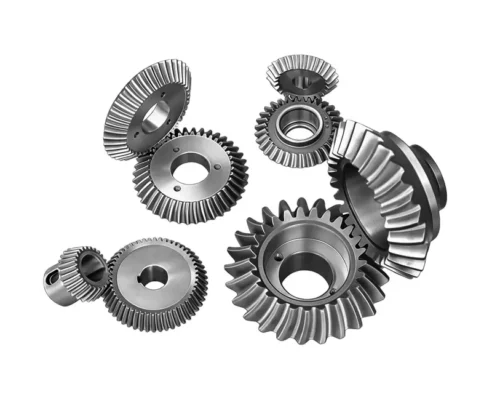
Zerol bevel gears show up in applications that care about noise, smoothness, and stable assembly:
Automotive differential and axle projects: stable meshing, matched gear sets, and repeatable contact pattern control.
Robotic systems and joint stages: smooth motion and compact right-angle layouts where NVH and efficiency matter.
Industrial equipment (machine tools, printing and packaging equipment, test benches): quieter operation at higher speed and consistent gear mesh under controlled loads.
Key characteristics (what buyers should understand)
Below are the most important “real-world” characteristics of Zerol bevel gears and what they mean for your program:
- Matched set behavior
Bevel gears are typically supplied as paired sets. Even small mix-ups can shift contact pattern, raise noise, and shorten life. If your application is sensitive, insist on matched-set labeling and inspection records. - Contact pattern & assembly sensitivity
Most bevel gear noise problems are not “material problems”—they’re contact pattern problems caused by misalignment, incorrect shimming, or inconsistent housing stiffness. For Zerol sets, ensure you control:- mounting distance
- backlash
- pattern position under light load and under working load
- Strength considerations
Some references claim Zerol gears can be stronger against breakage than straight or spiral bevel gears because of tooth geometry (e.g., tooth thickness and length characteristics). Treat this as a design tendency rather than a guarantee—confirm with your load spectrum and safety factor.
Wenlio manufacturing capabilities (what we can supply)
Wenlio supports Zerol bevel gear programs with flexible options across geometry, materials, heat treatment, and finish routes.
Specifications & options
| Item | Options (examples) | Why it matters |
| Accuracy grade | ISO 1328 Grade 5–8 / AGMA 8–12 | Controls noise, backlash stability, repeatability |
| Module range | 0.5–12 | Fits compact robotics to heavy-duty industrial sizes |
| Materials | 16MnCr5 / 20CrMnTi / SAE 8620 / 40Cr (and others) | Strength & heat-treat response |
| Heat treatment | Carburized & quenched / Q&T / nitriding / induction | Wear resistance, pitting, distortion risk |
| Tooth finishing | Cutting + optional grinding | Grinding improves accuracy and can reduce noise |
| Production scale | Prototype → batch → volume (capacity claims available) | Supports SOP→PPAP-style ramp |
Process route: how Zerol bevel gears are typically made
A common process chain for precision bevel gear sets looks like this:
- Blank preparation
Forging, bar stock, or near-net routes (when suitable) help control grain flow and reduce machining waste. - Tooth cutting/forming
Cutting is optimized for stable geometry and efficient throughput. For bevel gears, consistency in setup and tooling is critical to keep tooth geometry repeatable. - Heat treatment (if required by duty cycle)
Carburizing improves wear resistance; Q&T is often used for strength; nitriding is selected for specific distortion or surface requirements. The goal is not only hardness—it’s predictable distortion behavior so the finishing step can “bring back” geometry. - Finishing (selected by the noise/accuracy target)
- For robust industrial stages, controlled cutting + inspection may be enough.
- For quiet, high-precision stages, grindingis often the finishing choice.
- Inspection & reporting
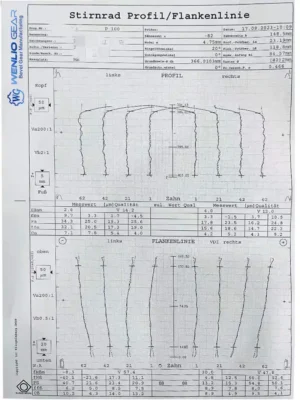
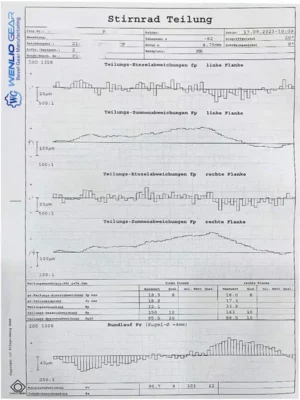
A serious bevel gear program measures what matters for assembly stability: geometry consistency, runout, backlash targets, and (when applicable) contact pattern verification on test setup.
Quality control: what should be in your inspection package?
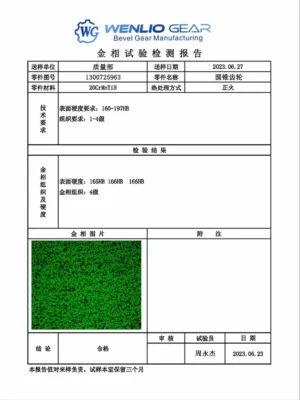
For most OEM-style projects, buyers want predictable assembly and low risk at incoming inspection. A practical inspection package often includes:
- Material certificate / heat number traceability
- Heat treatment record + hardness profile (as required)
- Key geometry checks (tooth and mounting-related dimensions)
- Runout and concentricity checks (as required by drawing)
- Matched set marking and packaging control
If you already have a drawing with a defined quality plan, Wenlio can align the report format to your requirements.
How to specify Zerol bevel gears for fast quotation (send once, quote faster)
To avoid back-and-forth and shorten lead time, send:
- Drawing or 3D model (preferred), or a sample + key dimensions
- Shaft angle (often 90°), ratio / tooth count, module
- Target accuracy (ISO/AGMA), backlash & noise requirement if any
- Material + heat treatment (or ask us to recommend)
- Expected load: torque, speed, duty cycle, lubrication
- Quantity: prototype / batch / annual demand
FAQ
Do Zerol bevel gears always run quieter than straight bevel gears?
Often yes, but the real result depends on contact pattern, alignment, lubrication, and housing stiffness. The gear type helps, but assembly control decides the final NVH.
Can I replace a straight bevel set with Zerol without changing bearings?
Many references state Zerol tooth forces are similar to straight bevel and remove inward thrust. In practice, confirm your load direction and bearing arrangement before switching.
Do Zerol gears need matched sets?
Yes. Bevel gears are generally paired, and correct pairing is critical for consistent contact and noise control.
What’s the biggest reason bevel gear sets fail early?
Common causes are poor contact pattern (misalignment), incorrect heat treatment choice for the duty cycle, lubrication issues, and mixed sets.
Conclusion
Zerol bevel gears are a practical option when you need quiet right-angle transmission with curved tooth smoothness, while keeping integration closer to straight bevel expectations in many designs.
Contact us for a fast quote or engineering review—share your drawing (or key parameters like module, tooth count/ratio, material & heat treatment, accuracy grade, and torque/speed), and we’ll recommend a practical manufacturing route for your application.
