
Blogs, Bevel Gear
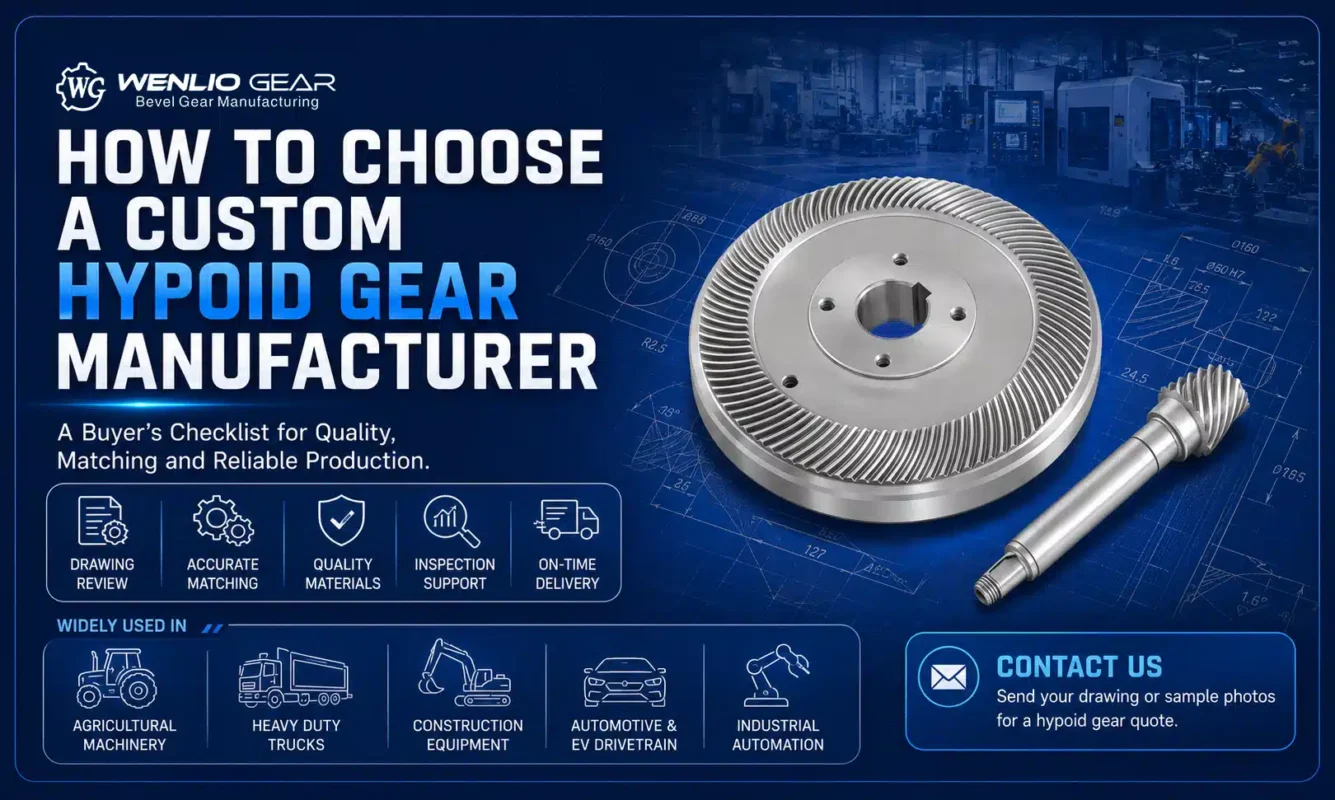
How to Choose a Custom Hypoid Gear Manufacturer
Jun
Introduction
At Wenlio Gear, many hypoid bevel gear projects begin with a technical sourcing question. The buyer may need an offset-axis drive, compact packaging, and stable torque transfer, but the real challenge is choosing a manufacturer that can turn those requirements into a workable matched gear set. A custom hypoid bevel gear project is therefore not only about machining one part to size. It also requires drawing review, offset confirmation, mating-part logic, heat treatment, inspection, and stable control from prototype review to batch production.
Hypoid bevel gears use non-intersecting offset axes, so the supplier must review offset, shaft layout, mating parts, backlash, contact pattern, material route, and application conditions before quotation. Wenlio supports custom hypoid bevel gear projects based on drawings, samples, and application requirements, with manufacturing and inspection planning adjusted to each project.
What a Custom Hypoid Gear Manufacturer Should Provide
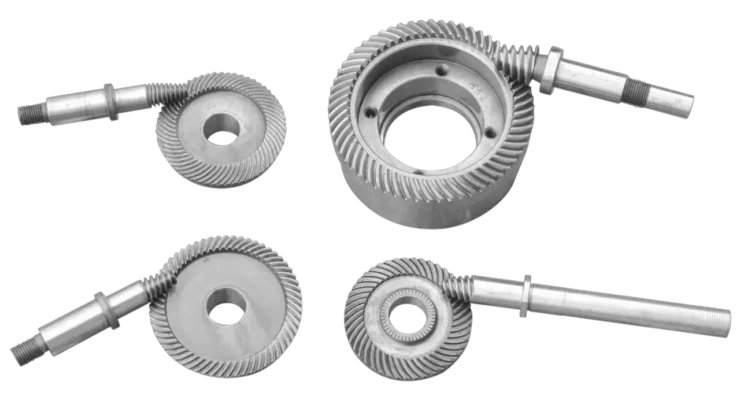
A custom hypoid bevel gear manufacturer should provide not only machining capacity, but also engineering review, matched-set logic, process planning, and inspection evidence needed to make an offset-axis hypoid gear project work in service.
Why Manufacturer Choice Matters for Custom Hypoid Gears
Because offset-axis gears are not simple single-part projects
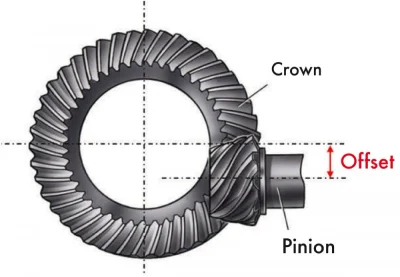
A hypoid gear set depends on the relationship between the two axes, the mating gear geometry, the contact path, and the real mounting condition. In many RFQs, buyers send only one sample, one damaged pinion, or one old drawing. For hypoid gears, that is often not enough because the offset layout and mating relationship are part of the gear definition, not just background information.
Because the supplier affects both quote accuracy and production reliability
A manufacturer that can review drawings, discuss offset and matching, plan the heat-treatment route, and provide meaningful inspection data will usually give a more useful quote. For custom hypoid bevel gears, the quotation should make key assumptions clear before production begins.
The Custom Hypoid Bevel Gear Project Types Buyers Usually Bring
| Project type | What the buyer usually has | What still needs to be confirmed |
| New custom hypoid bevel gear set | Drawing or 3D model | Offset, mating logic, material, heat treatment, inspection scope |
| Existing hypoid gear set review | Old drawing, part reference, or worn samples | Whether the old geometry still matches current service conditions |
| Pinion-only or gear-only project | One surviving part or one failed part | Whether single-part manufacturing is technically safe |
| Differential or offset-drive application | Ratio target and application notes | Offset value, load case, lubrication, contact expectations |
| Prototype job | Early design plus test requirement | Sample quantity, validation method, report format |
| Repeat production project | Approved sample or frozen drawing | Batch consistency, traceability needs, documentation, delivery plan |
This table shows why a custom hypoid bevel gear manufacturer should identify the project type before discussing price. A full matched set, a sample-based review, and a prototype job each require different assumptions, inspection points, and approval steps.
Who Usually Needs to Evaluate the Manufacturer
- Buyers comparing quotation, lead time, and commercial terms
- Design engineers checking offset, ratio, shaft angle, and mating logic
- Quality engineers confirming standards, inspection scope, and report format
- Assembly engineers reviewing fit, backlash, mounting distance, and contact behavior
- Service or rebuild teams reviewing existing hypoid gear sets for repair applications
- Project managers balancing prototype timing and repeat production
A hypoid project moves faster when these teams align early. Otherwise, the buyer may compare price while engineering is still unsure whether the supplier understands the real transmission problem.
What Buyers Should Check When Choosing a Custom Hypoid Gear Manufacturer
| Check point | What buyers should verify | Why it matters |
| Hypoid specialization | Whether the supplier handles offset-axis bevel gear work | Hypoid gears need different review logic than simpler bevel gears |
| Drawing review ability | Whether the supplier can review geometry and manufacturability early | Reduces quoting assumptions and later revisions |
| Offset understanding | Whether offset amount and direction are treated as core project variables | Offset affects contact, layout, and running behavior |
| Mating-part logic | Whether the supplier asks about the full pair | Hypoid gears must be judged as a working set |
| Custom parameters | Ratio, tooth count, shaft angle, spiral hand, mounting distance, target backlash | These details shape the real manufacturing and inspection route |
| Process support | Cutting or generating, measuring, heat treatment, grinding or lapping when required | Determines whether the process fits the drawing and application |
| Inspection scope | Tooth geometry, contact pattern, runout, backlash, hardness, and dimensional checks | Helps buyers approve the part with less risk |
| Prototype-to-batch control | Whether the supplier can move from sample review to repeat production | Reduces variation after approval |
If you are comparing hypoid gear suppliers or preparing a hypoid gear quote, send your drawing, sample photos, mating-part information, offset details, quantity, and application notes to Wenlio.
Wenlio’s custom hypoid bevel gear review normally focuses on ratio, shaft layout, offset, mating parts, material route, backlash, contact pattern, and inspection needs. These inputs help reduce quoting assumptions before production.
What a Good Custom Hypoid Gear Manufacturer Improves
| Project result | What improves | Why it helps |
| Better quote accuracy | Fewer hidden assumptions in geometry and process route | Reduces re-quoting and scope confusion |
| Better matched-set quality | Stronger control of contact, backlash, and alignment logic | Supports stable meshing and assembly performance |
| Better prototype approval | Clearer inspection evidence and review logic | Speeds up technical validation |
| Better production stability | Same process logic from sample review to batch production | Reduces lot-to-lot variation |
| Better sourcing confidence | Clear standards, documentation, and traceability planning | Makes approval easier for overseas buyers |
During RFQ review, buyers should confirm lead time, MOQ, process route, and report scope. Wenlio can support drawing review, gear-set review, machining, heat treatment, inspection, rust protection, and packing according to project needs.
Buyer Checklist Before You Send the RFQ
Confirm whether the project is a full matched set or a single-part manufacturing review.
For hypoid gears, this changes the risk level immediately. A single pinion project is not the same as a full set quote.
Make the offset and shaft layout clear.
Hypoid gears are chosen for offset-axis transmission, so the supplier should know whether the offset is fixed, measured, or still open to review.
Send mating-part information whenever possible.
A hypoid set should be reviewed as a pair. Photos, old samples, housing references, or contact information from the existing assembly all help reduce matching risk.
Define the inspection expectations before price approval.
Buyers should confirm whether they need material evidence, hardness results, gear inspection data, contact pattern evidence, FAI, PPAP, metallographic analysis, or other application-specific checks.
Ask how prototype review will connect to production.
A good supplier should explain how the approved prototype or sample result becomes the reference for later batch manufacturing, inspection, packaging, and shipping.
Why Choose Us
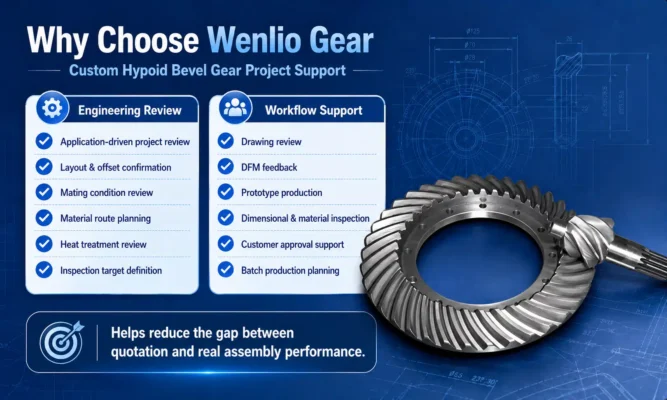
At Wenlio Gear, we treat custom hypoid bevel gear projects as application-driven engineering work, not generic part processing. Our bevel gear focus means we review layout, offset, mating condition, material route, heat treatment, and inspection target together because these details shape whether the final gear set works correctly in service.
Wenlio supports the workflow buyers usually need for custom hypoid jobs: drawing review, DFM feedback, prototype production, dimensional and material inspection, customer approval, and batch production planning when required. This helps reduce the gap between a quoted gear set and one that performs correctly after assembly.
FAQ
Q1: What is the most important thing to check in a custom hypoid bevel gear RFQ?
The key inputs are drawing, offset, mating relationship, material, heat treatment, backlash target, and inspection expectations.
Q2: Can a custom hypoid gear be quoted from one sample only?
Sometimes, but not always. A single sample may not be enough if the offset, mating gear condition, mounting distance, or housing reference is unclear.
Q3: Why is offset such a big issue in hypoid gear sourcing?
Because offset is part of what defines the gear set’s layout and contact behavior. If it is unclear, the quote and matching logic are both weaker.
Q4: What reports should buyers ask for before shipment?
Buyers should confirm material evidence, hardness results, dimensional or gear inspection data, and any required contact pattern evidence.
Q5: Does prototype capability matter if I plan a production order only?
Yes. Prototype discipline usually shows how the supplier handles review, revision, inspection, and process stability before production risk becomes expensive.
Conclusion
A custom hypoid bevel gear manufacturer should help reduce uncertainty before production starts. For hypoid projects, that means more than cutting teeth correctly. It means understanding the offset-axis layout, reviewing the mating relationship, choosing the right material and hardening route, and defining the inspection evidence that will decide approval.
If you are comparing suppliers for a custom hypoid bevel gear project, preparing a new RFQ, or reviewing an existing offset-axis gear set for repair or rebuild, Contact Us with your drawing, sample, mating-part information, offset details, quantity, and application notes.
