WHAT ARE POWDER METALLURGY GEARS?

Powder Metallurgy (PM) is a high-efficiency route for manufacturing gears by compacting metal powders followed by sintering. It is the preferred solution for high-volume programs where material utilization and complex geometries are required, typically achieving ISO 7-9 accuracy without the high waste of traditional cutting.


Engineering the Lifecycle of a Sintered Gear

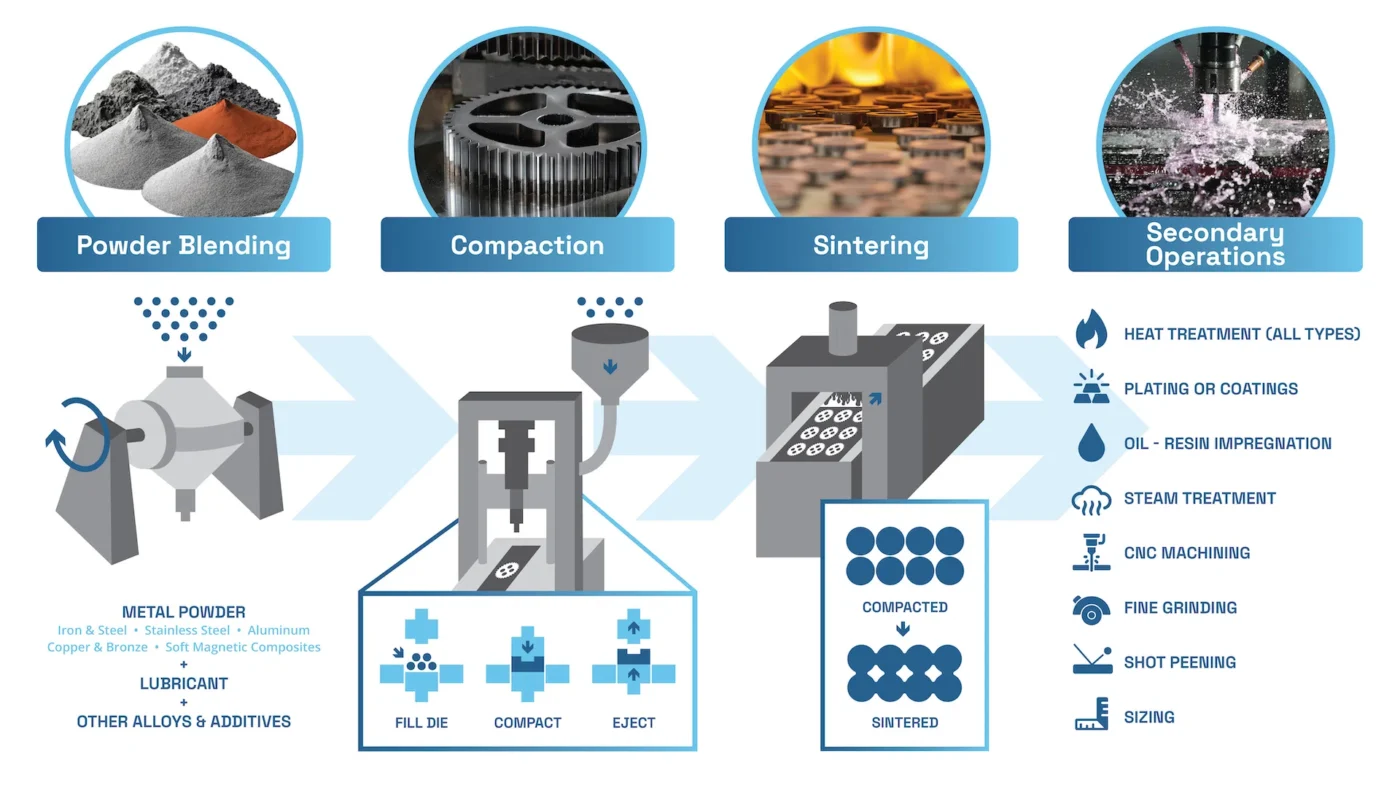
The efficiency of Powder Metallurgy lies in its ability to produce near-net-shape parts directly from a press. Unlike traditional machining, we “build” the gear rather than cutting it away from a solid blank.

Wenlio Gear Powder Metallurgy Manufacturing Process Flow

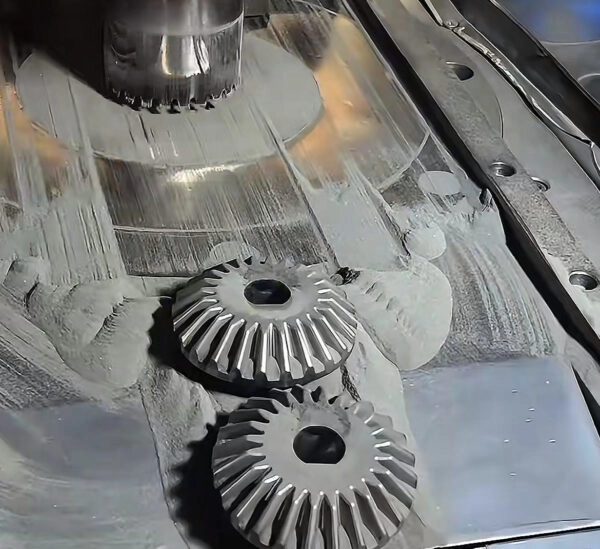
LIVE PRESSING OPERATION                                            COMPACTION CONSISTENCY: 99.8%

The STABILITY OF HIGH-TONNAGE PRESSING

The video illustrates our automated high-tonnage compaction cycle. Unlike variable manual processes, this synchronized movement ensures every “green” part exits the die with uniform weight and density—the foundation of gear durability.

Inquire About Lead Times

Geometric Complexity & Product Capability

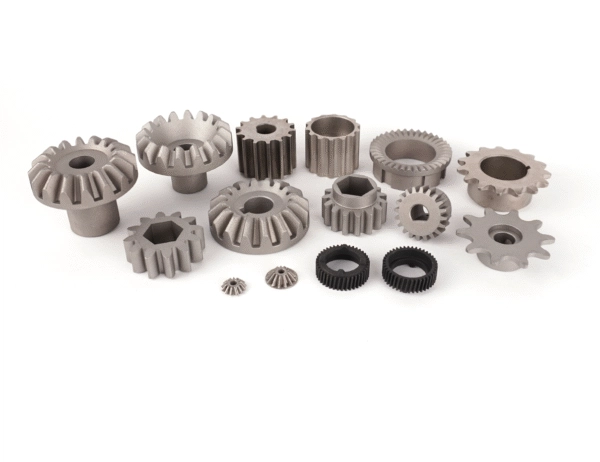
Powder metallurgy allows for “impossible” geometries—features like internal splines, integrated hubs, and bevel teeth are formed in a single press stroke.

Wenlio Custom Sintered Gear Gallery

BEVEL & SPUR GEARS

Complex involute profiles and pitch angles delivered near-net shape, reducing secondary cutting costs.

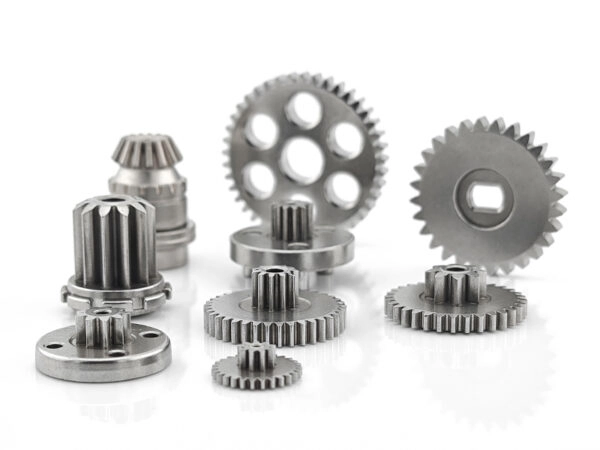
INTEGRATED FEATURES

Hubs, spacers, and locating features integrated into the gear body for simpler assembly.

Why Sourcing Managers Choose PM

Common PM Material Specifications

Data based on standard MPIF 35 structural components.

MPIF Standard Description Typical Density (g/cm³) Tensile Strength (MPa)
FC-0205 Iron-Copper-Carbon (Structural) 6.4 – 6.8 350 – 450
FN-0205 Iron-Nickel (High Strength) 6.7 – 7.1 400 – 750
FD-0208 Diffusion Alloy (Heat Treatable) 6.8 – 7.2 500 – 850
SS-316N Sintered Stainless Steel 6.5 – 6.9 ~400

*Performance values depend on compaction pressure and sintering environment.*

Gear Manufacturing Methods & Accuracy

Note: Accuracy grades depend on standard (ISO/AGMA/DIN), material state, heat treatment, machine capability, fixturing, and inspection method.

Machining Methods Principle Type Key Features Accuracy Grade Typical Applications
Gear Milling (Form Milling) Forming Method Simple equipment; low efficiency; low accuracy Below Grade 9 Single-piece repair/rework; low-precision gears
Gear Broaching Forming Method Extremely high efficiency; very expensive tools; dedicated tool for dedicated profile Grade 7–8 Large-batch internal ring gears; splines
Gear Planing (for Straight Bevel Gears) Generating Method Dedicated for straight bevel gears; relatively low efficiency Grade 8–9 Straight bevel gears
Powder Metallurgy Gears Near-Net Shape Forming High-volume and cost-efficient; good dimensional consistency; suitable for secondary operations when required Grade 7–9 High-volume small and medium gears; automotive parts; tools; appliances
Gear Hobbing Generating Method Universal & efficient; most common for rough / semi-finish machining Grade 7–8 External-mesh cylindrical gears; worm wheels
Gear Shaping (Slotting) Generating Method Can machine internal gears / compound gears; medium efficiency Grade 7–8 Internal gears; compound gears; racks
Gear Shaving Generating Method High-efficiency finishing, but cannot machine hardened parts Grade 6–7 Finishing of unhardened gears
Gear Honing Generating Method Finishing after hardening; improves surface quality Mainly improves Ra Deburring & polishing of hardened gears
Gear Grinding Generating Method Highest accuracy; highest cost; can machine hardened parts Grade 3–5 Final machining for high-precision (e.g., automotive) hardened gears

Technical Consultation FAQ

Powder Metal Gear

Are powder metallurgy gears suitable for high-load applications?

PM gears are typically used for moderate load requirements. However, by selecting high-density material blends (like FN-0205) and applying post-sintering heat treatment, they can be engineered for significant structural performance in industrial drives.

Can sintered gears be heat treated or plated?

Yes. We offer carbonitriding, steam treatment, and specialized plating. Steam treatment is particularly effective for sealing porosity and improving surface hardness and corrosion resistance.

What information should I provide for an inquiry?

To provide an accurate quote, we require a 3D STEP file, a 2D drawing with tolerances, the material grade, and the estimated annual volume. Note that PM tooling is most efficient for volumes over 10,000 units.

WENLIO GEAR

ENGINEERING SUPPORT

Our team helps you optimize gear designs for the powder metallurgy route to maximize cost savings while ensuring functional reliability.

✉ support@wenlio.com
☎ +86 182 5798 1010