
Blogs, Bevel Gear
Matched Bevel Gear Sets: What Buyers Should Check
Jun
Introduction
At Wenlio Gear, many bevel gear inquiries start with one practical question: should the customer buy one replacement gear, or should the project be treated as a matched set from the beginning? In our experience, that choice often decides whether the new parts assemble smoothly and run quietly, or whether the project turns into repeated adjustment, noise complaints, and unnecessary rework. Wenlio presents bevel gears as its core specialty and highlights spiral bevel gears in particular as smooth-running matched sets with custom ratios for applications that need stable meshing, lower vibration, and controlled contact behavior.
Matched bevel gear sets matter because bevel gears do not work as isolated parts. They work as a meshing pair, and the pair relationship affects backlash, contact pattern, load sharing, and long-term durability. Wenlio’s public process also shows why buyers should pay attention to this early: drawing review in 1 day, quotation in 2 days, prototype parts in 15 days, matched pairs available from 1 set, and a full process flow from forging through CNC, heat treatment, grinding, and inspection.
What matched bevel gear sets are
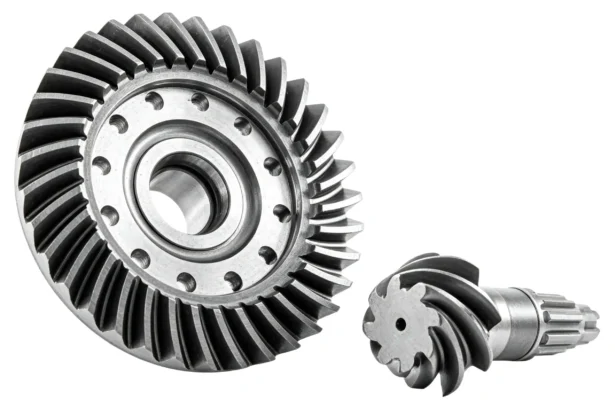
Matched bevel gear sets are paired bevel gears manufactured and checked to work together as one transmission unit, with the relationship between the two parts controlled for meshing stability, backlash, and contact behavior.
Why matched sets matter so much
Because one part may look correct and still be wrong in service.
A pinion can match the drawing on its own and still perform poorly if the mating gear, mounting position, or pair geometry is not aligned. For bevel gears, the working result depends on the relationship between the two parts, not just on the dimensions of one part.
Because noise and wear often come from pair mismatch, not only from machining error.
When buyers see early pitting, unstable contact, or abnormal noise, the root cause is often deeper than one out-of-tolerance value. The problem may be backlash, contact location, pair mismatch, or uncontrolled distortion after heat treatment.
Because a matched set affects quotation, inspection, and approval.
A supplier quoting a matched bevel gear set should think about the pair as a working transmission stage, not just as two separate pieces to machine. That changes the review logic, the inspection focus, and often the approval process as well.
The matched-set situations buyers usually face
| Project situation | What the buyer usually has | What still needs to be confirmed |
| New matched bevel gear set | Drawing or 3D model for the pair | Ratio, hand, material, heat treatment, inspection scope |
| Replacement matched set | Old drawing, sample pair, or axle reference | Whether original geometry still fits current service condition |
| Pinion-only replacement | One failed or worn pinion | Whether single-part replacement is technically safe |
| Gear-only replacement | One damaged mating gear | Whether the remaining gear is still a valid reference |
| Prototype matched set | Early design plus validation target | Sample quantity, approval method, report format |
| Stable production order | Approved sample or frozen drawing | Batch consistency, traceability, inspection repeatability |
This is the first thing buyers should clarify: not every bevel gear project should be treated the same way. A full matched pair is not the same as one replacement part, and the risk level changes immediately when the mating relationship is uncertain.
Who usually needs to review the set
- Buyers comparing quotations and project scope
- Design engineers checking pair logic and ratio
- Quality engineers confirming inspection format and standards
- Assembly engineers reviewing fit, backlash, and contact location
- Service teams diagnosing noise, wear, or repeat failure
- Project managers coordinating prototype timing and production release
Matched bevel gear projects move much faster when these roles align early, because a pair-related problem is rarely solved by purchasing or machining alone.
What buyers should check in the drawing package
| Drawing item | What to confirm | Why it matters |
| Pair requirement | Full matched set, pinion only, gear only | Defines the real project scope |
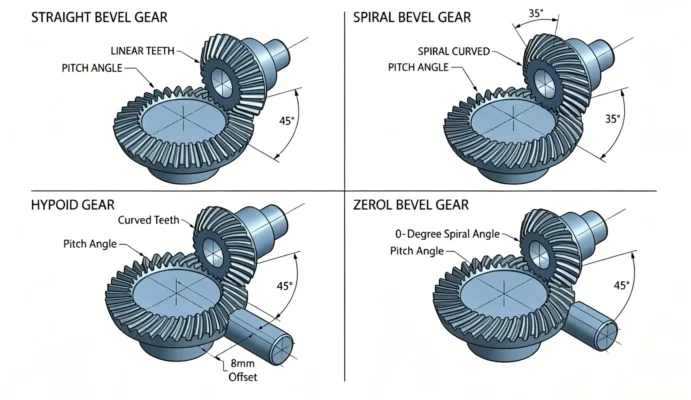
| Gear type | Straight bevel, spiral bevel, hypoid, zerol, miter, or crown | Changes process route and inspection focus |
| Ratio and tooth count | Ratio target and gear/pinion tooth numbers | Defines transmission function |
| Hand and orientation | Left hand, right hand, assembly direction | Prevents wrong-pair manufacturing |
| Mounting references | Bore, spline, flange, face width, shaft angle, offset if relevant | Affects fit and installation |
| Material | Steel grade or approved alternatives | Affects strength, hardenability, and cost |
| Heat treatment | Carburizing, nitriding, induction hardening, or required hardness | Affects wear life and distortion |
| Inspection requirement | Backlash, runout, profile, lead, hardness, contact pattern, material cert | Defines what approval really means |
At Wenlio Gear, our normal project flow starts with exactly this kind of review. We support build-to-print or co-design work, and our team reviews drawings quickly so missing information can be identified before the quote turns into a weak assumption. We also publish a process flow that connects drawing review, quotation, prototype inspection, customer approval, and batch production under one coordinated workflow.
What a good matched-set process improves
| Project result | What improves | Why it helps |
| Quote accuracy | Fewer hidden assumptions | Reduces re-quoting and revision risk |
| Running stability | Better control of backlash and contact | Helps lower noise and vibration |
| Prototype approval | Clearer inspection evidence for the pair | Speeds up validation |
| Batch consistency | Same pair logic from sample to production | Reduces lot-to-lot variation |
| Global sourcing confidence | Better traceability and report structure | Makes approval easier for overseas buyers |
This is where a stronger supplier shows up clearly. Wenlio’s public capabilities include prototype validation to mass production, flexible material and heat-treatment options, matched pairs from 1 set, PPAP-ready reports, and full traceability. Those points matter because matched bevel gear projects are usually approved through technical evidence, not by appearance alone.
What to check in inspection before approval
-
Backlash and pair fit
Backlash should be checked in the way the project defines it, not treated as a generic number without reference to the assembly condition.
-
Contact behavior
For a matched bevel gear set, contact pattern is often one of the most useful checks because it shows how the pair is likely to behave in mesh.
-
Gear geometry reports
Wenlio’s custom-gear process states that tooth profile, lead, hardness, and dimensional reports can be provided with each order, and that anonymized sample inspection reports are available on request.
-
Heat-treatment results
Surface hardness, core hardness, effective case depth, and microstructure matter because a matched set that meshes well but lacks the right surface condition can still fail early. Wenlio lists these heat-treatment-related checks directly in its report samples and quality content.
-
Dimensional and datum consistency
Wenlio also lists OD, ID, face width, center distance, surface roughness, concentricity, and perpendicularity among its dimensional report items, which shows that approval should combine gear geometry with mounting-related dimensions rather than looking at one type of result only.
Why Choose Us
At Wenlio Gear, we treat matched bevel gear sets as a full engineering project rather than a simple part order. Our published capabilities center on bevel gears, including straight bevel, spiral bevel, hypoid, zerol, crown, and miter categories, and we support projects from drawing review and DFM feedback through prototype validation, heat treatment, grinding, inspection, and stable repeat production.
That matters because matched sets ask more from the supplier than basic machining alone. They require attention to pair logic, controlled meshing behavior, inspection discipline, and consistency between sample approval and production release. Our public quality presentation also highlights calibrated in-house measurement, certified third-party lab support when needed, prototype runs, batch manufacturing, and quality levels up to project-dependent precision levels in some projects.
FAQ
Q1: What is the most important thing to check in a matched bevel gear set?
The most important point is whether the pair is being reviewed as a working set, not just as two separate parts.
Q2: Can I replace only one part of a matched bevel set?
Sometimes, but not always. The risk depends on the condition of the remaining mating part and how critical the pair relationship is in service.
Q3: Why are spiral bevel gear sets often discussed as matched sets?
Because stable meshing, lower vibration, and controlled contact behavior depend on how the pair works together, not only on the size of one gear. Wenlio describes spiral bevel gears in exactly those matched-set terms.
Q4: What reports should buyers ask for before shipment?
For many matched bevel gear projects, buyers should at least confirm material evidence, tooth geometry reports, hardness data, and dimensional inspection results.
Q5: Does prototype capability matter if I plan a production order only?
Yes. Prototype discipline usually shows how the supplier handles drawing review, pair logic, inspection, and revision before the production risk becomes expensive.
Conclusion
Matched bevel gear sets should be quoted, reviewed, and approved as a working transmission pair, not as two isolated parts. The better the buyer defines the pair requirement, gear type, ratio, mounting references, material route, heat treatment, and inspection target, the more useful the quotation and the more reliable the final set will be.
For this type of project, the real goal is not only to make two gears that fit a drawing. It is to deliver a pair that can mesh, carry load, and stay stable in service. If you are preparing a matched bevel gear RFQ, replacing an existing set, or trying to decide whether a single-part replacement is safe, Contact Us with your drawing, sample pair, or application details so the review can start from the right information.
