
Blogs, Bevel Gear
Bevel Gear Backlash Explained: Contact Pattern Checks
May
Introduction
In a bevel gear set, backlash may look like a small detail, but it affects far more than tooth clearance. It influences how the teeth meet, how smoothly the pair runs, how much heat it generates, and how fast the tooth surfaces wear in service. If backlash is checked without looking at contact pattern and runout, a gear set that appears acceptable on paper may still create trouble during assembly or operation.
For buyers, this is not just a technical detail. It affects whether a custom bevel gear can match the mating part, whether the pair will run quietly, and whether the project can move into production without repeated fitting changes. Wenlio Gear supports custom bevel gear projects based on drawings, samples, OEM numbers, photos, dimensions, and application data. This article explains bevel gear backlash in a practical way and shows why it should always be reviewed together with contact pattern and runout before production starts.
What bevel gear backlash is
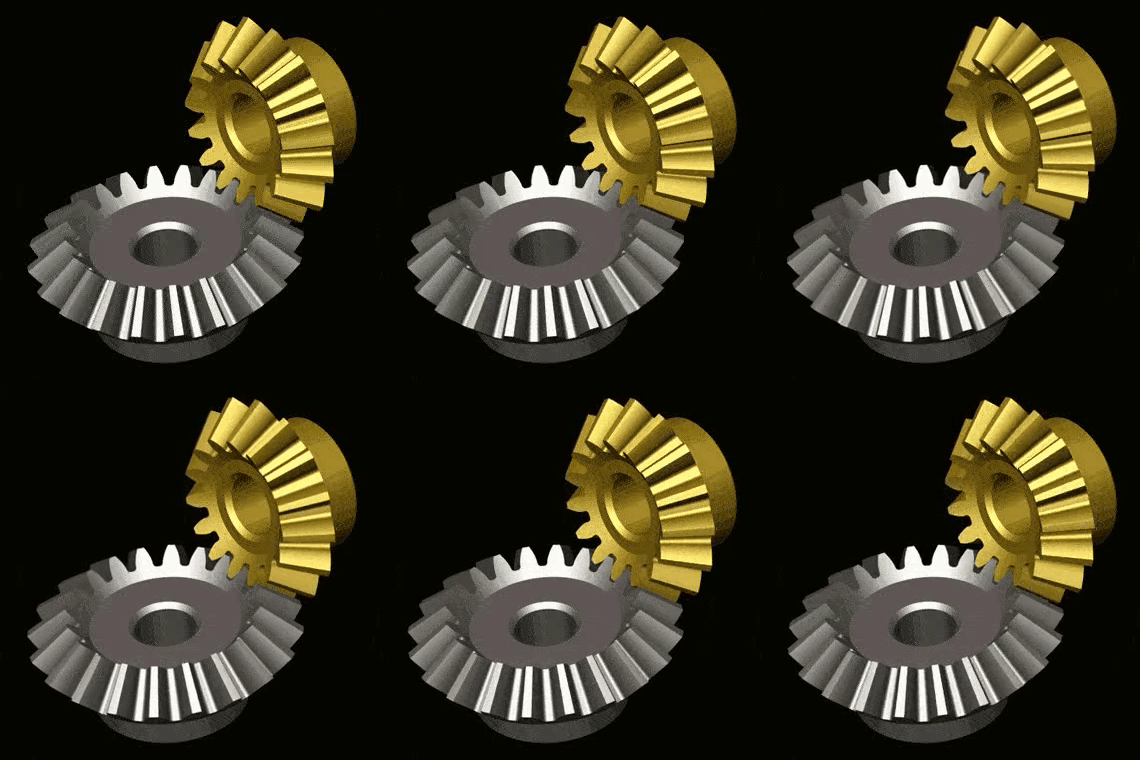
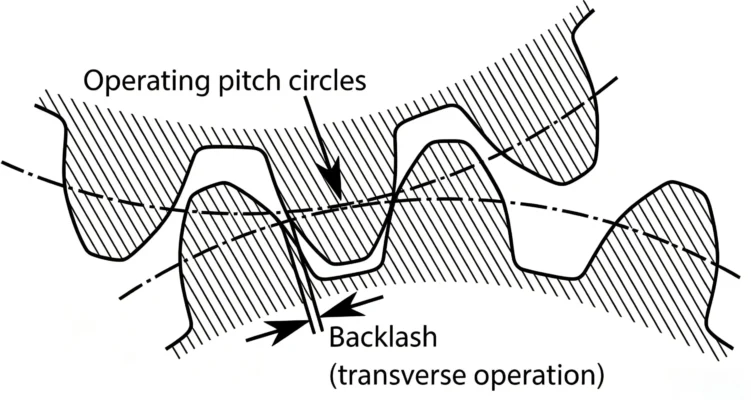
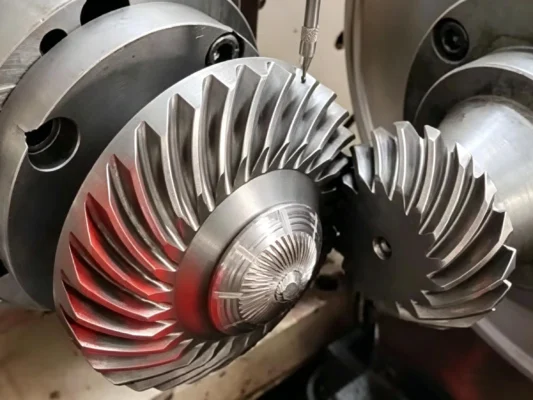
Bevel gear backlash is the small clearance between the mating tooth surfaces of a bevel gear pair when the gears are in mesh.
Why backlash matters in bevel gears
Because bevel gears do not run on clearance alone.
A bevel gear set needs some backlash to allow for lubrication, thermal expansion, small manufacturing variation, and assembly tolerance. But backlash cannot be judged by itself. In bevel gears, the real result depends on where the teeth touch and how the pair is mounted.
Because too little and too much backlash both create problems.
If backlash is too small, the mesh may run tight, generate heat, lose oil film, and wear quickly. If it is too large, the pair may feel loose, make more noise, and show unstable contact under load.
Because bevel gears are sensitive to assembly condition.
Unlike simpler gear layouts, bevel gear performance depends strongly on mounting distance, shaft angle, tooth contact position, and mating accuracy. A backlash value that looks acceptable on a drawing may still be wrong in the real assembly.
Backlash, contact pattern, and runout are not the same thing
| Item | What it means | What it affects | Why it matters |
| Backlash | Clearance between mating tooth surfaces | Noise, heat, lubrication space, assembly feel | Too small or too large can both create running problems |
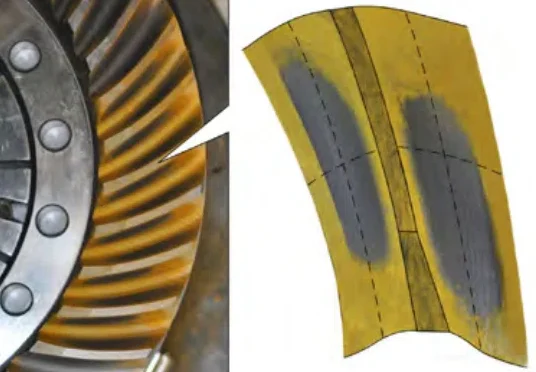
| Contact pattern | The actual area where mating teeth touch during mesh | Load distribution, wear, smoothness, service life | Poor contact can damage even a correctly cut gear |
| Runout | Radial or axial deviation during rotation | Vibration, uneven tooth engagement, contact shift | Excessive runout can distort real backlash and contact results |
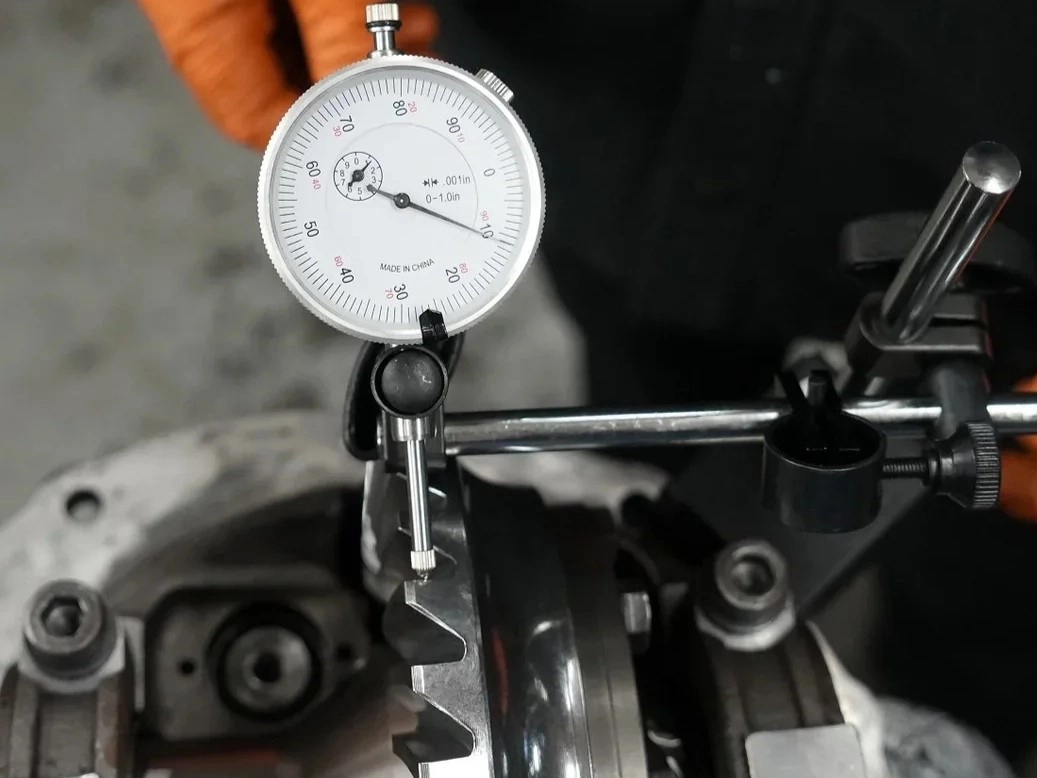
These three checks work together. A bevel gear set should not be approved by backlash alone. If runout is high, the measured backlash may change as the gear rotates. If contact pattern is off, a correct backlash value on paper may still lead to poor load sharing in service.
Who uses backlash information
- Design engineers setting a workable mesh condition
- Manufacturing engineers checking whether machining and assembly can meet the target
- Quality engineers reviewing backlash together with contact pattern and runout
- Purchasing teams comparing suppliers and trying to avoid hidden assembly risks
- Maintenance teams diagnosing noise, heat, or abnormal wear
- OEM and aftermarket buyers matching a new gear to an existing mating part
In custom bevel gear work, backlash is not only a shop-floor check. It is also a communication point between the buyer, the supplier, and the final machine application.
What happens if backlash is too small or too large
| Condition | Typical risk | What you may see |
| Backlash too small | Tight mesh, heat build-up, poor lubrication film, fast wear | Hard turning, overheating, noisy running, tooth surface damage |
| Backlash too large | Loose mesh, impact, unstable engagement, poor positional feel | Rattle, shock during reversal, uneven contact, higher noise |
| Backlash looks normal but contact is poor | Local overload and edge contact | Fast wear in one area, poor pattern, repeated assembly adjustment |
| Backlash looks normal but runout is high | Changing mesh around rotation | Uneven sound, unstable tooth contact, inconsistent measurement |
A common mistake is to treat backlash as a single acceptance number. In real bevel gear projects, the result depends on where the contact sits on the tooth, whether runout is controlled, and whether the mating parts are assembled in the correct position.
Key features and benefits of proper backlash control
| Feature or benefit | Explanation | Practical result |
| Controlled clearance | Backlash is a designed gap, not random looseness | Helps balance lubrication, expansion, and tooth engagement |
| Assembly-sensitive behavior | Backlash changes with mounting distance and mating condition | Incorrect assembly can shift the final result |
| Link to contact pattern | Backlash does not show where the teeth really carry load | Contact checks are needed to confirm the mesh |
| Influence from runout | Tooth position changes if runout is not controlled | Measured backlash may not stay stable around rotation |
| Smoother running | Correct backlash helps avoid tight or loose mesh | Lower noise and more stable motion |
| Longer service life | Better mesh condition reduces heat and local overload | Lower wear risk and more predictable service performance |
The goal is not to make backlash as small as possible. The goal is to control it at the level that fits the application, the gear geometry, the assembly condition, and the real duty cycle.
What Buyers Should Provide Before Quotation
To review backlash risk correctly, the supplier needs more than a basic gear description. The more complete the input is, the safer the quotation and production route will be.
Buyers should provide:
- Gear drawing, if available
- Old sample or mating gear sample
- Gear ratio and tooth count
- Module or diametral pitch
- Mounting distance or assembly reference
- Material and heat treatment requirement
- Bore, hub, keyway, and datum information
- Noise, wear, or service-life concerns
- Inspection requirements, such as backlash, runout, hardness, or contact pattern checks
- Application details, including speed, load, lubrication, and duty cycle
If the original data is incomplete, photos, basic dimensions, and the machine application can still help the review start in the right direction.
How to Choose a Supplier for Bevel Gear Backlash Projects
A good supplier should not only promise a backlash value. The supplier should understand how backlash works together with contact pattern, runout, and assembly condition.
- Check whether the supplier can review both drawing data and real mating conditions.
- Ask how backlash is checked during inspection and assembly verification.
- Confirm whether contact pattern checking is part of the process.
- Ask how runout is controlled and how it is linked to final mesh behavior.
- Compare engineering communication and inspection support, not only price.
A lower price is not a real saving if the gear later creates noise, heat, or repeated fitting problems.
Why Choose Us
Wenlio Gear works on custom bevel gear projects based on drawings, samples, OEM numbers, photos, dimensions, and application data. For bevel gear pairs, the real focus is not only nominal geometry, but also the inspection points that affect running quality after assembly.
That is why bevel gear review should include more than module, ratio, material, and heat treatment. In practical projects, backlash, contact pattern, runout, hardness, and tooth surface condition often decide whether the gear pair assembles correctly and performs reliably in service.
A stronger review at the front end usually helps reduce repeated fitting changes, unstable noise results, and avoidable field issues later.
FAQ
Q1: What is bevel gear backlash?
It is the small clearance between the mating tooth surfaces of a bevel gear pair.
Q2: Why is backlash important in bevel gears?
Because it affects noise, heat, lubrication space, wear, and assembly quality.
Q3: Is backlash the same as contact pattern?
No. Backlash is the clearance between teeth, while contact pattern shows where the teeth actually touch during mesh.
Q4: Can correct backlash still give poor performance?
Yes. If contact pattern or runout is poor, the gear may still run badly even when backlash seems acceptable.
Q5: What should a buyer provide before quotation?
A drawing is best. If not available, provide samples, photos, dimensions, gear ratio, mounting data, material, heat treatment, and inspection requirements.
Conclusion
Bevel gear backlash is a small clearance, but it has a large effect on how a gear pair behaves in real service. It should never be checked alone. Contact pattern and runout also need to be reviewed, because these three factors work together to affect noise, heat, wear, and long-term stability.
For custom bevel gear projects, the better approach is to start from the real application, not only from the nominal drawing value. If you are developing a new bevel gear pair, replacing an existing set, or reviewing backlash problems in production, you are welcome to Contact Us with your drawings, samples, photos, dimensions, and operating conditions.

Pingback: How Does Bevel Gear Contact Pattern Affect Performance