
Blogs, Pinion Gear
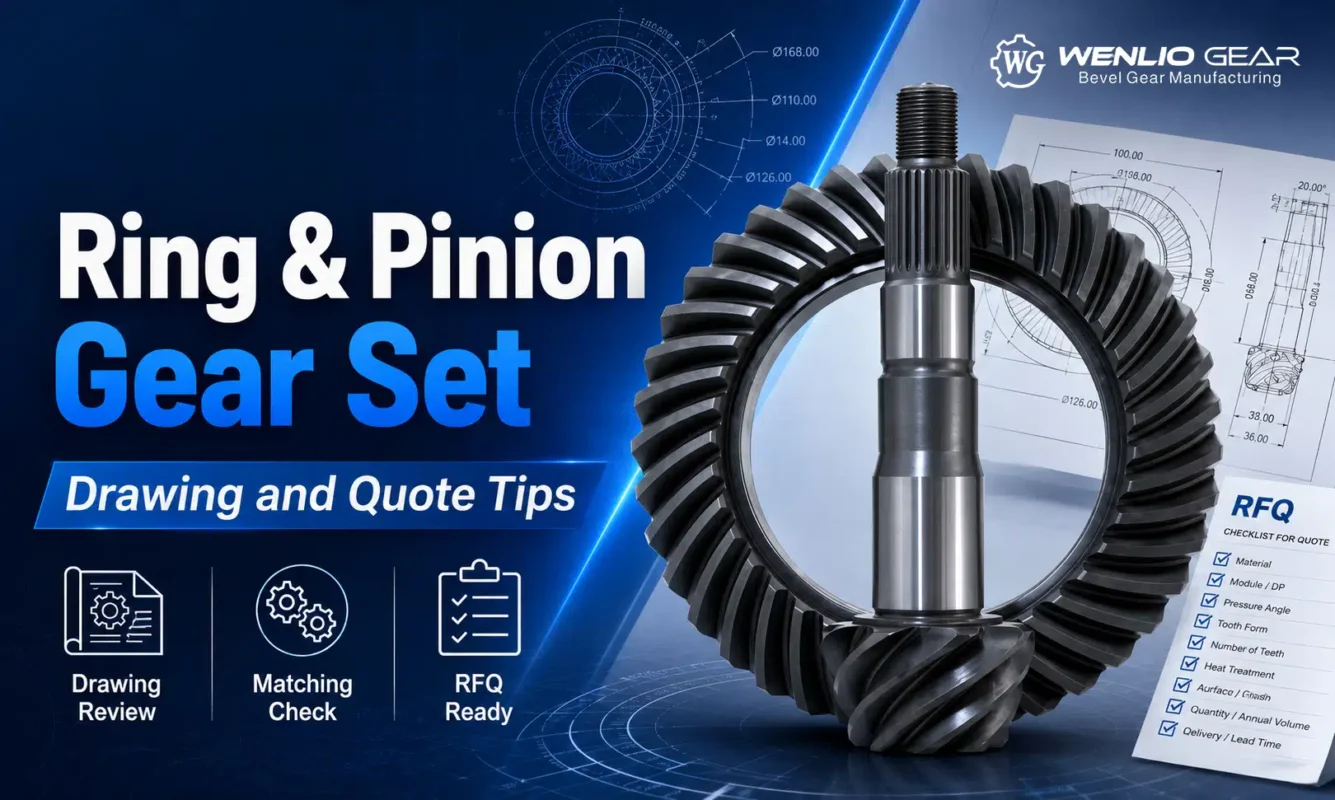
Ring and Pinion Gear Set: Drawing and Quote Tips
Jun
Introduction
At Wenlio Gear, ring and pinion gear set inquiries usually start with a practical sourcing problem: a worn sample, an old drawing, an OEM reference, or a quote that looks too low to trust. For buyers, the key question is not only whether the parts can be machined, but whether the new gear set can match, assemble, and run correctly in the original drive system.
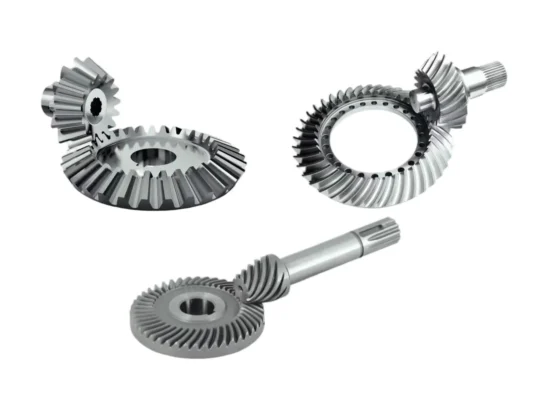
That matters because a ring and pinion gear set is not a single-part purchase. In automotive and drive applications, bevel gears change power direction and help convert speed and torque in systems such as differentials and right-angle transmissions. Wenlio supports spiral bevel and hypoid bevel gear projects for these drive layouts, so drawing quality, pair data, and matching logic deserve more attention than price alone.
What Is a Ring and Pinion Gear Set?
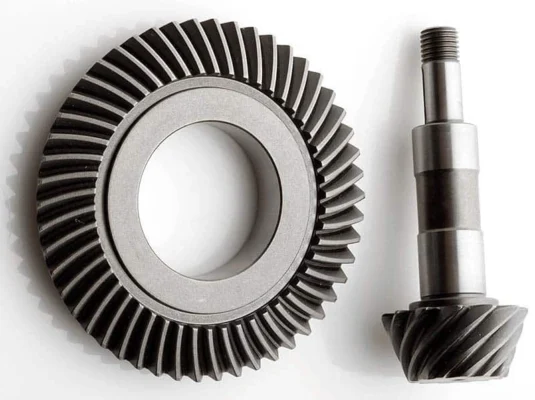
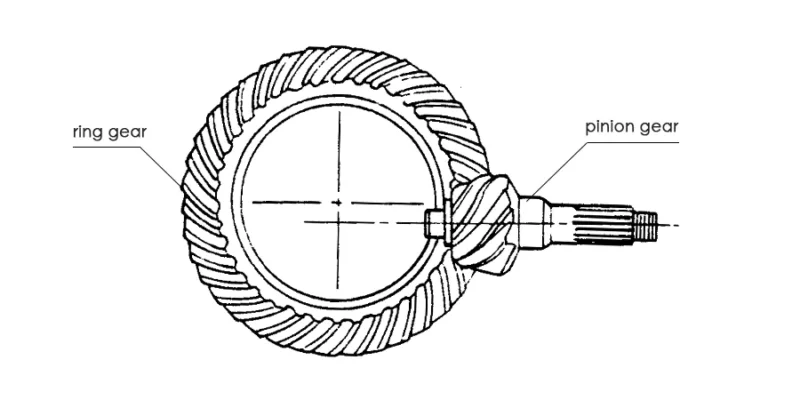
A ring and pinion gear set is a matched bevel-type gear pair in which a smaller pinion drives a larger mating gear to change power direction and deliver the required ratio, contact behavior, and torque transfer.
Why Drawing and Matching Matter Before Quotation
Because the set works as a pair, not as two independent parts. A ring gear and a pinion may each look acceptable by size, but if the pair logic is wrong, the result can still be noisy, unstable, or impossible to assemble correctly. For bevel-type sets, matching matters at the level of geometry, contact behavior, backlash, and application fit.
Because incomplete drawings create expensive assumptions. If the supplier has to guess the hand, mounting logic, pair type, or heat-treatment condition, the first quote may look fast but the technical risk stays hidden. Early drawing review and DFM feedback help prevent problems before production instead of correcting them after sample failure.
Because ring and pinion sets are often used where service conditions are demanding. Wenlio serves applications such as automotive, agricultural machinery, heavy truck, construction equipment, EV, and industrial automation. Load, lubrication, backlash, and contact stability all matter, so drawing clarity and matching logic matter too.
Common Ring and Pinion Sourcing Situations
| Project situation | What the buyer usually has | What still needs to be clarified |
| New ring and pinion set to drawing | 2D drawing, 3D file, target ratio | Gear type, material, heat treatment, inspection scope |
| Replacement set with old drawing | Legacy print, ratio, some mounting data | Whether the old drawing still matches current operating condition |
| Replacement without full drawing | Worn sample, photos, partial dimensions, OEM reference | Reverse-engineering scope, mating relationship, tolerance priority |
| Pinion-only or ring-only replacement | One damaged part and one surviving mate | Whether single-part replacement is technically safe |
| Prototype or trial order | Early design plus validation target | Sample quantity, approval criteria, report format |
| Production order | Frozen design or approved sample | Batch consistency, documentation, lead time, packaging |
This is where many mistakes start. Buyers think they are ordering a replacement gear, while the supplier is actually being asked to reconstruct a matched transmission stage.
Who Usually Needs to Understand the Drawing?
- Buyers preparing RFQs and comparing quotations
- Design engineers checking geometry and ratio logic
- Quality engineers confirming standards and report format
- Assembly engineers reviewing backlash, fit, and contact location
- Service teams diagnosing wear, noise, or repeated failure
- Project managers balancing prototype timing and production continuity
A ring and pinion project becomes much smoother when all of these people are working from the same drawing logic instead of different assumptions.
What Buyers Should Include in a Ring and Pinion Drawing
| Drawing item | What buyers should provide | Why it matters |
| Gear type | Spiral bevel or hypoid, and whether shafts intersect or are offset | Changes the whole process route and matching logic |
| Pair requirement | Full matched set, pinion only, ring only, or reverse-engineering project | Determines whether the supplier is quoting a set or a component |
| Ratio data | Tooth count, ratio target, or both | Defines transmission function |
| Hand and orientation | Left hand, right hand, mounting side, assembly direction | Prevents wrong-pair manufacture |
| Key mounting dimensions | Bore, spline, flange, pilot, PCD, offset, face width | Affects fit and assembly |
| Datum definition | Measuring basis and installation references | Keeps inspection aligned with real use |
| Material | Required steel grade or acceptable alternatives | Affects strength, hardenability, and cost |
| Heat treatment | Carburizing, nitriding, induction hardening, or required hardness | Affects wear life and distortion |
| Inspection request | Runout, backlash, profile/lead, hardness, contact pattern, material cert | Defines what approved actually means |
| Quantity plan | Prototype quantity and production demand | Helps choose process route and lead time |
If your drawing is incomplete, Wenlio can start with sample photos, old parts, OEM references, quantity demand, and application details. This helps our team judge whether the project should be quoted as a matched set, a reverse-engineering case, or a single-part replacement with matching risk.
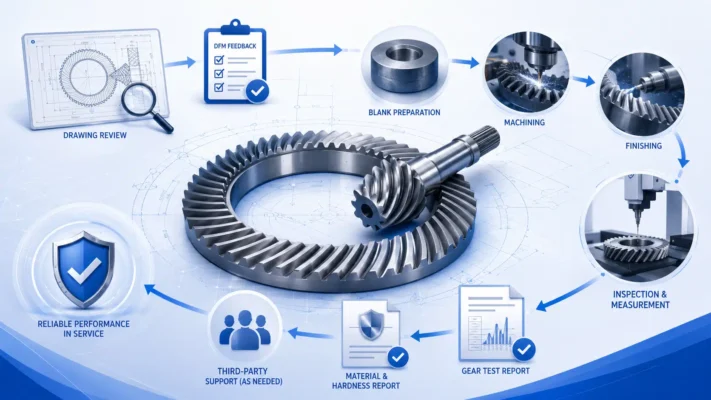
Wenlio asks customers to send drawings, samples, or application details and can review gear type, material, heat treatment, and inspection needs before production. Its manufacturing workflow covers key stages from blank preparation and cutting to heat treatment, finishing, and quality inspection, which is why complete input data matters so much at the RFQ stage.
What Correct Drawing and Matching Improve
| Project result | What improves | Why it helps |
| Quotation accuracy | Fewer hidden assumptions | Reduces later price or scope revisions |
| Assembly success | Better fit, datum consistency, and pair logic | Lowers rework risk during installation |
| Running behavior | Better contact, backlash, and load sharing | Helps reduce noise and uneven wear |
| Prototype approval | Clearer standards and report targets | Speeds up validation |
| Batch consistency | Same logic from sample to production | Lowers variation between lots |
A ring and pinion drawing is not just a manufacturing file. It is also the first quality document in the project. If it is weak, later inspection reports become harder to interpret because the original reference was never clear.
What Buyers Should Confirm Before Production
- Whether the set is spiral bevel or hypoid. These are different product families with different shaft relationships, contact behavior, and manufacturing routes.
- Whether the project is a true matched-pair requirement. A ring and pinion set should usually be reviewed as a working pair, not only as two separate parts.
- What reports will be provided before shipment. Buyers may need material evidence, hardness data, gear inspection reports, and optional FAI or PPAP depending on the project.
- How the supplier handles prototype-to-batch transition. The same drawing and inspection logic should continue from trial parts to stable batch production.
- Whether contact and matching are part of the discussion. For ring and pinion work, geometry alone is rarely enough. Buyers should ask how the supplier reviews backlash, contact behavior, and pair consistency.
Why Choose Wenlio for Ring and Pinion Gear Sets
At Wenlio Gear, bevel gear work is not treated as a side category. Wenlio focuses on spiral bevel, straight bevel, hypoid, and zerol gear projects across automotive, agricultural machinery, heavy truck, construction equipment, EV, and industrial automation. That matters because ring and pinion projects sit directly inside a bevel-gear manufacturing and matching workflow.
Wenlio also presents the kind of process depth that buyers usually look for in ring and pinion sourcing: drawing review, DFM feedback, matched-pair availability, process control from blank preparation to finishing and inspection, calibrated in-house measurement, third-party support when needed, and documentation such as material, hardness, and gear test reports. In practical terms, that means the discussion can move from “can you make this part?” to “can this set work reliably in service?”
FAQ
Q1: Can I replace only the pinion or only the ring gear?
Sometimes, but not always. For many ring and pinion projects, the safest route is to review the full pair because matching risk is high.
Q2: What is the most important item on a ring and pinion drawing?
The most important group of inputs is gear type, ratio, mounting reference, pair requirement, and heat-treatment requirement together.
Q3: Is a ring and pinion set always hypoid?
No. In practice, ring and pinion projects may be spiral bevel or hypoid depending on shaft relationship and application layout. Wenlio supports both families separately.
Q4: What reports should buyers ask for before shipment?
Material evidence, hardness data, dimensional or gear inspection reports, and any contact- or application-specific checks that matter for the project.
Q5: What should I send first if I want a quote?
Send the drawing if available. If not, send sample photos, sample parts, OEM reference, quantity, and application details so the supplier can judge the reverse-engineering path more clearly.
Conclusion
A ring and pinion gear set should be quoted and reviewed as a working transmission pair, not as two isolated components. The better the drawing, the clearer the matching logic, and the earlier the supplier understands the real application, the more reliable the project becomes. For this kind of gear set, small missing details at RFQ stage often become large problems later in assembly, noise, wear, or delivery.
If you are preparing a ring and pinion inquiry, replacing an existing set, or trying to decide whether your drawing is complete enough for quotation, Contact Us with your drawing, sample photos, OEM reference, or application details so the matching and manufacturing review can start from the right information.
