
Blogs, Bevel Gear
The Efficiency of Bevel Gears: A Factory Guide
Jan
Introduction
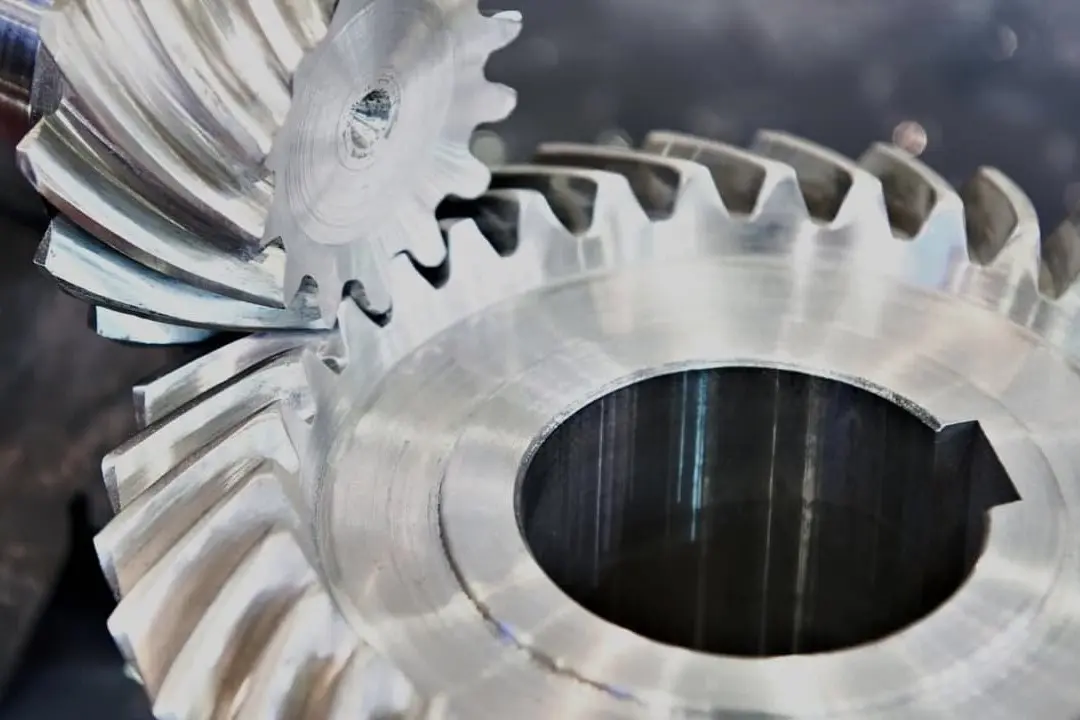
Bevel gear efficiency is easy to feel in real machines: more heat, higher noise, faster wear, or rising power consumption. In our daily production and inspection work, we often hear the same question: “The gears look fine—so why is the system getting hotter and less efficient?”
This article shares a simple factory view of what reduces efficiency and how to keep it stable. Wenlio cover bevel gear type trade-offs, sliding vs rolling, oil viscosity, surface finish, and contact pattern—plus practical checks you can use from prototype to batch production.
Bevel Gear Efficiency in Plain Terms
Bevel gear efficiency (η) is the ratio of output power to input power during transmission: η = P_out / P_in × 100%
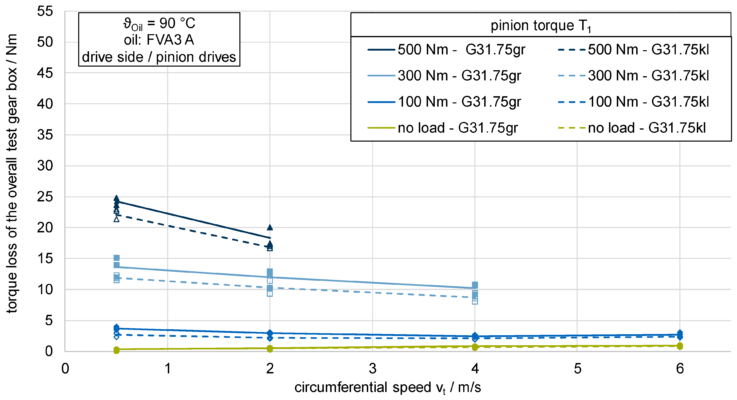
Efficiency can never be a perfect 100% because some power is always lost to friction, small impacts during meshing, and material deformation.
Why Efficiency Matters in Real Machines
1) Efficiency becomes heat.
Power loss does not disappear—it turns into heat. More heat usually means thinner oil film, faster oil aging, and faster wear.
2) Efficiency affects usable output.
Even with the same ratio and motor, higher losses reduce real output torque/power at the driven side. This matters in heavy loads, long duty cycles, and energy-sensitive systems.
3) Efficiency is a “system result,” not one number on a drawing.
Two gears can both meet size tolerances, yet one set runs hotter. The difference is often contact pattern, surface finish, lubrication, and alignment under load.
How gear type changes friction loss
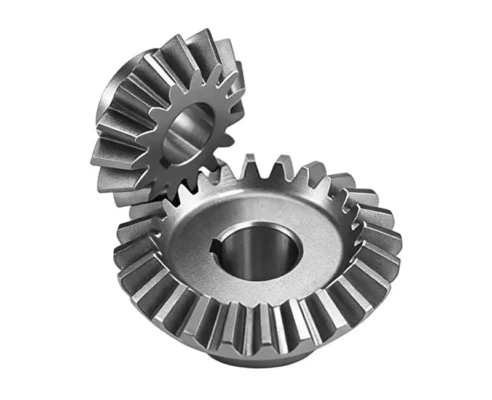

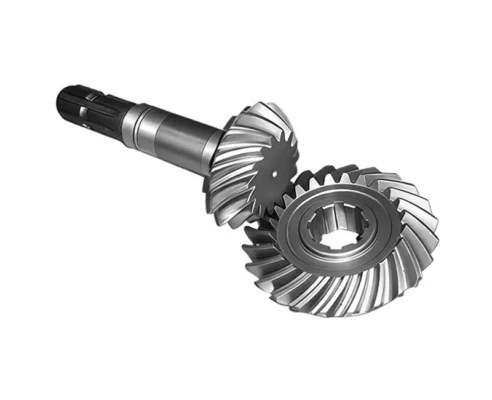
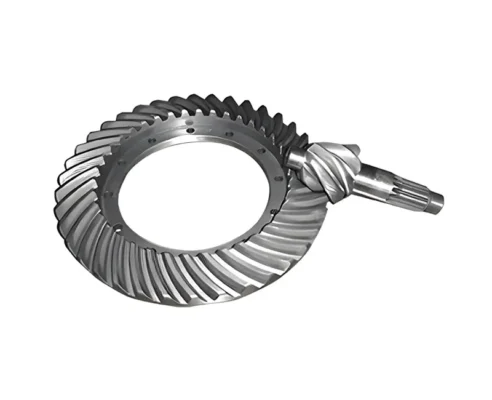
In simple terms: more sliding = more sensitivity to oil, surface finish, and contact setup.(ISO 23509: bevel & hypoid gear geometry)
| Bevel Gear Type | Contact Style (Simple) | Where efficiency loss often comes from | Factory note |
| Straight Bevel | quick “line-like” contact | meshing impact + local friction | OK at moderate speed; can get noisy/hot if pushed |
| Zerol Bevel | very small surface contact | boundary friction + higher single-tooth load | often misunderstood as “straight”; needs good setup |
| Spiral Bevel | progressive surface contact | extra sliding from spiral + multi-tooth friction sum | smoother, but process control matters more |
| Hypoid (offset) | large progressive surface contact | high sliding due to offset + boundary friction | most sensitive to lubrication and surface condition |
Who cares most about efficiency
Agricultural machinery: long working hours, dust/water risk, mixed loads → oil film stability is critical
Heavy-duty truck: high torque density, long mileage targets → heat control and wear control are key
Construction equipment: shock load + heavy duty cycles → contact stability under load matters
EV drivetrain: energy efficiency + quiet running → small losses become noticeable
Industrial automation: long uptime + repeatability → stable friction behavior matters
The real factors that control efficiency
Below are the factors we see again and again when troubleshooting “hot running” or fast wear.
| Factor | What it looks like in real projects | Why it changes efficiency |
| Sliding vs rolling | high-speed stages show quick temp rise when sliding is high | sliding friction is a direct power loss |
| Lubrication viscosity | too thick → drag; too thin → film breaks | oil film decides friction mode and wear rate |
| Surface roughness | visible tool marks / high Ra | rougher surface increases friction and local heat |
| Contact pattern under load | pattern too close to edge, or shifts after heat treat | edge load increases friction and wear fast |
| Alignment / mounting distance | small assembly variation changes contact | misalignment increases sliding and heat |
| Load distribution | uneven load across face width | local overload increases friction loss |
| Oil cleanliness | particles or water contamination | damages film → scuffing, rapid efficiency drop |
Factory note: what we check first when a customer says “efficiency dropped”
We rarely start with “gear strength.” We start with:
Contact pattern position and stability (especially after heat treatment and in real assembly)
Surface condition (roughness, scuff marks, polishing direction)
Oil condition (viscosity choice, contamination, temperature) ( SKF oil selection basics)
What you gain when efficiency is stable
| Benefit | What you see in the field | Why it matters |
| Lower operating temperature | cooler housing and oil | slower wear + longer oil life |
| More usable output | less drag under load | better real performance |
| Longer service life | less scuffing, slower pitting growth | lower downtime risk |
| More stable noise | less unit-to-unit scatter | easier QC and assembly |
| Better repeatability | prototypes and batches behave similar | less rework and faster ramp-up |
Supplier selection tips — a simple checklist that works
If efficiency and heat are important, these questions usually save time:
Do you verify contact pattern, not only dimensions?
A set can be “on size” but still run hot if the contact is too near the edge or unstable under load.
What finishing route do you use (lapping / grinding / polishing)?
Surface finish strongly changes friction. Ask for a realistic plan based on speed, load, and cost target.
How do you control distortion after heat treatment?
Many efficiency problems are actually pattern-shift problems after heat treat.
What inspection evidence will you provide?
For many programs, a practical package includes key dimensions, datums/runout, and contact pattern evidence when required.
What lubrication assumptions are used in design and validation?
Especially for higher sliding designs, oil choice and operating temperature matter.
Quick troubleshooting questions (for rebuild or field issues)
Did the oil viscosity change (or did temperature rise enough to thin the oil too much)?
Is the contact pattern still centered, or did it move to the toe/heel/edge?
Are there scuff marks, discoloration, or rough zones on the tooth surface?
Did bearing preload, alignment, or mounting distance change in assembly?
Why Choose Us
Factory-minded engineering support. We review shaft angle, mounting constraints, load and speed targets, then suggest a manufacturable route.
Process built for repeatability. From blank control to heat treatment and finishing, we focus on keeping contact behavior stable.
Inspection you can use. We align checks to assembly reality: datums, runout, and contact behavior—not only “pass/fail sizes.”
Project communication that stays simple. Clear RFQ input list, drawing-friendly feedback, and consistent documentation from sample to batch.
FAQ
Q1: Can bevel gear efficiency reach 100%?
No. There is always loss from friction, meshing impacts, and deformation. The goal is to keep loss low and stable.
Q2: What usually causes the fastest efficiency drop?
Most fast drops come from oil film failure plus wear—often triggered by wrong viscosity, contamination, or a contact pattern that loads the edge.
Q3: Are spiral bevel gears always more efficient than straight bevel gears?
Not always. Spiral bevel gears run smoother, but they can introduce extra sliding. The real result depends on speed, load, oil, and contact setup.
Q4: Why are higher-sliding designs more sensitive to lubrication?
Because sliding friction creates heat quickly. Without a stable oil film and good surface condition, scuffing and rapid efficiency loss become more likely.
Q5: What should I send for an efficiency-focused evaluation before production?
Drawings or a sample, ratio, shaft angle/offset (if any), load & speed range, oil/temperature assumptions, and mounting constraints.
Conclusion
Bevel gears may be hidden, but efficiency is easy to feel: heat, noise, wear, and power loss all point back to friction and contact quality. Gear type matters, but in many real projects the biggest gains come from the basics—a stable contact pattern, the right surface finish route, and lubrication that matches speed and load.
If you are planning a new project, localising an existing design, or troubleshooting efficiency issues in a right-angle drive stage, you are welcome to Contact Us to share your drawings, samples and operating conditions with our engineering team.
