
Blogs, Bevel Gear
Cold Forging for Precision Bevel Gears
Oct
1.About Wenlio Gear
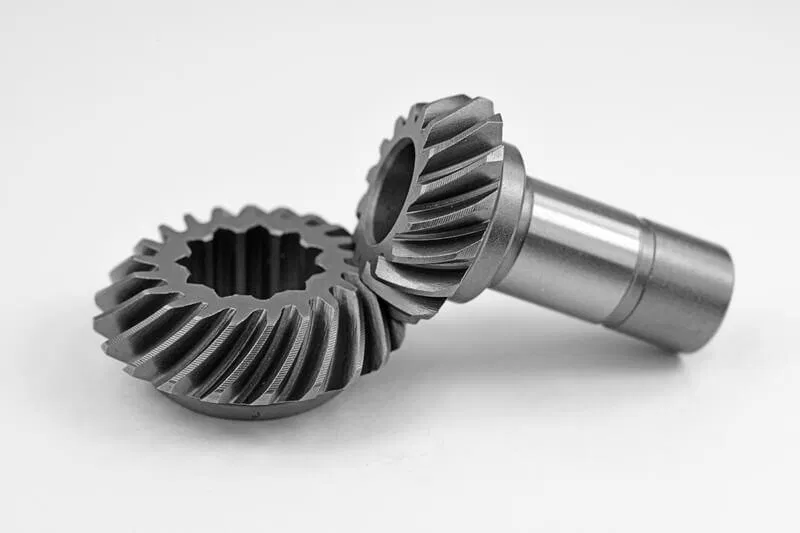
Wenlio Gear focuses on bevel gears and power-transmission components. Guided by our core values—Precision Transmission, Reliable Performance—we deliver high-quality solutions for agricultural machinery, heavy trucks, construction equipment, electric vehicles, and industrial automation. Beyond cutting and grinding, our manufacturing stack integrates cold forging to achieve near-net geometries, excellent surface integrity, and high throughput for gear hubs, sleeves, and preforms used in bevel gear systems.
2.What Is Cold Forging?
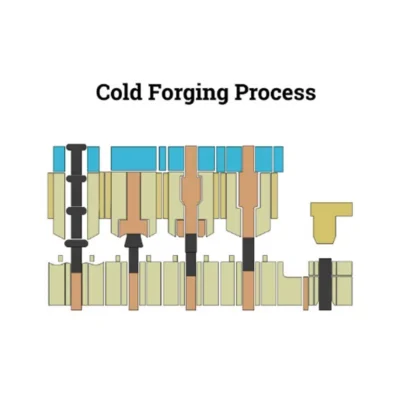
Cold forging includes cold heading, cold extrusion, and closed-die forging performed below the metal’s recrystallization temperature. Starting from wire, rod, or disk blanks, the process plastically displaces material into precision dies to form 3D features. As a result, it’s well suited for hubs, sleeves, and tooth preforms that support bevel gearsets.
Typically, forgeable materials include:
-
Steels: low/medium-carbon and low-alloy structural grades
-
Nonferrous: aluminum and selected copper alloys
So why does this help bevel-gear programs?
-
Near-net shape reduces cutting stock and shortens cycle time.
-
Improved surfaces and a work-hardened skin can enhance durability.
-
Repeatability and volume efficiency support stable quality at scale.
3.Where Cold Forging Fits in Bevel-Gear Manufacturing
Cold forging complements tooth cutting and grinding in two main routes:
-
Preform route for finished bevel gears
First, forge hubs, collars, bosses, and tooth preforms. Then finish the teeth by bevel cutting (e.g., face milling or face hobbing). Finally, use lapping or grinding to hit the final NVH and contact-pattern targets. -
Near-net toothed components
Alternatively, forge near-net parts around bevel gearsets—such as splined sleeves, star hubs, differential/axle sleeves, and clutch races—so they need little or no follow-on machining as supports, couplers, or carriers.
4.Process Building Blocks
4.1 Forward & Backward Extrusion
First, use forward/backward extrusion to control wall thickness and fillets when forming deep sleeves and internal cavities. As a result, it works well for axle and differential modules that mate with bevel gears.
4.2 Heading / Upsetting
Next, heading/upsetting efficiently forms shaft shoulders, hubs, and multi-step features. Then, it feeds cleanly into extrusion or final tooth-finishing steps.
4.3 Split-Flow (Divided-Flow) Forging
When the die needs better corner fill, split-flow forging intentionally divides material flow. This helps fill root corners and complex regions, while lowering peak tonnage and stabilizing geometry for later bevel-tooth finishing.
4.4 Closed-Die (Flash-less) Forging
Finally, closed-die (flash-less) forging uses a sealed cavity to produce near-net, flash-free parts with strong fiber flow. So it’s a solid fit for differential hubs, e-axle sleeves, power-divider components, and other elements around spiral or straight bevel gearsets.
5.Materials & Heat-Treat Stack
Low/medium-carbon and low-alloy steels for forgeability and strength
Carburizing, nitriding, or induction hardening on critical flanks/roots after finishing
Through-hardening where uniform properties are preferred
Optional shot peening at roots to boost bending fatigue
Outcome: a tough core with hard wear surfaces, supporting long life and stable performance in bevel-gear drivetrains.
6.Tolerances, QA, and Finishing
6.1 Finishing strategy
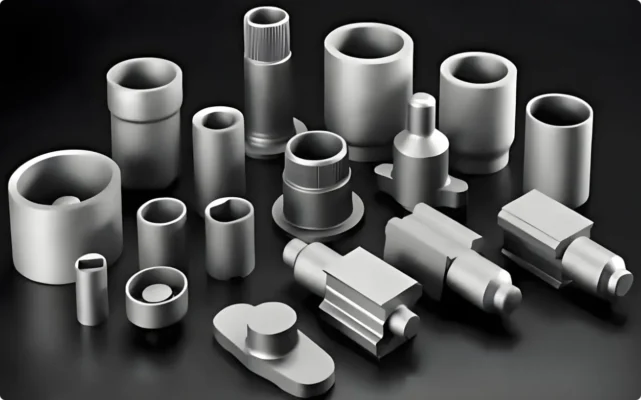
Cold-forged surfaces are already strong and smooth, so we tailor finishing to the duty:
-
First, keep parts as-forged when robust, cost-focused function is sufficient.
-
Next, use calibrating/sizing to hold tight fits, roundness, and runout.
-
Then, apply bevel cutting (face milling/face hobbing) with light stock to achieve precise tooth geometry.
-
Finally, add lapping, grinding, or superfinishing when NVH targets are stringent—especially for quiet cabins in trucks and EVs.
6.2 Inspection & verification
To close the loop, we verify three layers of evidence:
-
Geometry – runout, concentricity, tooth thickness (for toothed parts), and profile/lead/pitch after finishing.
-
Metallurgy – case depth, microhardness traverse, and retained austenite where required.
-
Process – press tonnage traces, die-wear audits, lubricant lot control, plus full traceability.
7.Digital Engineering: Simulation-Led Dies & Cycles
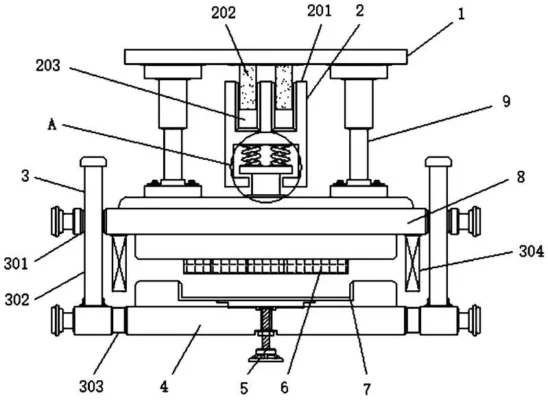
We use 3D finite-element (FE) simulation to design preforms, flash-less cavities, and press cycles. In practice, the model maps material flow, strain, stress, and velocity so we can:
-
First, ensure complete fill in root and corner regions around tooth-adjacent geometry.
-
Next, reduce peak forming loads and die stress to protect tooling life.
-
Then, tune fillets, land lengths, lubrication, and ejection for stable production.
-
Finally, plan sizing/calibration steps early to avoid downstream surprises.
8.Advantages & Trade-offs of Cold Forging
8.1 Advantages
-
First, near-net or net shape reduces machining to a minimum.
-
In addition, excellent surface integrity and directional fiber flow support durability.
-
At scale, high throughput helps deliver consistent quality in volume.
-
Finally, material efficiency improves the buy-to-fly ratio.
8.2 Trade-offs
-
However, the process benefits most from clean steel and suitable chemistries.
-
Also, precision tooling raises upfront cost, so ROI is strongest at scale.
-
And because the process window is tight—lubrication, press dynamics, and temperature—you need disciplined control to hold repeatability.
9.What “Good” Looks Like in Bevel-Gear Programs
Fully filled root/edge regions on sleeves and hubs that interface with bevel gears
Reduced press loads and longer die life via split-flow tactics
Stable roundness/runout for quiet meshing after finish
Consistent microfinish to lower early-life wear and heat
Heat-treat + finish stack tuned for torque, duty cycle, and NVH
10.Wenlio Use Cases
10.1 Agricultural Machinery
Agricultural drivetrains often need high-volume PTO couplings, spline sleeves, and gearbox hubs. So cold-forged preforms reduce machining time, while carburized or induction-hardened surfaces resist dust, shock, and long duty cycles.
10.2 Heavy Trucks (On-/Off-Highway)
For heavy trucks, differential hubs, star hubs, and power-divider sleeves sit around spiral/straight bevel gearsets. Accordingly, closed-die and split-flow preforms help stabilize geometry so that NVH stays consistent after bevel cutting and lapping.
10.3 Construction Equipment
Construction duty brings winch/hoist hubs, slewing sleeves, and heavy spline couplers that support bevel-gear angles. To handle shock and field service, we specify robust fillets and apply selective induction hardening where impact loads concentrate.
10.4 Electric Vehicles (EVs)
EV packaging pushes compact e-axle sleeves, differential couplers, and toothed preforms around spiral bevel sets. So simulation-led split-flow forging ensures complete fill, and then grinding/superfinishing helps keep cabin NVH low.
10.5 Industrial Automation
Industrial automation relies on right-angle gear units, robotic joints, and precision couplings built around bevel interfaces. As a result, cold-forged near-net parts can minimize machining and improve concentricity for smoother, more repeatable motion.
11.lustrative Capability Window
| Feature | Cold-Forged Range (typ.) | Notes |
| OD | ~Ø 10–120 mm | Larger by design review |
| Length | up to ~150 mm | Aspect-ratio dependent |
| Tooth module | up to ~m 3–4 (near-net) | Higher as preform + finish cut |
| Tolerances | IT8–IT10 as forged | Tighter with sizing/finish |
| Materials | Low/med-carbon, low-alloy, Al/Cu | Heat-treat per duty cycle |
12.From Prototype to Volume: Wenlio Workflow
Feasibility & DfM — geometry, material, duty, volume, finishing route
Simulation & die design — preforms, split-flow/closed-die, press/load map
Tooling & trials — first-article forging, fill verification, load validation
Finish route — bevel cutting (face milling/hobbing), sizing, heat treat, lap/grind/superfinish
PPAP/FAI — dimensional + metallurgical pack, functional torque/NVH checks
Ramp — SPC on critical features, die-maintenance plan, lot traceability
13.Conclusion
Cold forging gives Wenlio a powerful lever to deliver precision bevel-gear components with consistent transmission quality and long-term reliability. Combined with simulation-led tooling, disciplined heat-treat/finish stacks, and full QA, it turns demanding right-angle drives—across agriculture, trucks, construction, EVs, and industrial automation—into stable, high-value products.
Ready to evaluate a bevel-gear part for cold forging—or a hybrid route with finish cut and lap/grind? Contact us.
