
Blogs, Bevel Gear
Bevel Gear Heat Treatment: Process and Selection
May
Introduction
Bevel gear performance is never decided by geometry alone. Tooth form, mounting condition, and contact pattern all matter, but heat treatment often decides whether the gear can keep that performance in real service. A bevel gear may look correct on a drawing and still wear too fast, run noisy, or lose contact stability if the material and hardening route do not match the application.
At Wenlio Gear, heat treatment is one of the key links between design intent and field reliability. Buyers usually ask about hardness first, but hardness alone is only part of the story. The more useful questions are broader: how much wear resistance is needed, how much core toughness is required, how sensitive the part is to distortion, and what kind of service load the gear will face. This article looks at bevel gear heat treatment from that practical angle, so process selection makes sense before production starts.
What Is Bevel Gear Heat Treatment?
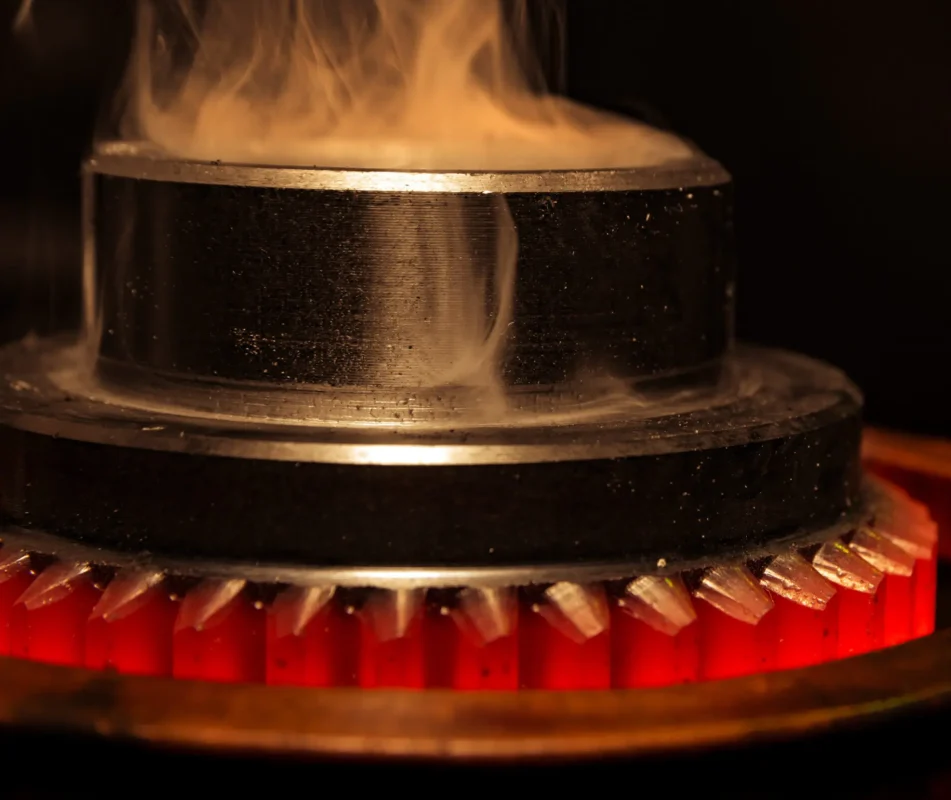
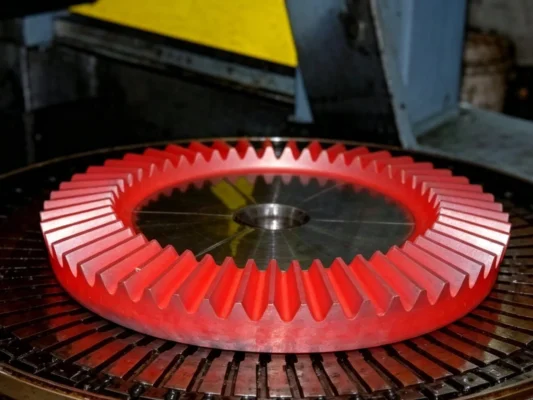
Bevel gear heat treatment is the controlled heating and cooling process used to give a bevel gear the surface hardness, core toughness, and dimensional stability it needs in service.

Why Heat Treatment Matters for Bevel Gears
Because bevel gears work under repeated load.
A bevel gear tooth sees contact stress on the flank and bending stress near the root. If the treatment is too weak, the surface may wear early. If the balance is wrong, the tooth may lose fatigue life.
Because harder is not the whole answer.
A hard surface is useful, but hardness alone does not guarantee a good gear. The gear also needs enough core support, enough toughness, and enough stability after treatment.
Because bevel gears are sensitive to distortion.
A little movement after heat treatment can change contact pattern, backlash, and noise. That is why process choice affects not only durability, but also finishing and assembly.
Common Heat Treatment Processes for Bevel Gears
| Process | What it does | Best fit | Main caution |
| Carburizing | Creates a hard case and keeps a tougher core | High-load bevel gears and long-life applications | Usually brings more distortion risk |
| Nitriding | Hardens the surface by nitrogen diffusion | Precision gears that need better dimensional stability | Case is shallower, so load target matters |
| Induction hardening | Hardens selected areas quickly | Parts that need local surface strengthening | Depth and heating path must be controlled carefully |
| Through hardening | Hardens the section more uniformly | Simpler or moderate-duty gears | Less ideal when the design needs a hard case plus a tougher core |
These are the common routes buyers usually compare. None of them is “best” in every case. The right choice depends on how the gear will actually run.
Who Usually Needs to Understand Heat Treatment Choice
- Buyers comparing custom gear quotations
- Design engineers choosing material and target life
- Process engineers planning machining and finishing
- Quality engineers checking hardness and case depth
- Assembly teams watching distortion and contact stability
- Service teams trying to reduce wear, pitting, or early failure
Heat treatment may be defined by engineering, but its result affects the whole project.
How Carburizing, Nitriding, Induction Hardening, and Through Hardening Differ
Carburizing for Bevel Gears
Carburizing is often used when the gear needs a hard surface for wear resistance and a tougher core underneath. That is why it appears so often in high-load transmission work. It gives strong support for flank durability and fatigue life.
The trade-off is distortion. Carburized bevel gears often need closer control after heat treatment, especially if the set will be ground, lapped, or matched by contact pattern.
Nitriding for Bevel Gears
Nitriding is often chosen when buyers want good surface performance but less geometry change after treatment. Because the process usually runs at a lower temperature than carburizing, it is often linked with better dimensional stability.
That does not mean nitriding is always the better choice. It still depends on load, required hardening depth, and whether the chosen material suits the process.
Induction Hardening for Bevel Gears
Induction hardening is useful when only certain zones need stronger surface hardness. It can work well when the application does not need a deep full case across the whole tooth.
The key issue is control. If depth, path, or transition areas are not stable, performance may vary from part to part.
Through Hardening
Through hardening changes the section more uniformly. It is simpler in concept and can work for moderate-duty applications where a full-section property is acceptable.
Its limit is also clear. It is usually not the first choice when the design needs strong flank wear resistance together with a tougher supporting core.
What Good Heat Treatment Improves
| Design goal | What improves | Why it helps |
| Better wear resistance | A harder, more stable tooth flank | Reduces surface damage and wear |
| Better fatigue life | Stronger support under repeated load | Lowers the risk of pitting and tooth failure |
| Better contact stability | Less distortion and better finishing control | Helps maintain backlash and contact quality |
| Better service reliability | A process that fits the real duty cycle | Reduces field complaints and early failure |
| Better production consistency | Better alignment between process and inspection | Makes prototype and batch results easier to compare |
A good heat treatment plan should support how the gear will work in the machine, not just how the hardness number looks in a report.
How to Choose the Right Heat Treatment Before Production
- Start from the real load case. High torque, repeated loading, shock, and long service life usually need a different answer than moderate-duty industrial use.
- Ask about distortion early. On bevel gears, distortion can change tooth contact, backlash, and noise after hardening.
- Confirm what hardness data will be supplied. Surface hardness alone may not be enough. Some projects also need core hardness or effective case depth.
- Match material and heat treatment together. The process should never be judged alone. Material grade and performance target need to be reviewed as one package.
- Ask how the result will be checked. A useful supplier should explain how hardness, case depth, dimensional stability, and if needed contact behavior will be verified.
Why Choose Us
Wenlio Gear supports precision bevel gear projects with a focus on geometry stability, practical process planning, and inspection evidence that reflects real service requirements.
For bevel gear heat treatment, the useful discussion starts with the application, not only the hardness target. That means looking at load, wear mode, distortion sensitivity, finishing route, and assembly expectations together.
This makes it easier to choose a process that fits the real transmission job, and easier to keep production consistent once the project moves forward.
FAQ
Q1: What is the best heat treatment for bevel gears?
A: There is no single best answer. The right process depends on load, speed, wear target, fatigue requirement, distortion sensitivity, and finishing route.
Q2: Why is carburizing common for high-load bevel gears?
A: Because it can give a hard wear-resistant case with a tougher core underneath, which helps under repeated contact and bending load.
Q3: Why do some buyers choose nitriding instead?
A: Nitriding is often chosen when lower distortion and better dimensional stability are more important.
Q4: Is hardness enough to approve heat treatment quality?
A: No. Hardness matters, but buyers may also need to review core hardness, case depth, distortion impact, and how the gear behaves after treatment.
Q5: What should buyers confirm before production starts?
A: They should confirm the material, heat-treatment route, hardness target, case-depth requirement if needed, distortion expectations, and inspection format.
Conclusion
Bevel gear heat treatment is not just a step after machining. It is one of the decisions that shapes wear resistance, fatigue life, contact stability, and service reliability. Carburizing, nitriding, induction hardening, and through hardening all have their place, but the right choice depends on the real job the gear has to do.
If you are selecting a heat-treatment route for a bevel gear project, comparing process options, or reviewing a drawing before production, you are welcome to Contact Us with your application details and technical requirements.

Pingback: How to Choose Materials for Bevel Gears - wenlio.com
Pingback: What Should Buyers Approve Before Gear Mass Production? - wenlio.com