
Blogs, Bevel Gear
The Characteristic and Application of Spiral Bevel Gear
Oct
1.Meta Description
A practical guide to spiral bevel gears—how they work, why they’re quiet and durable, and where they excel across modern drivetrains.
2.Wenlio Gear at a Glance
At Wenlio Gear, we focus on bevel gears and right-angle power-transmission components. Guided by “Precision Transmission, Reliable Performance,” we deliver engineered gearsets and sub-assemblies for agricultural machinery, heavy trucks, construction equipment, electric vehicles (EVs), and industrial automation. If you’re looking for a precision gear manufacturer and custom gear supplier with real-world application depth, you’re in the right place.
3.What Makes a Spiral Bevel Gear “Spiral”?
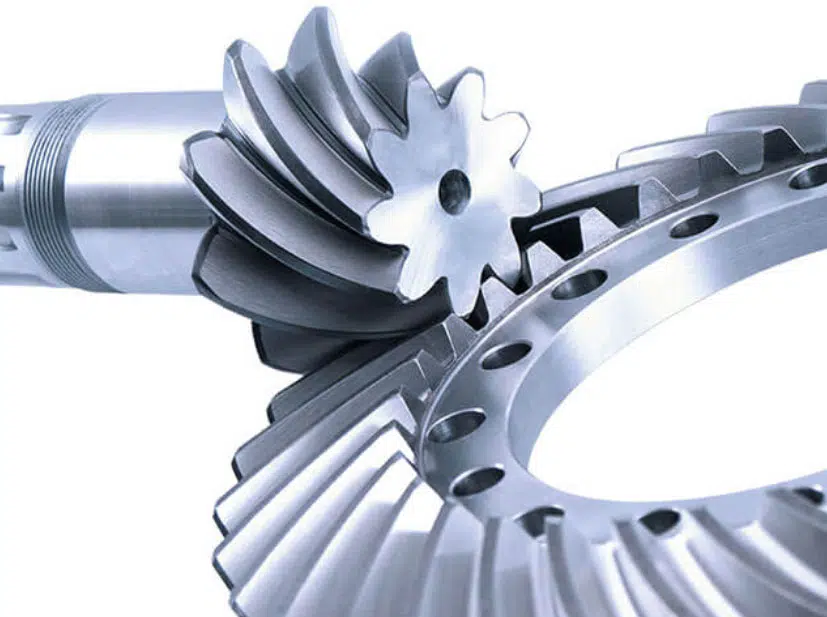
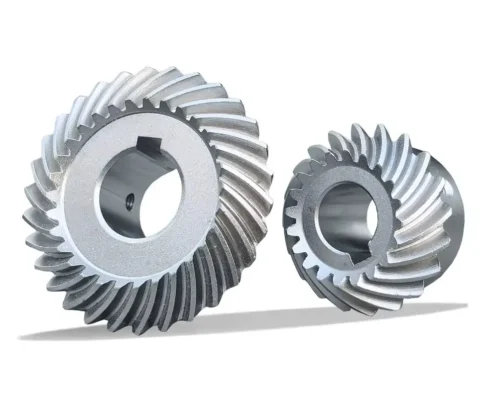
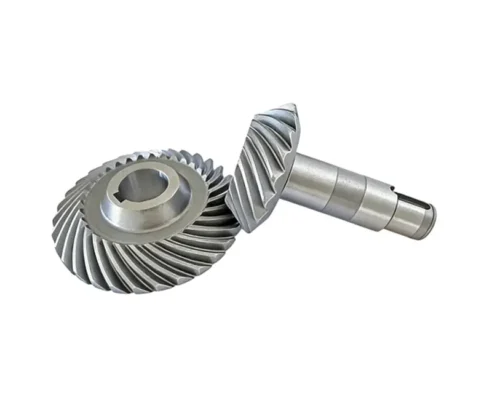
Unlike straight bevel gears, spiral bevels use curved (helical) teeth laid out on the pitch cone. As a result, contact transitions progressively—point to line and back to point—as the teeth roll into and out of mesh. That progressive engagement is what end users actually notice: smoother torque hand-off, quieter running, and higher load capacity in a compact right-angle package.
In practical terms, the core benefits show up as:
-
Smooth & quiet operation – Because engagement is gradual, impact loading and gear whine drop, especially at higher speed—which is why spiral bevels are a strong fit for EVs and cab-quiet trucks.
-
High load-carrying capacity – Since more than one tooth shares load over a longer contact band, root stress falls and durability improves.
-
Efficiency at speed – With steadier rolling action, spiral bevels can maintain high efficiency where straight bevels tend to “sing.”
-
Precise motion control – When tooth contact is accurate and backlash is controlled, positioning and torque delivery stay consistent.
-
Compact & robust – So you get high torque density at right angles, saving space versus belts/chains and simplifying packaging.
-
Long service life – Finally, the right heat-treat and finishing stack improves wear resistance and keeps micro-geometry stable over time.
4.Engineering Notes that Matter on the Shop Floor
To get the most out of spiral bevels, design and manufacturing need to work in lockstep. In practice, teams focus on five linked controls:
-
Tooth micro-geometry – First, use profile/lead crowning and controlled bias so you prevent edge contact and reduce early pitting.
-
Mounting distance & pattern – Next, remember that even small mounting errors can shift the contact patch. So we dial this in during lapping and inspection to keep noise low at operating speed.
-
Backlash targets – Then, set backlash tight but not choking, based on torque ripple, thermal expansion, and lubrication behavior.
-
Materials & heat treat – Meanwhile, most programs use a carburized case over a tough core; however, nitriding or induction hardening can fit specific duty cycles when distortion or localized hardening matters.
-
Finishing – Finally, lapping or grinding refines tooth flanks for low NVH, and superfinishing becomes an option when you need premium quietness.
5.Where Spiral Bevel Gears Excel
5.1 Agricultural Machinery
Implements, PTO angle drives, and right-angle gearboxes benefit from quiet torque delivery and compact packaging around hydraulic and mechanical subsystems. Spiral bevels handle muddy, shock-laden duty while keeping operator fatigue and pass-by noise low.
5.2 Heavy Trucks (On-/Off-Highway)
Differentials, power dividers, and auxiliary angle drives demand load sharing and NVH control over long mileage. Spiral bevels’ curved teeth reduce whine at cruise and distribute torque spikes from grade climbs and frequent start-stop cycles.
5.3 Construction Equipment
Winches, slewing/rotation drives, and high-torque reducers need robust flanks and predictable contact. Spiral bevels deliver smooth motion for crane rotation or excavator swing mechanisms while absorbing transient shocks from real-world loads.
5.4 Electric Vehicles (EVs)
With no engine masking, EVs expose gearbox acoustics. Spiral bevels support quiet e-axle differentials and compact angle drives with high efficiency under sustained high rpm—exactly where straight bevels are most challenged.
5.5 Industrial Automation
Right-angle gear units and robotics benefit from low backlash, repeatable contact, and small form factors. Spiral bevels ensure precise motion and consistent torque in servo-driven joints and indexing axes.
6.Typical Performance Advantages vs. Straight Bevel
| Attribute | Spiral Bevel | Straight Bevel |
| Tooth engagement | Gradual (lower impact) | Instant (higher impact) |
| Load sharing | Multiple teeth in contact | Fewer teeth share load |
| NVH at speed | Lower gear whine | Higher gear whine |
| Efficiency (high rpm) | High & stable | Can drop with noise rise |
| Setup sensitivity | Requires precise setup | More forgiving |
| Unit cost | Higher (geometry/finishing) | Lower (simpler to produce) |
Bottom line: When quietness, efficiency, and durability matter—especially at higher speeds—spiral bevel usually wins. For low-speed, cost-sensitive angle drives, straight bevel can be a rational choice.
7.Selecting the Right Spiral Bevel for Your Program
Speed & torque: Define continuous and peak conditions—this sets flank finish, case depth, and backlash policy.
Noise targets: Cabin and pass-by limits determine how aggressively to lap/superfinish and how tightly to hold mounting distance.
Packaging: Shaft centers, offsets, and housing stiffness influence microgeometry choices (crowning, bias).
Lubrication: Match base oil and additives to load and temperature; over-greasing can aerate and raise noise.
Verification: Pattern checks, profile/lead charts, and runout/concentricity data tie the build to measured NVH.
8.Quality Fundamentals You Should Expect
Dimensional control: Runout, concentricity, and fit tolerances held to drawing throughout heat treat.
Tooth accuracy: Verified profile/lead/pitch with inspection charts included.
Case integrity: Controlled surface carbon and effective case depth (Eht); microhardness traverses and retained-austenite checks as required.
Traceability & repeatability: Lot-tracked materials, finishing, and lapping parameters for consistent field performance.
9.Applications Snapshot
Spiral bevel gears are proven across automotive differentials, aerospace actuation, machine tools, printing presses, marine propulsion, and robotic joints. The combination of quiet, efficient torque transfer and compact right-angle geometry explains their long list of wins—from oilfield drives and steel-rolling gearboxes to elevator drives and mining machines.
10.Conclusion
Spiral bevel gears convert right-angle geometry into quiet, efficient, high-load transmission—exactly what modern drivetrains demand. With the right microgeometry, heat treat, and finishing, they deliver stable contact patterns, low NVH, and long life across agriculture, trucks, construction equipment, EVs, and industrial automation.
Have a drawing or target spec? Let’s align on speed/torque, NVH, and finishing to get you a clean, production-ready bevel set.Contact us.
