
Blogs, Bevel Gear
Why Won’t Two Bevel Gears With the Same Ratio Mesh?
Jul
Two bevel gears may have the same transmission ratio and look similar in size, yet still fail to mesh correctly. They may bind, rotate unevenly, produce unusual noise, or show poor tooth contact after installation.
This happens because the ratio describes only the relationship between tooth counts. It does not fully define the tooth geometry, shaft arrangement, spiral direction, or installation conditions of a bevel gear pair.
At Wenlio, bevel gears are reviewed as mating transmission parts, especially when drawings are incomplete or only one worn sample is available.
Quick Answer
Two bevel gears with the same ratio are not automatically compatible.
Correct meshing also depends on the gear type, module or diametral pitch, pressure angle, shaft angle, pitch cone geometry, spiral angle, spiral hand, mounting position, and condition of the mating gear. Buyers should provide drawings or samples of both gears whenever possible, together with tooth counts, assembly information, application details, and the required quantity.
What Does the Gear Ratio Actually Tell You?
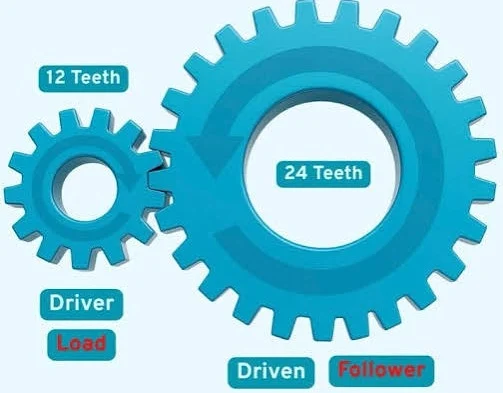
The gear ratio is usually determined by the tooth counts of the pinion and gear.
For example, a 20-tooth pinion driving a 40-tooth gear has a nominal ratio of 2:1. The ratio helps engineers understand the intended speed relationship, but it does not describe the complete tooth form or installation geometry.
A 20-tooth pinion and 40-tooth gear form a 2:1 ratio. A 25-tooth pinion and 50-tooth gear also form a 2:1 ratio. These two sets may still use different modules, pressure angles, shaft angles, or spiral parameters.
The same ratio is useful project information, but it is not enough to prove that two bevel gears can work together.
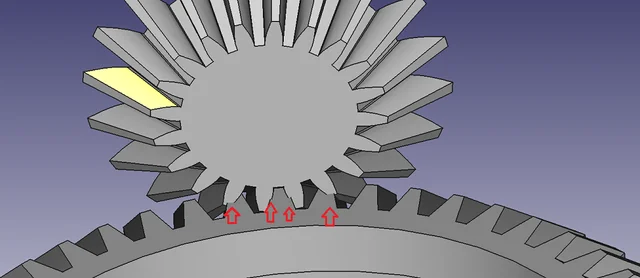
Why Can Bevel Gears With the Same Ratio Fail to Mesh?
Different Gear Types
Straight bevel gears, spiral bevel gears, Zerol bevel gears, and hypoid gears use different tooth structures and operating geometries.Buyers who are unsure about the original tooth form can first compare the practical differences between straight bevel gears and spiral bevel gears.
A straight bevel gear cannot be paired with a spiral bevel gear simply because the tooth counts are similar. A hypoid set also cannot normally replace an intersecting-axis bevel gear set because hypoid gears operate with a shaft offset.
The original gear type must therefore be identified correctly using the tooth direction, shaft arrangement, mating part, and application.
Different Tooth Geometry
Two bevel gears need compatible tooth geometry, not just a matching ratio.
Key parameters include:
- Module or diametral pitch
- Pressure angle
- Tooth system and tooth thickness
- Addendum and dedendum geometry
- Any intentional tooth modification
Module or diametral pitch determines the basic tooth size and spacing.For a clearer explanation of how tooth count and tooth size relate, see What Is Module of a Bevel Gear? Pressure angle affects the tooth profile and force direction. If these values do not match, the teeth may not engage correctly even when the ratio is the same.
When no complete drawing is available, sample measurement or additional equipment information may be required.
Different Shaft and Pitch Cone Geometry
Bevel gears are designed around the relationship between two shafts.
Many sets operate at a 90-degree shaft angle, but this is not universal. Some applications use other intersecting angles, while hypoid gears use non-intersecting shafts with an offset.
The shaft arrangement affects the pitch cone geometry of both gears. A pair designed for one shaft angle may not work in a housing with another angle, so buyers should provide the shaft angle, any offset, and the assembly layout.
Incorrect Spiral Angle or Spiral Hand
For spiral bevel and hypoid gears, the spiral angle and spiral hand are essential matching conditions.
The pinion and gear must follow the hand relationship required by the original design. Buyers should provide clear photos of both sides, the installation direction, the mating gear, tooth counts, and any available spiral-angle information.
Different Assembly or Mating Conditions
Bevel gear performance depends on both the manufactured parts and their installed positions.
Axial movement of the pinion or gear can change the operating clearance and tooth contact position. A new gear may fit the bore, shaft, and housing while still being positioned incorrectly.
Useful information may include mounting distance, bearing position, housing dimensions, shim arrangement, target backlash, and existing contact-mark information.
The retained mating gear also matters. Wear, pitting, deformation, or abnormal contact may affect a new replacement, while copying a worn sample may reproduce wear-related errors. Many replacement projects should therefore begin with both mating parts. See Why Matched Bevel Gear Sets Reduce Pairing Risks. 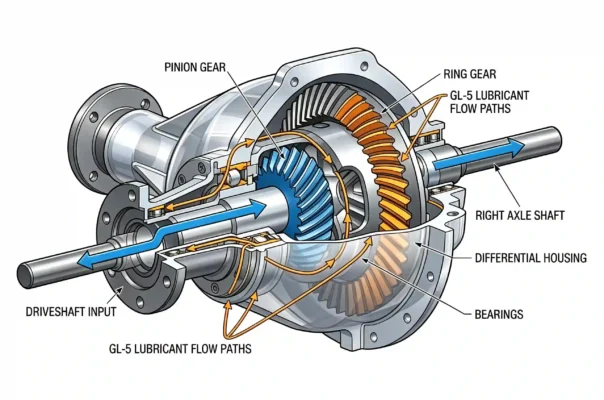
Common Situations That Cause a Mismatch
Common mistakes include:
- Choosing a replacement only because it has the same ratio
- Measuring only tooth count and outside diameter
- Sending only one worn gear for evaluation
- Assuming every bevel gear set uses a 90-degree shaft angle
- Treating a custom spiral or hypoid set as a standard interchangeable part
What Should Buyers Provide Before Ordering?
| Information | Why It Matters |
| Drawings or samples of both gears | Helps confirm the complete mating relationship |
| Tooth counts and ratio | Confirms the intended speed relationship |
| Module or diametral pitch | Defines the basic tooth size |
| Gear type and pressure angle | Helps confirm tooth-profile compatibility |
| Shaft angle and offset | Defines the transmission arrangement |
| Spiral angle and spiral hand | Confirms tooth direction and pairing |
| Assembly and mounting information | Helps review the installed position |
| Application, quantity, and project stage | Supports prototype and production planning |
When drawings are unavailable, buyers should provide multi-angle photos, both mating samples, major dimensions, assembly photos, machine information, operating conditions, and visible wear. Photos support an initial judgment but do not always replace sample measurement.
Can You Replace Only One Bevel Gear?
In some projects, replacing only one bevel gear is possible. However, this should not be decided from the visible damage alone.
The retained gear should be checked for wear, pitting, deformation, broken teeth, unusual contact marks, and previous repairs. Replacing one gear may be reasonable when the mating part remains acceptable and the original design information is clear.
A complete pair review is usually more appropriate when:
- Both gears show significant wear
- The drawing is incomplete or unavailable
- The existing parts have been modified
- The set uses special spiral or hypoid geometry
- The original mounting information is uncertain
- The project requires stable repeat production
The decision should be based on both parts, the available technical information, and the application.
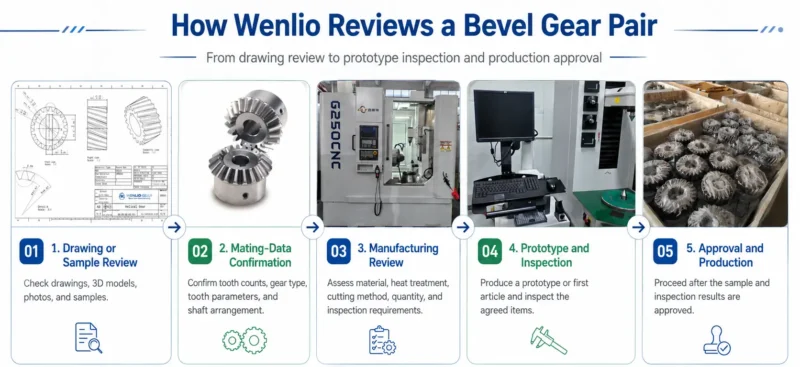
How Wenlio Reviews a Bevel Gear Pair
Wenlio does not determine compatibility from the ratio alone. A typical review includes:
- Drawing or sample review:Check available drawings, 3D models, photos, and physical samples.
- Mating-data confirmation:Confirm tooth counts, gear type, tooth parameters, shaft arrangement, and missing information.
- Manufacturing review:Assess material, heat treatment, cutting method, quantity, and inspection requirements.
- Prototype and inspection:Produce a prototype or first article when required and inspect the agreed items.
- Approval and production:Proceed after the sample and inspection results have been approved.
Depending on the project, inspection may include critical dimensions, runout, tooth geometry, backlash, contact checks, or trial assembly with the mating gear.
Why Choose Wenlio?
Wenlio supports custom bevel gear projects from technical review through prototyping, inspection, and production planning. The manufacturing route is reviewed according to the gear type, drawings, mating information, material, heat treatment, quantity, and future demand. Final compatibility should be based on confirmed technical information and an agreed validation plan.
FAQ
Can Bevel Gears With the Same Tooth Count Mesh?
Not necessarily. Matching tooth counts do not confirm the module, pressure angle, pitch cone geometry, spiral parameters, or assembly conditions.
Is the Same Module Enough for Bevel Gears to Mesh?
No. The same module indicates a similar basic tooth size, but it does not confirm the pressure angle, shaft angle, spiral hand, pitch cone relationship, or mounting position.
Can I Replace Only One Gear in a Bevel Gear Pair?
Sometimes. The remaining gear should first be evaluated for wear, damage, and compatibility. If the drawings are incomplete or both parts are significantly worn, reviewing the complete pair is usually more reliable.
Does Spiral Hand Matter for Spiral Bevel Gears?
Yes. The left-hand or right-hand relationship must follow the original design. An incorrect spiral hand may prevent proper assembly or result in unsuitable tooth contact.
What Should I Send If No Drawing Is Available?
Provide both mating samples whenever possible, together with multi-angle photos, tooth counts, major dimensions, assembly photos, machine information, operating conditions, and the required quantity.
Conclusion
Two bevel gears with the same ratio are not automatically compatible. The ratio describes only the tooth-count relationship, while successful meshing also depends on the gear type, tooth geometry, shaft arrangement, spiral direction, assembly position, and condition of the mating parts.
For a replacement or custom project, contact Wenlio and send drawings or sample photos of both gears, tooth counts, assembly information, application conditions, and the required quantity. Complete information helps identify compatibility risks and supports a suitable prototype, inspection, and production plan.
