
Blogs, Bevel Gear
Why Do High-Precision Bevel Gears Cost More?
Jul
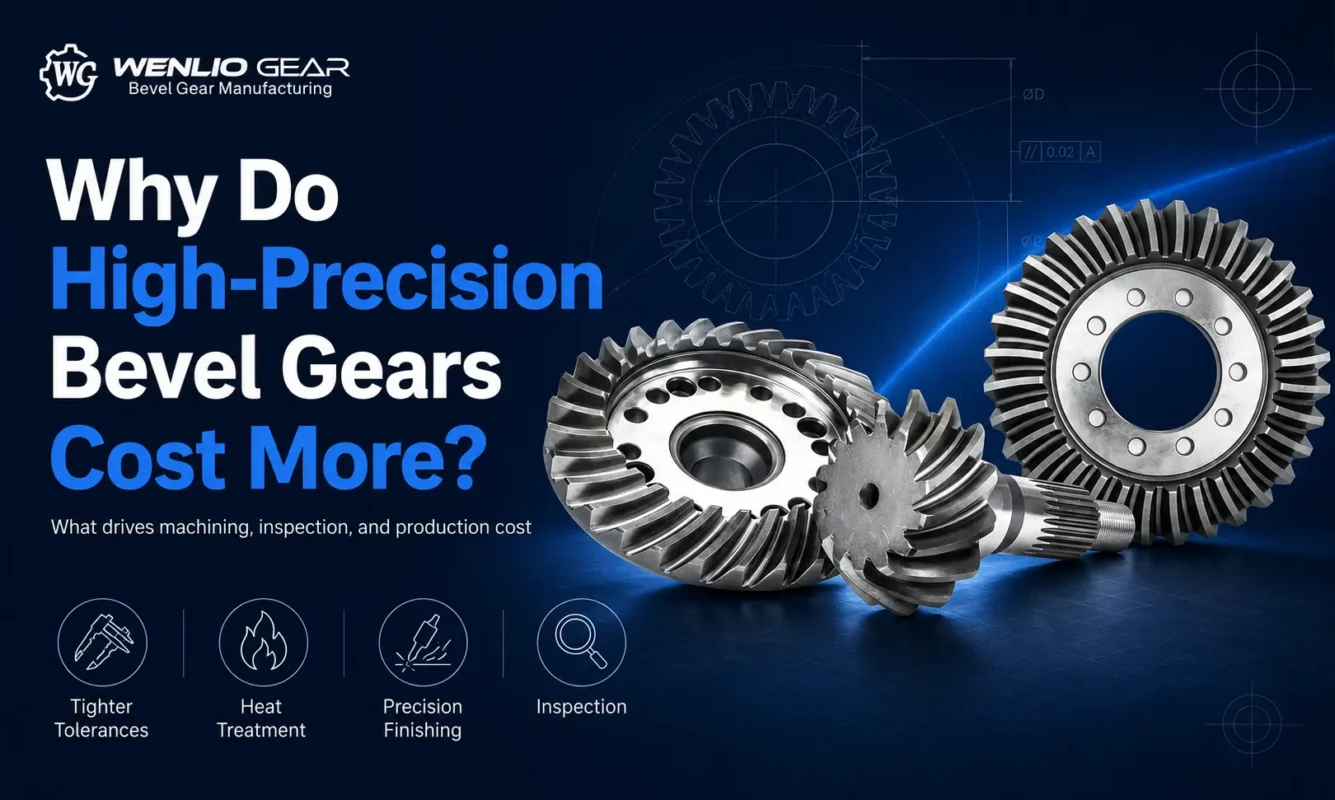
Bevel gears with similar dimensions and materials can still receive very different quotations. Bevel gear cost depends not only on size and material, but also on accuracy grade, heat treatment, finishing method, pairing requirements, inspection scope, and order quantity.
As a precision gear manufacturer, Wenlio evaluates each project according to its drawing, operating conditions, and acceptance criteria. Quotations can only be compared fairly when suppliers are working to the same technical scope.
Quick Answer
High-precision bevel gears generally cost more because they require tighter process control, better management of heat-treatment distortion, additional finishing, more inspection, and a higher risk of rework or rejection.
However, the highest accuracy grade is not always the best choice. The requirement should match the actual speed, load, service life, noise target, assembly conditions, and project budget.
What Factors Affect Bevel Gear Cost?
| Factor | Effect on Cost |
| Accuracy grade | Tighter tolerances require more stable equipment, tooling, and process control. |
| Heat treatment | Carburizing or hardening may cause distortion and require correction. |
| Finishing | Lapping, grinding, or other hard-finishing processes add machining time. |
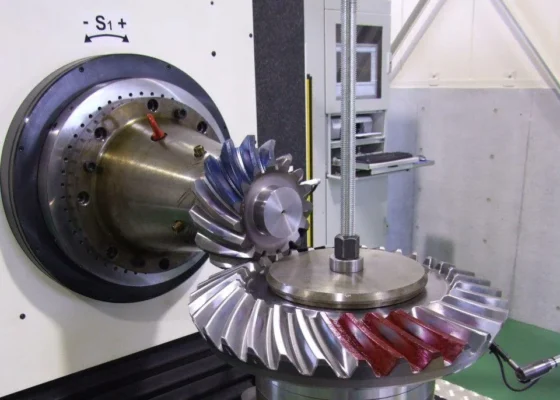
| Pairing | Matched sets may require rolling inspection, backlash measurement, and identification. |
| Inspection | Tooth geometry, runout, hardness, and inspection reports add work. |
| Order quantity | Prototypes and small batches spread setup costs across fewer parts. |
The main cost driver is not the grade number alone. It is the manufacturing and inspection work required to achieve and verify that grade.
How Does the Manufacturing Route Affect Bevel Gear Cost?
Different bevel gear projects may require different manufacturing routes. A simple delivery route may be enough for one project, while another may need paired running, hard finishing, or a complete inspection package.
When Cutting Alone May Be Enough
This route involves fewer operations and may suit standard-accuracy, low-speed, or non-critical applications.
When heat treatment follows gear cutting, the drawing should clarify whether the specified accuracy applies before heat treatment or to the final delivered part.
Matched-Pair Lapping
Lapping is mainly used to improve tooth contact and running smoothness between a gear and pinion. It may involve:
- Pairing the gear and pinion
- Rolling inspection
- Contact pattern adjustment
- Pair identification and set management
Lapping improves the meshing condition of the pair, but it does not fully correct every individual tooth geometry deviation.
Related reading: Why Do Bevel Gears Need Lapping After Cutting?
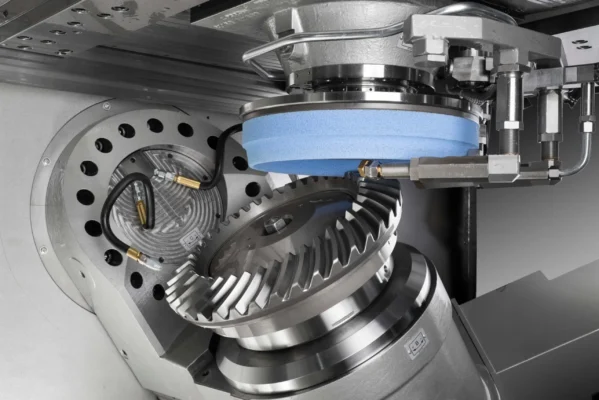
Grinding After Heat Treatment
Heat treatment can change dimensions and tooth geometry. If a high final accuracy is required, grinding or another hard-finishing process may be necessary.
These operations require more capable equipment, precise workholding, longer machining time, and additional inspection. As a result, they normally increase the quotation.
Why Does Heat Treatment Increase Cost?
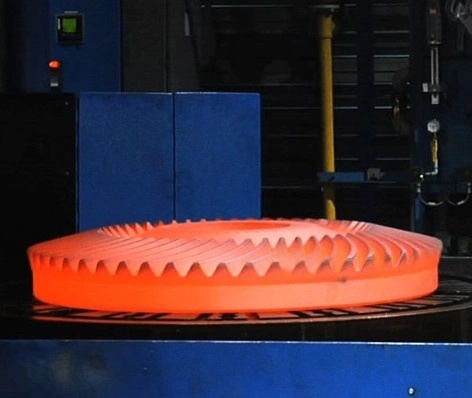
Heat treatment improves hardness and wear resistance, but it may also cause:
- Gear body distortion
- Bore or end-face deformation
- Datum movement
- Tooth geometry changes
- Batch-to-batch variation
To manage these risks, the manufacturer may need to adjust machining allowances, optimize loading methods, and add post-heat-treatment correction.
Testing requirements also affect cost. Hardness, effective case depth, metallographic inspection, and heat-treatment records all require additional equipment, labor, and documentation.
For this reason, two quotations using the same material and heat-treatment name may still include different manufacturing scopes.
Why Do Matched Bevel Gear Sets Cost More?
An individual bevel gear may meet its dimensional requirements but still produce unsuitable backlash or contact after assembly.
For spiral bevel or hypoid gears supplied as matched sets, the manufacturer may need to complete:
- Rolling inspection
- Backlash measurement
- Contact pattern confirmation
- Pair adjustment
- Pair identification
- Set packaging and traceability
These operations increase machine time and production management work.
Pair identification is especially important. If the original gear and pinion are mixed with other parts, their meshing condition may change even though the individual dimensions remain acceptable.
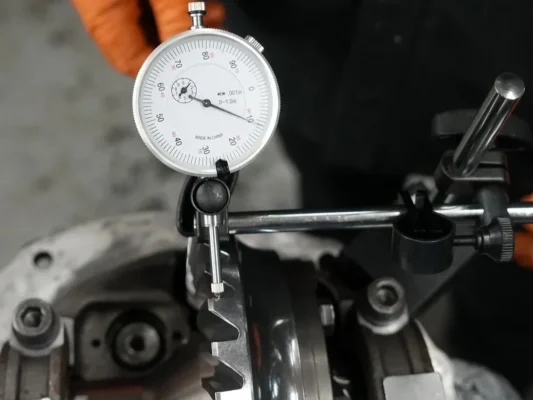
How Do Inspection Requirements Affect Bevel Gear Cost?
The statement “inspection report required” is too general. A basic dimensional report and a complete tooth-geometry report involve very different workloads.
Basic inspection may include:
- Outside diameter, bore, and thickness
- Critical mounting dimensions
- Tooth thickness
- General runout
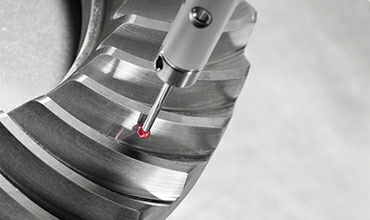
A more complete inspection may include:
- Pitch deviation
- Tooth surface geometry
- Composite rolling error
- Backlash results
- Contact pattern photographs
- Material certificates
- Hardness and case-depth reports
- First-article or batch inspection reports
The more detailed the inspection scope, the more measuring time and specialist equipment are required. Buyers should define report requirements during the RFQ stage rather than adding them after production.
Related reading: How to Read a Gear Inspection Report
How Does Order Quantity Affect Unit Price?
High-precision bevel gears normally require drawing review, process planning, tooling preparation, machine setup, first-piece cutting, and inspection.
These preparation costs occur whether the order is for a few prototypes or a larger production batch. In a small order, the cost is divided among fewer parts, so the unit price is higher.
Once production becomes stable, programs, tooling, and inspection plans can be reused. This usually reduces the unit cost.
For a more accurate quotation, buyers should provide:
- Prototype quantity
- Initial production quantity
- Estimated annual demand
This allows prototype and production pricing to be evaluated separately.
How Can Buyers Get a More Accurate Bevel Gear Quote?
A more accurate bevel gear quote starts with a clear technical scope. When suppliers receive only a drawing and quantity, they may price different assumptions for heat treatment, inspection, pairing, and finishing. That is why two quotations can look different even when the part name is the same.
Before requesting a quotation, buyers should prepare the information that affects manufacturing risk and acceptance requirements:
- 2D drawings, 3D models, or a clear sample reference
- Final delivery accuracy and the standard used for acceptance
- Material, heat treatment, hardness, and case-depth requirements
- Whether the gear is supplied as a single part or a matched set
- Backlash, contact pattern, and mounting distance requirements
- Inspection report type and documentation expectations
- Prototype quantity, production quantity, and estimated annual demand
- Application details such as speed, torque, lubrication, and operating environment
These details help the manufacturer separate necessary controls from optional ones. They also help buyers compare quotations based on the same scope, instead of comparing a basic machining offer with a full manufacturing and inspection package.
How Can Buyers Avoid Over-Specifying Accuracy?
Common specification mistakes include:
- Copying a high accuracy grade from an old drawing
- Applying a cylindrical gear standard to a bevel gear
- Requiring full inspection without identifying critical features
- Assuming noise or service life depends only on accuracy grade
- Using the same inspection scope for prototypes and production
A better approach is to provide the operating conditions:
- Speed
- Torque and shock load
- Required service life
- Noise or smoothness target
- Assembly structure
- Lubrication conditions
- Operating environment
- Expected annual demand
The supplier can then identify which features require tighter control and which can use standard tolerances.
What Should Buyers Confirm When Comparing Quotations?
| Comparison Item | What to Confirm |
| Accuracy | Standard, revision, grade, and final delivery condition |
| Manufacturing route | Whether grinding, lapping, or other finishing is included |
| Pairing | Individual parts or fixed matched sets |
| Inspection | Backlash, contact pattern, and tooth geometry requirements |
| Documentation | Material, hardness, heat treatment, and inspection records |
| Quantity | Separate prototype and production prices |
| Packaging | Pair identification, rust protection, and set packaging |
The lowest quotation does not always represent the lowest total cost. If pairing, inspection, or documentation is excluded, extra charges and lead-time changes may appear later.
Why Choose Wenlio?
Wenlio focuses on custom bevel gears and related gear projects. Each manufacturing route is reviewed according to the drawing, application, target accuracy, and order quantity.
The review may cover:
- Material and heat-treatment requirements
- Post-heat-treatment finishing
- Individual or matched-pair delivery
- Backlash and contact pattern requirements
- Prototype and production inspection scope
- Documentation and traceability
When some specifications are not yet finalized, buyers can provide the drawing, mating gear information, operating conditions, and estimated quantity. Wenlio can assess manufacturability and inspection needs before quotation, helping reduce unnecessary tolerances and missing acceptance requirements.
FAQ
Q1: Does a Higher Accuracy Grade Always Cost More?
It usually increases cost, but the actual difference depends on gear size, material, heat treatment, manufacturing route, and inspection scope.
Q2: Do High-Precision Bevel Gears Always Require Grinding?
No. Some projects can meet their functional requirements through stable gear cutting and matched-pair lapping. Grinding depends on the final accuracy and heat-treatment condition.
Q3: Why Are Matched Gear Sets More Expensive?
Matched sets may require rolling inspection, backlash measurement, contact pattern checking, adjustment, identification, and set management.
Q4: Do Inspection Reports Affect the Quotation?
Yes. Basic dimensional reports have a limited cost impact, while complete tooth-geometry inspection, contact pattern records, and heat-treatment documentation require more time and equipment.
Q5: How Can Buyers Reduce Bevel Gear Cost?
Select the accuracy level according to actual operating conditions, avoid unnecessary full inspection, and provide complete drawings, quantities, and acceptance criteria.
Conclusion
Bevel gear cost is determined by accuracy, heat treatment, manufacturing route, pairing, inspection, and order quantity, not not by one grade number alone.
When comparing quotations, buyers should confirm that every supplier is pricing the same technical scope.Contact us to send your drawing, operating conditions, expected quantity, and inspection requirements for a manufacturability and inspection-scope review.
