
Blogs, Spur Gear, Helical Gear
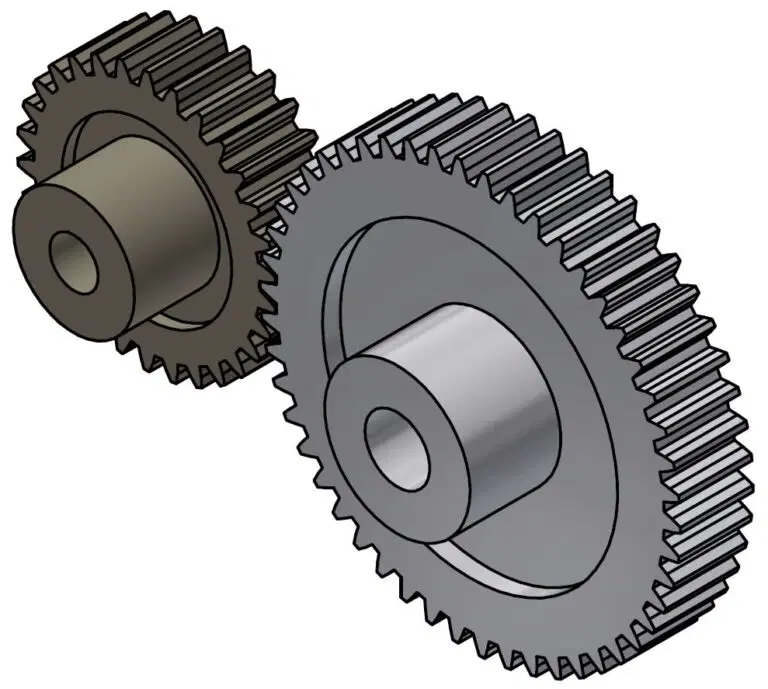
Spur Gears Explained: Design, Materials & Applications
Oct
1. Introduction
At Wenlio Gear , we focus on bevel and high-precision gearing and deliver precision transmission, reliable performance for agricultural machinery, heavy trucks, construction equipment, electric vehicles (EVs), and industrial automation. While bevel gears are our core strength, spur gears remain fundamental building blocks across many systems we support—especially where parallel shafts, simplicity, efficiency, and easy service are priorities.
This guide clarifies spur-gear structure, key design choices, materials and heat treatment, the manufacturing flow, typical defects, and where spur gears still make the most sense today.
2. What Is a Spur Gear?
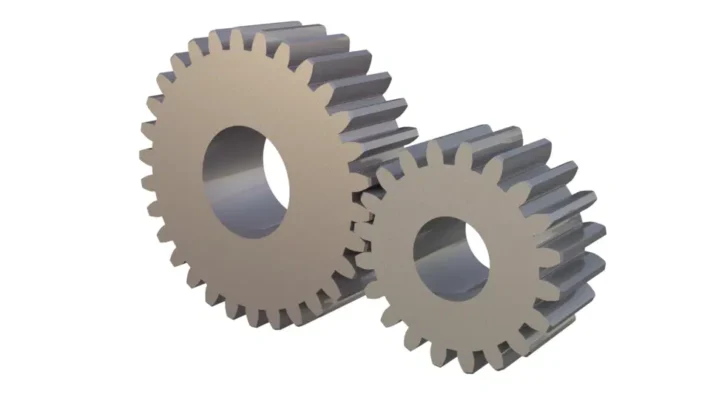
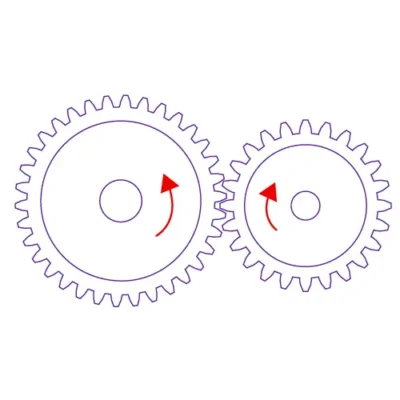
A spur gear is a cylindrical gear with straight teeth parallel to the axis of rotation. It meshes with another spur gear on a parallel shaft, transmitting torque through line contact along the tooth flank.
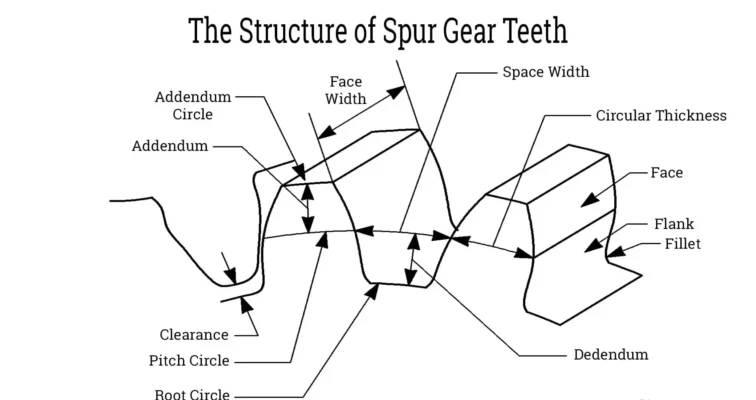
Core geometry you’ll see on drawings:
Pitch circle: the theoretical rolling circle where two gears effectively “touch.”
Addendum / Dedendum circles: tip and root boundaries of a tooth.
Face width: axial width; wider face spreads load.
Module / Diametral pitch: tooth size scaling.
Because of the simple tooth form and parallel-shaft layout, spur gears are efficient, compact, and economical—ideal wherever high efficiency and straightforward maintenance matter more than ultra-low NVH.
3. Key Characteristics
Strengths
-
With good lubrication, spur gears can run at high efficiency (often ~97–98% per mesh).
-
Because the geometry is simple, they’re easy to design and manufacture, with predictable cost and lead times.
-
In addition, they’re straightforward to inspect and service, with clear metrology for profile, lead, and pitch.
-
And they position well between parallel shafts, with low-backlash options available.
Trade-offs
-
However, NVH tends to rise with speed because tooth entry is more instantaneous than a helical’s gradual roll-in.
-
Also, the overlap ratio is lower than helical gearing, so each engaged tooth can see higher stress.
-
Finally, spur gears only support parallel shafts—no inherent right-angle capability.
Design note
So when speed or cabin noise is critical (for example, EV e-axles), designers often choose helical or planetary stages. That said, spur gears still shine in auxiliary drives, low-speed reductions, and compact, cost-sensitive mechanisms.
4. How We Classify Spur Gears
4.1 material
Metal (steel, stainless, brass, aluminum): highest strength and temperature capability.
Engineering polymers (POM/Acetal, PA, PEEK): low noise, light weight; for modest torques.
Composites / PM (powder metal): cost-effective near-net shapes for volume programs.
4.2 tooth profile
Straight-tooth spur (standard): simplest and most common.
High-contact-ratio spur: modified geometry for smoother running and improved load sharing.
4.3 mounting configuration
External spur: teeth on the outer cylinder (most common).
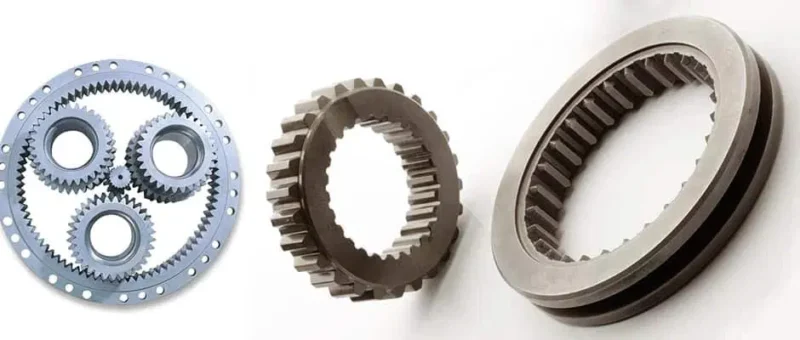
Internal spur: teeth on the inner surface—typical in planetary ring gears to save space.
5. Material & Heat-Treat Choices
| Application context | Typical materials | Heat treatment | Why choose it |
| High torque / long life (trucks, construction) | 20MnCr5 / 18CrNiMo7-6 | Carburize + quench + temper, hard grind | Deep case, high contact strength, tough core |
| Mixed load, serviceable (agriculture) | 40Cr / 42CrMo4 (4140) | Q&T + selective induction | Impact tolerance; targeted hard tracks |
| Precision / low distortion (EV auxiliaries, automation) | 38CrMoAlA | Nitriding | Very low distortion, high surface hardness |
| Quiet, light, corrosion-aware (devices) | POM, PA, PEEK | Optional thin films / none | Low noise, light weight, easy to mold or machine |
Practical tips
Carburized steel is the workhorse for high contact stress and long life; plan grind stock to correct distortion.
Nitriding keeps geometry stable—valuable when tight mesh and NVH matter.
For polymers, temperature/humidity and creep must be modeled; coatings (e.g., DLC-like) can extend life in boundary lubrication.
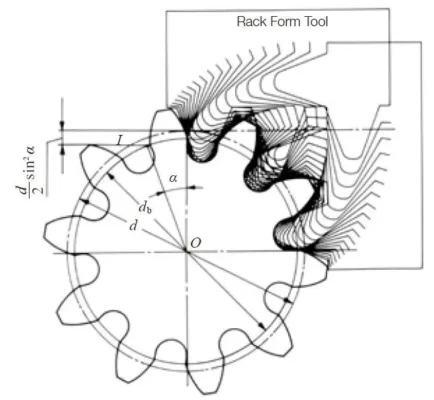
6. Manufacturing Overview
Blank preparation — forged/rolled steel or PM compact; normalize if cold-worked.
Rough machining — turn hubs/bores; establish datums; pilot oil features if needed.
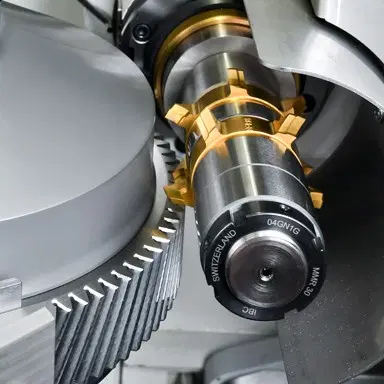
Gear cutting — hobbing for most spur gears; shaving/skiving for refinement.
Heat treatment — carburize/induct/nitride to match duty and NVH targets.
Finishing — grinding/honing to final accuracy and surface; superfinish where required.
Inspection — profile/lead/pitch charts, runout, hardness traverses, roughness, and contact pattern verification at mounting distance.
Green manufacturing note: dry/MQL hobbing and vacuum carburizing + gas quench reduce scatter and lower environmental impact—aligned with Wenlio’s quality and sustainability goals.
7. Common Spur-Gear Defects & Prevention
Pitting (contact fatigue): inadequate surface hardness, poor film thickness, or misalignment.
Prevent with proper case depth, smooth flank finish, and correct oil viscosity/film control.
Tooth breakage (root bending): stress concentration at small fillets or inclusions/low core toughness.
Use generous fillets, clean steel, and validated core hardness.
Scuffing / galling: high sliding with thin oil films or rough surface.
Improve finish, use EP lubricants, and maintain correct backlash.
Vibration marks (chatter lines): instability in cutting or insufficient rigidity.
Stiffen fixturing, tune speed/feed to stability lobes, reduce finishing stock.
Wenlio’s lot package can include tooth-form charts, microhardness traverses, and contact-pattern images, so issues are caught before assembly.
8. Where Spur Gears Fit in Wenlio’s Five Sectors
8.1 Agricultural machinery
PTOs, seeders, straw choppers, and auxiliary drives benefit from robust, serviceable spur stages. We favor carburized and ground flanks for contact life, plus sealed housings that tolerate dust and mud. When budgets or maintenance access drive design, spur gears offer a clean cost–performance win.
8.2 Heavy trucks
Inside transmissions and auxiliaries (e.g., PTOs, pumps), spur gears deliver simplicity and efficiency. Where cabin NVH is strict, we use tight profile/lead limits, controlled case depth, and superfinished flanks to minimize noise and wear.
8.3 Construction equipment
Winches, hoists, mixers, and small reducers rely on durable spur stages that handle intermittent shocks. We combine Q&T cores with induction-hardened teeth or deep carburized cases, depending on module and space.
8.4 Electric vehicles (EVs)
While high-speed reducers lean helical/planetary, spur gears are still used in auxiliary and low-speed reductions where packaging and efficiency dominate. For these, Wenlio controls runout, surface finish, and backlash to keep whine orders low.
8.5 Industrial automation
In indexing drives and compact mechanisms, precision spur gears provide repeatable motion with straightforward metrology. Nitrided steels help preserve geometry for long service intervals.
9. Practical Design Notes
Fillets & root relief: generous fillets reduce bending stress; use profile modifications to avoid edge loading.
Backlash & micro-geometry: enough backlash for oil film; small crowning to center the patch.
Mounting distance control: validate the contact pattern at the specified center distance; include target and tolerance on the print.
Surface finish: polished flanks (or honed) lower initial wear and noise; journals/bores should meet bearing and seal specs.
Lubrication & cleanliness: oil viscosity, EP additives, filtration, and seal strategy matter as much as metallurgy.
10. Inspection: what to check before release
-
First, report profile/lead/pitch results against the required grade.
-
Then, verify runout/concentricity to the main datum.
-
In addition, record surface roughness (Ra/Rz) on flanks and journals.
-
Where applicable, include hardness and case-depth (Eht) traverses with clear acceptance ranges.
-
Next, check the contact pattern at the design mounting distance (light bluing).
-
Finally, lock traceability for material heat, furnace load, and key finishing parameters.
Packaging – Wenlio can align these QA artifacts with your PPAP/FAI templates when required.
11. Conclusion
Spur gears remain a practical, efficient, and maintainable solution across industries—especially where parallel shafts, predictable cost, and easy inspection are priorities. The difference between an average spur gear and a great one lies in matched metallurgy and heat treatment, thoughtful micro-geometry, clean finishing, and evidence-based QA.
If you’d like Wenlio to review a drawing or propose a material + process stack for your next spur gear or mixed geartrain, Contact Us.
