
Bevel Gear
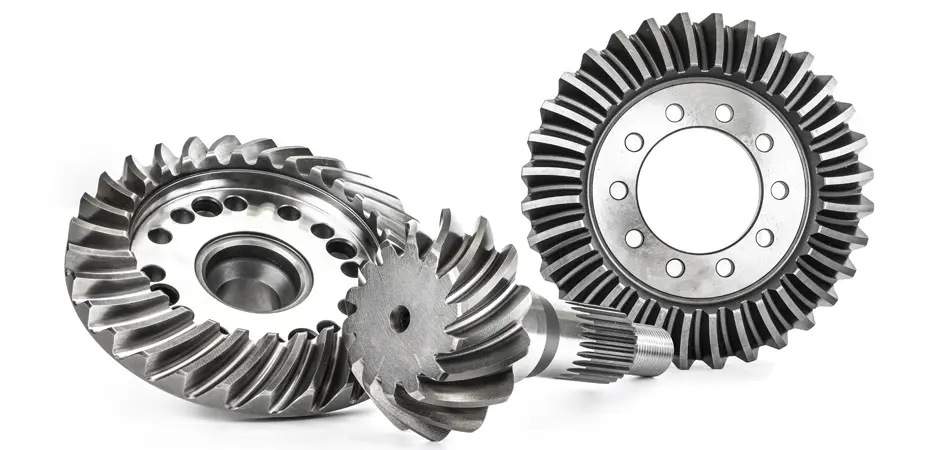
Custom Bevel Gear Solutions for High-Performance Applications
Oct
1.Introduction
At Wenlio Gear, our core promise is precision transmission, reliable performance. We specialize in bevel/right-angle and high-precision gearing for agricultural machinery, heavy truck, construction equipment, electric vehicle (EV), and industrial automation. Standard catalog bevel gears don’t always fit modern performance, packaging, or NVH targets. That’s where custom bevel gear solutions—spiral, straight, or hypoid—deliver measurable gains in torque capacity, durability, and quiet operation.
2.Why custom bevel gears?
Off-the-shelf gears work well for prototypes, but high-duty programs demand tighter control over geometry, metallurgy, surface condition, and tolerances. That’s why custom solutions help you:
-
First, match the duty cycle by sizing tooth form, contact ratio, and module to the real torque–speed spectrum.
-
Next, control NVH with tuned micro-geometry (lead crown, profile mods) and mounting distance so contact patterns stay centered.
-
In addition, extend life through deeper case depth, cleaner steel, and superfinished flanks and journals.
-
Meanwhile, meet packaging constraints—space envelope, bearing spans, shaft angles, and lubrication paths—unique to your gearbox.
-
Finally, harden for the environment, whether mud, dust, salt, or elevated temperature, by selecting the right heat-treat and finishing stack.
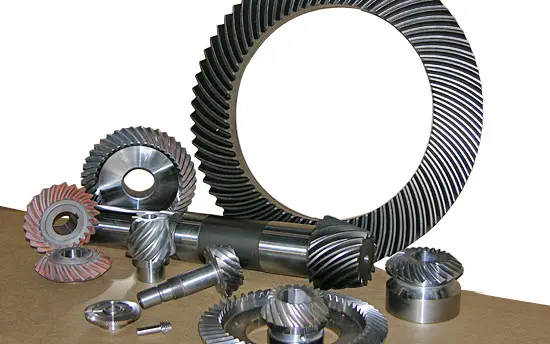
3.Choosing the right bevel type
| Type | Teeth & mesh | Best for | Notes |
| Straight bevel | Straight teeth, line contact | Low–moderate speed, simpler gearboxes | Lower cost, higher impact load at mesh entry; louder at speed |
| Spiral bevel | Curved teeth, gradual contact | High speed/torque, low NVH | Smoother, higher contact ratio, tighter manufacturing |
| Hypoid | Spiral + offset axes | High torque, packaging freedom | Sliding contact, great ratio in one stage, careful lube selection |
Wenlio engineers help you map shaft angle, ratio, torque, speed, NVH, oil strategy, and cost to an optimal choice.
4.Key design considerations
4.1 Gear geometry & micro-geometry
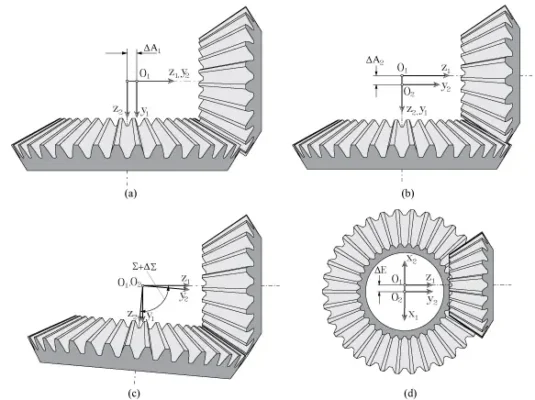
First, module, pressure angle, face width, and spiral/helix angle set the baseline capacity and efficiency. Then micro-geometry—lead crowning and profile modifications—recenters contact under load and reduces edge stress. Finally, define target mounting distance and backlash with clear tolerances, and validate the choices with a contact-pattern check.
4.2 Materials & heat treatment
Next, choose materials and heat treat as a matched stack:
-
20MnCr5 / 18CrNiMo7-6 (carburized + ground) for high contact strength and long life in trucks, construction, and EV duty.
-
42CrMo4 / 4140 (Q&T + induction) for a tough core with selective hard tracks—often cost-effective in agriculture and general industry.
-
38CrMoAlA (nitrided) when you need low distortion for precision automation.
In all cases, call out effective case depth (Eht), surface hardness, and core hardness directly on the drawing.
4.3 Surface engineering
After heat treat, grinding or honing to a target roughness (e.g., Ra 0.4–0.8 μm on flanks) helps shorten run-in and reduce noise. Where NVH is especially tight, add superfinishing. And for splines or corrosive environments, phosphate or DLC-like coatings can further mitigate fretting and wear.
4.4 Bearings, alignment, and lube
At the system level, bearing spans and stiffness drive mesh stability—less deflection typically means a more stable pattern. Equally important, lubricant choice (viscosity, EP package) and delivery (spray vs. splash, jet angles) can matter as much as the gear material itself.
5.Practical specification table
| Parameter | Typical target (tune per program) | Why it matters |
| Contact pattern | Centered and stable at operating load | Confirms mounting distance & micro-geometry |
| Surface hardness | HRC 58–62 (carburized) / nitrided equivalent | Wear & pitting resistance |
| Eht (case depth) | Sized to duty; e.g., 0.8–1.4 mm for truck hypoids | Prevents sub-surface fatigue |
| Flank roughness | Ra 0.4–0.8 μm (ground/honed) | Lower noise, better film formation |
| Runout to datum | ≤ 0.01–0.02 mm (gear & shaft seats) | Keeps pattern centered; reduces whine |
| Backlash window | Application-specific, controlled by class | Oil film + thermal growth margin |
Wenlio will tune these numbers to torque, speed, duty cycle, temperature, and NVH.
6.Manufacturing flow at Wenlio
-
Blank & conditioning – Start with forged/rolled steel with tight cleanliness control; then normalize or stress-relieve as needed.
-
Pre-cut machining – Next, turn hubs/bores and establish key datums; at the same time, mill lubrication features and manage residual stress for stable cutting.
-
Tooth cutting – Depending on geometry and volume, choose the right cutting route:
-
Gleason/Klingelnberg systems for spiral/hypoid sets;
-
Hobbing/shaping for straight bevels;
-
Skiving where geometry allows and cycle time benefits.
-
Heat treatment – Then apply the heat-treat stack that fits distortion and duty:
-
Vacuum carburizing + gas quench for low distortion and a uniform case;
-
Induction for selective hard tracks;
-
Nitriding when geometry stability is paramount.
-
Finishing – After heat treat, grind/hone teeth and OD-grind bearing/journal surfaces; and add superfinishing where NVH is critical.
-
Validation – Finally, close the loop with a complete evidence pack: profile/lead/pitch charts, microhardness traverse & Eht, contact pattern at mounting distance, runout/concentricity to datums, NVH spin checks (as required), plus full traceability (steel heat, furnace load, cutters, gages).
7.Typical defects & how custom design prevents them
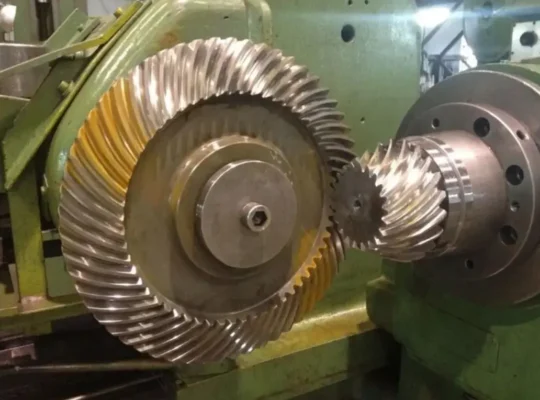
Edge loading / scuffing → Fixed by proper crowning, correct mounting distance, and oil jet direction.
Pitting / micro-spalling → Increase Eht, improve flank finish, and confirm lubricant film thickness.
Whine at specific orders → Tighten runout, refine micro-geometry, and re-check bearing stiffness.
Fretting at hub/spline → Deeper case under spline, anti-fretting coating, defined assembly lube and torque.
8.Applications we serve
8.1 Agricultural machinery
Agricultural PTO drives, wheel ends, and harvesters see mud, dust, and shock every day. So we build robust bevel stages with Q&T cores plus induction tracks or carburized-and-ground flanks. In addition, we specify generous fillets and route sealed lubrication paths to protect the mesh in dirty service.
8.2 Heavy truck
Truck axles, transfer cases, and PTOs demand long life and strict NVH control. Accordingly, we lean on vacuum carburizing, hard grinding, and superfinishing, while holding tight runout and tuned micro-geometry to keep order energy low.
8.3 Construction equipment
Cranes, winches, and slew drives face transient peaks and heat. To handle that, we use deeper cases with reinforced root radii, and we optimize bearing spans so contact patterns stay stable under load.
8.4 Electric vehicle (EV)
E-axles and auxiliaries run at high speed with a low noise floor. Therefore, we choose low-scatter heat-treat routes, honed/superfinished flanks, and careful backlash control to minimize whine.
8.5 Industrial automation
Right-angle precision drives need low distortion and repeatable mesh over long intervals. So we apply nitrided steels and hold mounting distance tightly, which helps extend service intervals and preserve positioning accuracy.
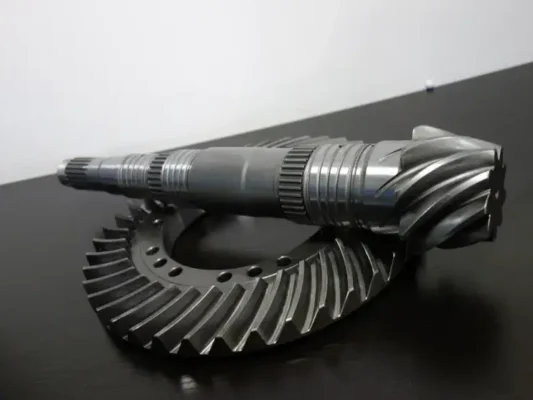
9.Case Overview — custom hypoid pair for an EV e-axle
Challenge
We needed to package a quiet, high-torque right-angle reduction for an EV e-axle under strict cabin NVH and tight thermal limits. At the same time, the unit had to absorb launch torque spikes, run continuously at high RPM, and fit a compact housing with fixed bearing spans.
Approach
-
Geometry – We selected a hypoid spiral bevel pair and tuned lead crowning plus profile relief for the real load map. Then we set a backlash window that supports film formation at operating temperature.
-
Metallurgy – We used vacuum-carburized 18CrNiMo7-6 with verified effective case depth (Eht) and controlled retained austenite. In parallel, we validated core toughness with Charpy to protect shock margin.
-
Finishing – We ground and honed tooth flanks to Ra 0.4–0.6 μm, and OD-ground + superfinished journals to keep bearings cooler. Finally, we controlled runout to primary datums at ≤0.01–0.02 mm.
Validation
We mapped contact patterns at mounting distance across multiple load points, then ran thermal-growth simulations over the duty cycle. After that, we used spin-rig NVH checks to track mesh orders/sidebands, and we completed full hardness traverses with Eht documentation.
Results
The program reduced whine orders across the operating band, increased pitting-life margin, and lowered bearing temperature at endurance load—meeting OEM targets with additional reserve
Performance metrics (EV e-axle hypoid)
| Metric | Requirement | Achieved |
| Peak input speed | 14,000 rpm | 15,200 rpm |
| Launch torque (gear mesh) | 2,200 Nm | 2,450 Nm |
| Surface hardness (flank) | HRC 58–62 | HRC 61–62 |
| Effective case depth (Eht) | 0.9–1.2 mm | 1.10 mm (±0.05) |
| Flank roughness (post-hone) | Ra ≤ 0.8 μm | Ra 0.5–0.6 μm |
| Pattern stability (hot) | Centered, no edge load | Pass |
| Spin-rig NVH (dB(A) at target orders) | ≤ spec | Pass with margin |
| Predicted pitting life (L10) | ≥ target | +22% margin |
10.Future-ready trends
Advanced materials & cleanliness: tighter inclusion control and retained austenite targets for longer fatigue life.
Low-scatter heat treat: LPC + gas quench recipes that reduce distortion and grinding stock.
Process-aware micro-geometry: coupling simulation with real cut/grind data to set crowning “right first time.”
Smart QA: condition-based inspection frequency and digital traceability tied to material/HT lots.
11.Conclusion
Custom bevel gears turn tight envelopes and harsh duty cycles into stable, high-value drives. The winning stack is consistent: a fit-for-purpose geometry and micro-geometry, duty-matched metallurgy and heat treat, clean finishing, and evidence-based QA. That’s how Wenlio delivers precision transmission, reliable performance—from the farm field and jobsite to long-haul routes and EV platforms.
Thinking about a bevel pair for your next right-angle drive—or upgrading a current design for life and NVH? Let’s review your drawing and duty cycle together.Contact Us.

Pingback: Gear Grinding vs Shaving vs Hobbing: Simple Guide - wenlio.com