
Blogs, Spur Gear, Helical Gear, Worm Gear
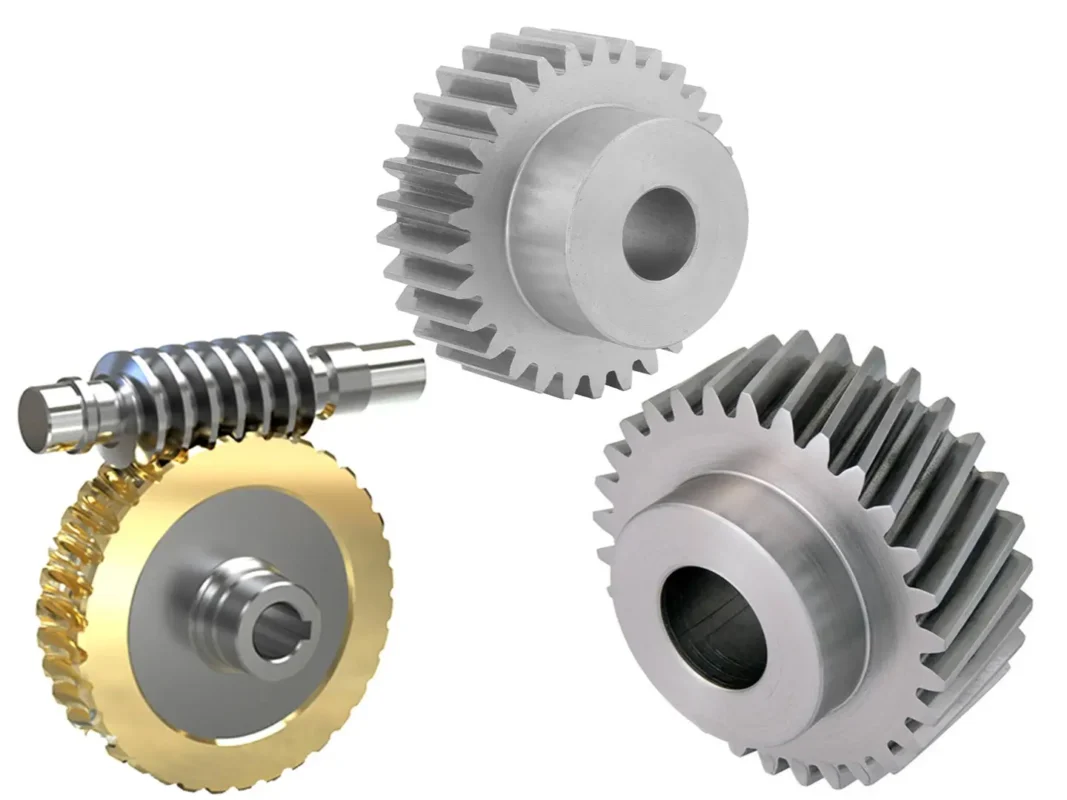
Differences between Worm Gear, Spur Gear and Helical Gear
Nov
Introduction
As a precision gear manufacturer and custom gear supplier, Wenlio Gear focuses on bevel gears. At the same time, our engineering team frequently helps customers decide between worm, helical, and spur stages that sit elsewhere in the drivetrain. The right choice is a physics-first decision shaped by duty cycle, envelope, lubrication, thermal path, and the evidence you can present. Some stages need quiet, efficient power on parallel shafts; others require high single-stage reductions in a right-angle layout or hold-at-rest behavior.
This article updates, extends, and adapts our earlier gear-selection brief for five sectors—Agricultural Machinery, Heavy Truck, Construction Equipment, Electric Vehicles (EV), and Industrial Automation—so you can move from opinions to testable choices.
Key differences between Worm vs. Spur vs. Helical Gears
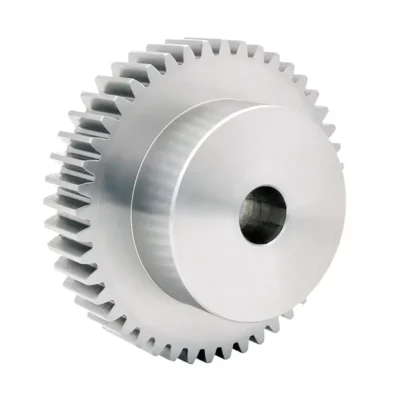
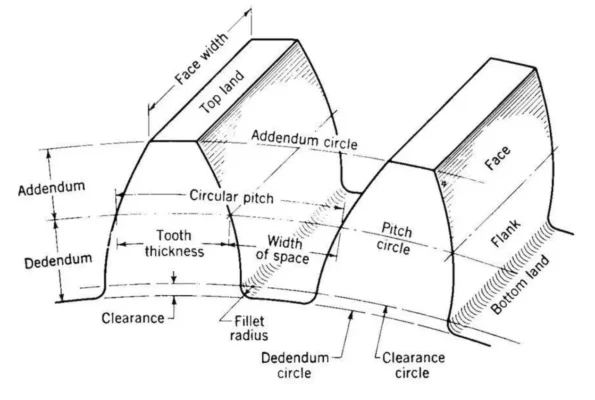
Spur (straight teeth, parallel shafts). Simplest, economical, efficient at modest speeds; noise rises at higher rpm due to abrupt tooth entry.
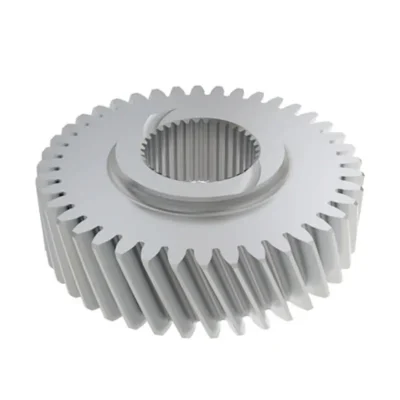
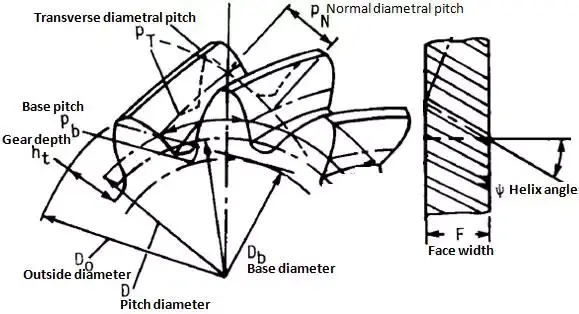
Helical (angled teeth, parallel or crossed). Gradual entry → smoother acoustics and higher load capacity; introduces axial force that bearings and housing stiffness must handle.
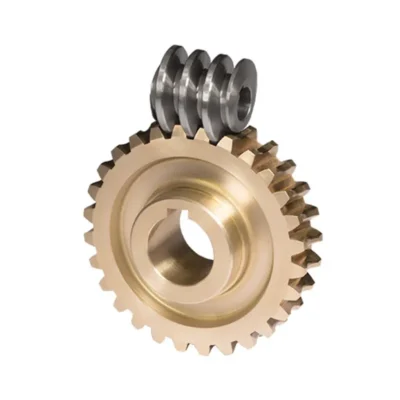
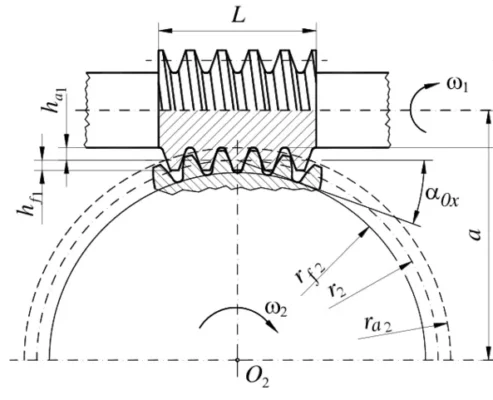
Worm (screw + wheel, right-angle). Very high ratios in one stage with potential back-drive resistance; sliding dominates contact → efficiency and heat management are central.
How they work
Spur. Involute teeth engage across the face width; single-stage ratios ~1:1–6:1 are typical. Great where serviceability and cost outrank acoustic targets.
Helical. Teeth at ~15–30° helix give longer contact lines and gradual load sharing. The default for quiet, efficient parallel shafts; design for thrust loads.
Worm. 90° orientation; ratio density ~5:1–300:1 enables compact reducers and hold-at-rest potential. Efficiency is limited by sliding; bronze wheels and solid thermal paths are common countermeasures.
Performance comparison
| Attribute | Spur | Helical | Worm |
| Shaft orientation | Parallel | Parallel or crossed | Right angle |
| Single-stage ratio | Low–moderate | Moderate | Very high |
| Efficiency | High (modest speed) | High (at speed) | Lower (sliding) |
| Noise / acoustics | Higher at speed | Low (gradual entry) | Low whine; heat to manage |
| Axial force | None | Yes (bearing load) | Minimal; thermal focus |
| Capacity | Moderate | High (contact line length & sharing) | High torque at low speed |
| Cost / complexity | Lowest | Medium | Highest (materials & cooling) |
Use the table to shortlist; then verify with drawings, pilot lots, and a written control plan.
Selection guidance from a custom gear supplier
Start with priorities. Quiet, efficient parallel → Helical. Big single-stage reduction/right-angle or hold-at-rest → Worm. Lowest piece cost where noise is secondary → Spur.
Check constraints. Envelope and bearing capacity (helical thrust); thermal design and oil flow (worm); cleanliness/filtration (all).
Plan evidence. Charts, contact patterns, effective case depth (Eht), hardness maps, CMM dimensions, and functional tests—decisions are only as strong as the proof behind them.
Materials & heat treatment (typical routes)
Spur/Helical – high duty. 16MnCr5 / 20MnCr5 / 18CrNiMo7-6 → carburize + quench + temper → grind/hone; consider superfinish where bearing heat or micro-acoustics demand it.
Spur/Helical – modest duty. Medium-carbon steels with induction on flanks/roots; finish as needed.
Worm pairs. Alloy-steel worm (surface hardened) + bronze wheel; oil must tolerate boundary lubrication and heat.
Size-critical parts. Nitriding or low-distortion carburizing preserves form with minimal post-HT correction.
Lubrication & thermal management
Spur/Helical. Select viscosity for speed/load; avoid churning/aeration; seals and breathers must match the environment (mud/water in agriculture, fine grit in construction).
Worm. Sliding contact makes oil and cooling central—EP packages, directed flow at the mesh, and heat paths in housings. Duty cycle (start-stop vs. steady) rules thermal design.
Cleanliness. Filtration and controlled breathers protect flanks; contamination triggers scuffing/pitting long before strength limits.
Tolerances, micro-geometry & acoustics
Backlash must reflect thermal growth and oil-film thickness—freeze cold vs. hot conditions in drawings.
Micro-geometry (helical). Profile/lead crown and bias keep contact centered and prevent edge loading.
Runout/concentricity. Manage through heat; helix error must meet the target grade.
Contact patterns. Verify at mounting distance and representative preload; worm sets need pattern checks under target compliance.
Functional datums. Treat bearing seats and spline hubs as real datums—not afterthoughts.
Sector field notes
Agricultural Machinery
In agricultural duty, dirt, shock, and long hours are common, so serviceability matters. For that reason, helical gears are typically used for primary reductions, while spur gears suit secondary stages or PTO drives. Meanwhile, worm gears are a practical option for right-angle augers/conveyors or positioners—especially when a hold-at-rest tendency is beneficial.
Tips: use carburized flanks on high-load sets; select oils tolerant to contamination; also size thrust bearings properly for helical stages; and specify defined chamfers to protect tooth edges.
Heavy Truck
In heavy-truck transmissions, you’re dealing with high torque spikes over long mileage, and noise targets are often explicit. Accordingly, helical gearing dominates the quiet parallel stages. In addition, worm drives can fit lifts/actuators that benefit from back-drive resistance, whereas spur gears are usually reserved for low-speed auxiliaries.
Tips: consider vacuum carburizing + grinding for clean flanks; keep runout tight to functional datums; and provide PPAP-ready charts plus contact patterns to prove build quality.
Construction Equipment
Construction equipment sees transient peaks, heat, and frequently bidirectional duty, so robustness under non-steady conditions is key. Typically, helical gears appear in slewing/rotation reducers; at the same time, worm gears help in compact right-angle “hold” layouts; and spur gears remain common in slow accessory trains.
Tips: aim for deeper case depth where feasible; reinforce roots/fillets; make sure oil jets actually reach the mesh off-design; and keep thrust loops stout.
Electric Vehicles (EV)
EV drivetrains run at high rpm with tight acoustic floors, therefore helical gears are preferred for e-axles and many accessories. By contrast, spur gears tend to be limited to low-speed or isolated duty. When compact right-angle accessories need large ratios, worm gearing can work—but watch thermal paths and heat rejection.
Tips: use low-scatter heat treatment (e.g., LPC + gas quench) to stabilize distortion; minimize grind stock; hold tight TIR; and use honed/ground flanks for consistency.
Industrial Automation
Industrial automation emphasizes precise motion in compact packaging, so control-friendly stiffness and repeatability come first. As a result, helical gears are common in quiet reducers and servo gearboxes. Where ratio density and hold-position are useful, worm gearing can be a good fit, while spur gears still work well in low-speed indexers.
Tips: align backlash windows with servo tuning targets; and keep surface finish consistent with duty so performance doesn’t drift between batches.
Selection matrix
| Need | Primary pick | Why it wins | Backup path |
| Quiet, efficient parallel stage | Helical | Gradual entry, high capacity, good acoustics | Spur if speed is modest and cost dominates |
| Large single-stage reduction at 90° | Worm | 5:1–300:1 in one stage; hold-at-rest potential | Multi-stage helical if efficiency is paramount |
| Lowest piece cost | Spur | Simple teeth; easy inspection | Helical is quieter but costs more |
| Limited bearing capacity for thrust | Spur / Worm | No or low axial force | Helical only with upgraded bearings |
| Tight packaging with a right-angle turn | Worm | Compact package | Crossed-axis helical if heat allows |
| Tight backlash & predictable contact | Helical | Tunable micro-geometry | Nitrided spur for low-speed cases |
Quality artifacts to request
First, ask for the basic inspection records that show the gear meets the drawing requirements, such as tooth accuracy charts for profile, lead, and pitch. Then, if heat treatment may affect geometry, also check key dimensions before and after heat treatment, including runout, concentricity, and helix error.
Next, review case integrity. This usually includes surface hardness, effective case depth sections, microhardness traverse, and retained austenite when required. After that, look for functional proof, such as light-load contact patterns at the mounting distance and backlash results within the required range.
Finally, make sure traceability is complete. In other words, you should be able to trace the material heat, furnace load, quench recipe, finishing parameters, and lot ID. If the project requires a higher documentation level, PPAP or FAI can also be provided.
Conclusion
Spur brings simplicity and cost, helical delivers efficient parallel-shaft performance with higher capacity, and worm compresses big ratios into right-angle packages with self-locking potential—when lubrication and thermal paths are engineered. Map your duty cycle, packaging, acoustics, and efficiency to the right combination of materials, heat treatment, micro-geometry, lubrication, and quality artifacts, then test.
Wenlio Gear remains focused on bevel gears and can help you integrate the chosen spur/helical/worm stage with bevel-gear angle drives and axle sets. Review our manufacturing depth, and governance, then Contact Us to translate torque/speed, noise, and cost targets into the right drive selection for Agricultural Machinery, Heavy Truck, Construction Equipment, EV, and Industrial Automation.
