
Blogs, Helical Gear
What Is a Helical Gear and How Does It Work?
Nov
1. Introduction
Helical gears are one of the most common ways to transmit power between parallel shafts.In this short guide, Wenlio Gear explains in simple terms:
-What a helical gear is
-How it works
-Where it is used
with a focus on the five main sectors Wenlio Gear serves.
2. What is a helical gear?
A helical gear is a cylindrical gear whose teeth are cut at a helix angle to the shaft, rather than straight across like a spur gear.
Two key differences from spur gears:
-The tooth line is slanted around the gear, forming a spiral.
-Teeth do not engage all at once; contact starts at one end of the tooth and gradually spreads across the face width.

Because of this progressive engagement, helical gears:
-Run smoother and with less vibration
-Can carry more load, because more than one tooth pair is in contact
-Are generally quieter in many medium- and high-speed applications
Helical gears are mainly used in parallel-shaft transmissions, but crossed-helical arrangements are also used in some lighter-duty, non-parallel drives.
3. Key design basics
When Wenlio Gear designs a helical gear set, we focus on several core parameters:
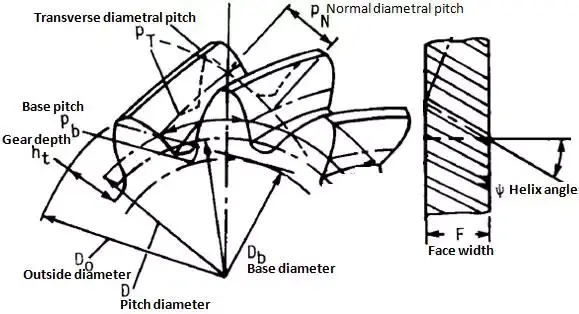
Pitch diameter
Sets the basic size of the gear and the gear ratio.
Determines the center distance between shafts.
Module (or diametral pitch)
Defines the tooth size.
Mating gears must use the same value to mesh correctly.
Number of teeth
Determines the gear ratio.
Affects smoothness of operation and risk of undercut.
Pressure angle
Commonly 20°.
Influences tooth strength and sensitivity to misalignment.
Helix angle
Larger helix angles increase contact ratio and smoothness.
They also increase axial forces that bearings and housings must support.
For many readers, a simple comparison with spur gears is helpful:
Helical gears vs. spur gears
| Point | Spur gear | Helical gear |
| Tooth direction | Straight, 90° to the shaft | Slanted, at a helix angle |
| Engagement | Almost full-width at once | Gradual, from one end to the other |
| Running smoothness | Less smooth at higher speeds | Smoother, especially at higher speeds |
| Load sharing | Fewer teeth in contact | More teeth share the load |
| Typical use | Simple, low- to medium-speed drives | Parallel-shaft drives needing higher quality |
In real projects, Wenlio Gear balances these design factors with your required torque, speed, life, noise level, lubrication and cost.
4. Where are helical gears used?
Wenlio Gear supplies custom helical gears across five major application fields.
Below is a brief, non-technical overview of each.
4.1 Agricultural machinery
In tractors, harvesters and forage machines, helical gears are widely used in:
-Main transmissions and shifting units
-PTO (power take-off) drives for implements
-Drives for hydraulic pumps and working tools
These machines face dust, mud, changing loads and long working hours.
Wenlio Gear designs helical gears here for high load, stable operation and long service life, using suitable materials, heat treatment and finishing.
4.2 Heavy-duty truck
In heavy truck, helical gears are key components in:
-Manual, AMT and automatic gearboxes
-PTO drives for hydraulic pumps and other auxiliary equipment
-Truck transmissions need to handle high torque and long mileage with controlled noise.
Wenlio Gear can tailor tooth geometry and accuracy to match your gearbox platform, duty cycle and cost targets.
4.3 Construction equipment
Wheel loaders, bulldozers, cranes and other construction machines use helical gears in:
-Travel gearboxes
-Working gearboxes for lifting, swinging and driving attachments
-Pump and motor drives in hydraulic systems
These applications operate at low speed but very high torque, with frequent start/stop and reversing in harsh environments.
Our designs focus on robust tooth strength, reliable surfaces, and enough safety margin for shock loads and misalignment.
4.4 Electric vehicle (EV)
In EV, helical gears are used in:
-Two-speed or multi-speed reduction gearboxes
-Auxiliary drives such as electric pumps and compressors
-EV drivetrains demand high efficiency, low noise and compact layouts.
For EV projects, Wenlio Gear provides fine-pitch, high-precision helical gears designed for:
-High-speed operation
-Compatible lubrication with modern EV gear oils
-Tight space around motors and batteries
4.5 Industrial automation
In industrial automation and robotics, helical gears appear in:
-Servo gearboxes and actuator units
-AGV/AMR drive systems
-Conveyor and handling equipment
Here the focus is on accuracy, controlled backlash, smooth motion and acceptable noise levels.
Wenlio Gear can supply helical gears and gear shafts as matching sets, making it easier to integrate them into modular drive units and automation cells.
5. How Wenlio Gear supports your helical gear project
You do not need to be a gear specialist to work with us.
Most customers share only a few basic points:
-What machine and application it is for
-Torque and speed ranges
-Target life and environment
-Available space and shaft layout
As a precision gear manufacturer and custom gear supplier, Wenlio Gear will:
1.Propose a suitable helical gear concept (size, module, helix angle, material, etc.).
2.Complete detailed design and define tolerances.
3.Produce prototypes and inspection reports.
4.Support your testing and then move to stable series production.
We can also provide matching spur gears, bevel gears and gear shafts, so your entire drivetrain can be designed and manufactured under one consistent quality system.
6. Conclusion
Helical gears are a proven way to make parallel-shaft drives smoother, stronger and more reliable. They quietly support many key machines in agriculture, truck, construction, EV and industrial automation.
If you are designing or upgrading a gearbox, drive module or complete drivetrain and need a practical helical gear solution, Wenlio Gear is ready to support you. You can share your basic project information with our team through the Contact Us page on the Wenlio Gear website, and we will help you move from concept to tested hardware and stable series production.
