
Blogs
What You Need to Know About Gear Hobbing
Feb
Introduction
Gear hobbing is one of the most widely used gear cutting processes in modern manufacturing. It offers high production throughput while maintaining consistent tooth geometry in external gears. At Wenlio Gear, we apply gear hobbing in precision external gear projects where synchronization accuracy and repeatability directly influence performance.
This article explains the gear hobbing process from a practical perspective—covering its working principle, machine structure, process parameters, and accuracy control considerations.
What Gear Hobbing Is
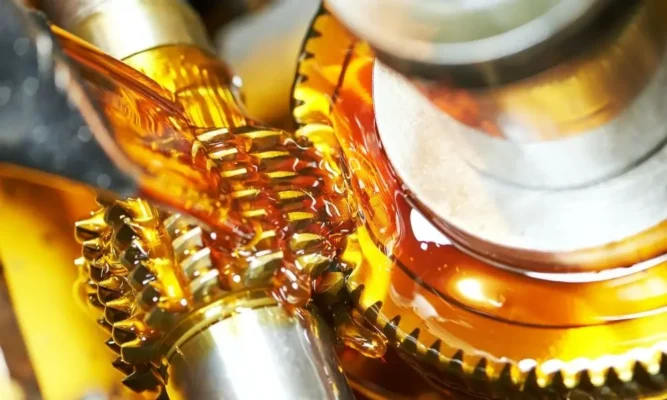
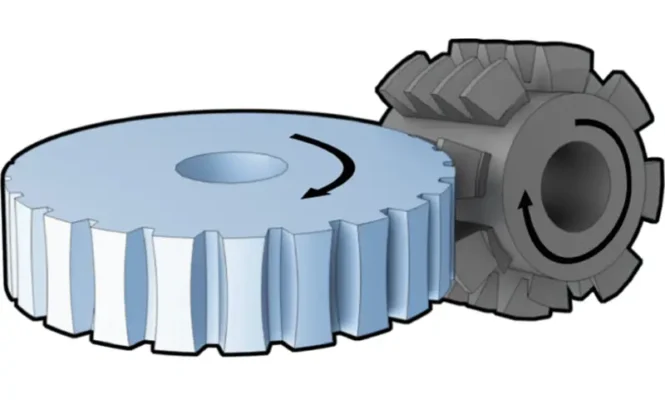
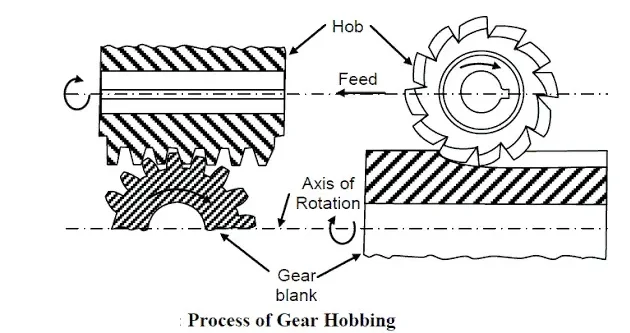
Gear hobbing is a continuous generating gear cutting process in which a rotating hob forms external gear teeth through synchronized motion with a rotating gear blank.
Why Gear Hobbing Matters
Gear hobbing remains a core process in gear manufacturing because it balances productivity with geometric control. In practice, this balance becomes especially important when production volume and accuracy requirements increase at the same time.
High machining throughput
Because the cutting action is continuous, hobbing significantly reduces cycle time compared with single-tooth indexing methods. As a result, manufacturers can maintain efficient output in medium and large batch production.
Flexible application range
By adjusting tool geometry and setup configuration, the process supports spur gears, helical gears, worm wheels, and certain external spline profiles. Therefore, hobbing adapts to a wide range of transmission designs.
Stable involute generation
Since the hob and gear blank rotate at a fixed transmission ratio, the involute profile forms progressively and consistently. Consequently, pitch spacing and tooth geometry remain stable when synchronization is properly controlled.
For these reasons, many transmission components rely on hobbing during the primary cutting stage before heat treatment or finishing operations.
Gears Commonly Produced by Hobbing
To better understand where gear hobbing fits in manufacturing, it is helpful to review the typical gear types produced through this method.
| Gear Type | Description | Typical Applications |
|---|---|---|
| Spur Gear | Straight tooth profile | General transmission systems |
| Helical Gear | Angled tooth profile | Higher-speed, lower-noise drives |
| Worm Wheel | Gear mating with worm | Reduction systems |
| External Splines | Tooth profile on shaft surface | Torque transmission shafts |
Hobbing primarily processes external gears. Internal gears generally require shaping or broaching because the hob cannot effectively access internal tooth geometry. In many production lines, hobbing serves as the main rough-to-semi-finish cutting process before grinding or honing.
Where Gear Hobbing Is Used
Because the process supports consistent involute generation and repeatable pitch spacing, manufacturers widely adopt gear hobbing in transmission systems that demand stability.
Common application fields include:
-
Automotive transmission components
-
Agricultural machinery drive systems
-
Industrial gear reducers
-
Construction equipment drivetrains
-
Servo and automation assemblies
In these industries, consistent tooth geometry directly affects vibration behavior, load distribution, and service life. Even small pitch deviations can influence noise levels in high-speed systems. As a result, process stability becomes critical in practical production.
Key Technical Features of the Hobbing Process
Beyond its application range, the technical characteristics of gear hobbing explain why the process remains widely adopted.
| Feature | Why It Matters | Practical Impact |
|---|---|---|
| Generating motion | Hob and workpiece rotate synchronously | Ensures involute accuracy |
| Continuous cutting | Teeth formed progressively | Improves production efficiency |
| Adjustable helix setup | Tool and workpiece angle adjustment | Supports helical gears |
| CNC synchronization | Servo-controlled motion | Reduces cumulative pitch error |
| Machine rigidity | Controls vibration | Influences surface finish |
However, these advantages translate into reliable performance only when synchronization and machine rigidity remain stable throughout the cutting cycle.
Practical Benefits in Manufacturing
From a manufacturing perspective, these technical features translate into measurable production benefits.
| Manufacturing Goal | How Hobbing Contributes |
|---|---|
| Increase production rate | Continuous generating motion |
| Maintain tooth profile consistency | Fixed transmission ratio |
| Reduce pitch deviation | Accurate servo synchronization |
| Adapt to multiple gear types | Adjustable setup geometry |
| Support batch repeatability | Stable CNC control |
Under controlled production conditions, hobbing can achieve ISO 8 or ISO 7 accuracy levels, depending on machine capability, tool condition, and gear size. For higher precision requirements, manufacturers often combine hobbing with finishing operations such as gear grinding after heat treatment.
Even so, achieving consistent results depends on disciplined process control.
Process Control Considerations
For this reason, process control becomes the defining factor between theoretical capability and actual gear quality.
When applying gear hobbing, manufacturers must carefully manage:
-
Machine rigidity and alignment
-
Hob geometry and coating selection
-
Cutting speed, feed rate, and depth
-
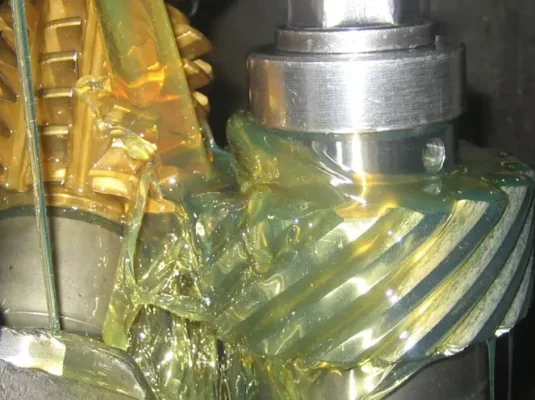
Cooling and lubrication stability
-
Tooth profile and runout inspection
Among these variables, synchronization accuracy between the hob spindle and workpiece spindle remains the most critical control point. Any deviation in transmission ratio directly affects pitch spacing and cumulative error.
Consequently, disciplined parameter control and inspection verification ensure that productivity does not compromise geometric accuracy.
Choosing the Right Gear Hobbing Supplier
Since machine capability alone does not guarantee stable output, supplier evaluation becomes equally important.
When selecting a gear hobbing supplier, consider the following:
-
Machine capability and maintenance discipline
Confirm that the supplier operates stable CNC hobbing machines with controlled spindle accuracy and servo synchronization. -
Tool management system
Ask how hob wear is monitored and how tool life is managed to prevent pitch variation in batch production. -
Parameter control strategy
Verify whether cutting speed, feed rate, and coolant flow are optimized according to material and module size. -
Inspection capability
Ensure the supplier can measure tooth profile, lead deviation, pitch error, and runout using calibrated gear inspection equipment. -
Production repeatability
Evaluate how the supplier maintains dimensional consistency from prototype to volume manufacturing.
In other words, selecting a supplier requires evaluating both equipment and execution discipline.
Why Choose Us
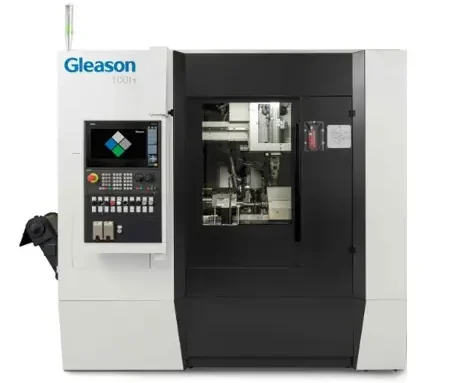
At Wenlio Gear, we integrate CNC gear hobbing with structured process planning and inspection management. Our external gear cutting capability supports various modules and helix configurations under controlled machining parameters.
We optimize cutting parameters based on material properties and gear dimensions, and we verify tooth profile, pitch, and runout before proceeding to subsequent processes. By coordinating machining strategy with heat treatment and finishing planning, we maintain consistent gear geometry from prototype validation to batch production.
In addition, we align hobbing operations with downstream processes such as case hardening, quenching, and gear grinding to control dimensional change and minimize cumulative deviation. Our inspection workflow includes gear measuring equipment for profile and lead analysis, ensuring that each production stage supports final transmission performance rather than only dimensional conformity.
FAQ
Q1:What accuracy level can gear hobbing achieve?
With proper equipment and process control, hobbing can reach ISO 8 or ISO 7 levels depending on gear size and machine condition.
Q2:Can hobbing produce internal gears?
No. Internal gears typically require shaping or broaching processes.
Q3:Is gear hobbing suitable for helical gears?
Yes. Adjusting hob angle and setup allows controlled helical tooth generation.
Q4:Why is synchronization critical in hobbing?
Precise synchronization ensures accurate pitch spacing and consistent involute geometry.
Q5:Is hobbing suitable for high-volume production?
Yes. Continuous generating motion makes it efficient for medium and large batch manufacturing.
Conclusion
Gear hobbing remains a foundational process in gear manufacturing. Its generating principle supports efficient production while maintaining consistent tooth geometry. As CNC systems, tooling materials, and inspection technologies continue to advance, gear hobbing is evolving toward higher precision and improved process stability.
If you are evaluating gear cutting methods or planning a new external gear project, you are welcome to Contact Us to discuss your drawings, required accuracy level, and production volume so we can review a suitable machining approach.
