
Apr
Introduction
Worm gears are often chosen when a drive needs a large reduction ratio, compact layout, and smooth running. On paper, the principle looks simple: a worm drives a worm wheel, speed drops, torque rises, and the system fits into a relatively small space. In production, however, worm gear quality depends on much more than basic geometry. Material pairing, tooth generation method, surface finish, heat treatment, and inspection discipline all shape how the set will actually run.
At Wenlio Gear, practical gear knowledge matters because buyers and engineers rarely make decisions from one parameter alone. They usually compare noise, efficiency, wear, cost, lead time, and manufacturability at the same time. Worm gear manufacturing is a good example of that balance. A set can look acceptable dimensionally and still run hot, wear too quickly, or lose efficiency if the process route is not matched to the application. This article explains worm gear manufacturing from that practical angle.
What worm gear manufacturing is
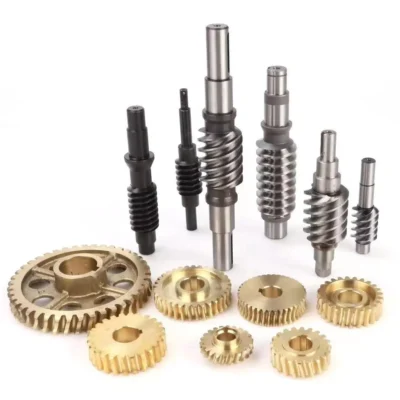
Worm gear manufacturing is the controlled process of producing a worm and mating worm wheel so the pair can deliver the required ratio, contact behavior, surface condition, and service life in actual use.
Why this topic matters
Because worm gears depend heavily on surface condition and material pairing.
Unlike many ordinary gear pairs, worm gears work with significant sliding. That means friction, heat, and lubrication behavior become central to performance. If the process route is not chosen carefully, the gearset may show wear or efficiency loss much earlier than expected.
Because a “correct” geometry is not enough on its own.
A worm and wheel can meet nominal dimensions and still perform poorly if tooth finish, backlash control, or contact quality are not stable. Manufacturing decisions strongly affect how smooth the set feels in service.
Because buyers often judge worm gears by ratio and price first, while the real risk sits elsewhere.
In practical projects, the biggest problems often come from material mismatch, insufficient finishing, weak inspection logic, or oil assumptions that were never clarified early enough.
The manufacturing routes engineers usually compare
| Manufacturing route | Typical use | Main strength | Main caution |
| Cut worm + hobbed wheel | Standard industrial worm sets | Mature process, cost-effective | Surface quality and contact control still matter |
| Ground worm + cut wheel | Smoother-running or higher-demand sets | Better worm accuracy and finish | Higher process cost |
| Hardened worm + bronze wheel | Common wear-resistant pairing | Good practical balance of durability and running behavior | Material and lubrication must match duty cycle |
| Higher-precision finished pair | Noise- or efficiency-sensitive drives | Better consistency and smoother mesh | Requires tighter process and inspection control |
The point is not that one route is always best. The right route depends on speed, load, duty cycle, cost target, and how much heat and wear the application can tolerate.
Who usually cares about worm gear manufacturing quality
- Buyers comparing gearbox or reducer suppliers
- Design engineers selecting a high-ratio drive layout
- Process engineers choosing cutting, grinding, and heat-treatment routes
- Quality engineers checking contact, finish, and dimensional stability
- Maintenance teams trying to reduce heat, wear, and oil-related failures
- Project teams balancing cost against life and noise expectations
These groups may ask different questions, but they are usually looking at the same issue: whether the manufactured gearset will behave well after installation.
What really affects worm gear quality in production
| Factor | Why it matters | What should be controlled |
| Cutting accuracy | Defines the basic tooth geometry and meshing quality | Tool condition, machine accuracy, setup repeatability |
| Material selection | Drives wear resistance, strength, and compatibility between worm and wheel | Correct material pairing for speed, load, and lubrication |
| Heat treatment | Changes hardness, durability, and dimensional stability | Hardness target, distortion control, process consistency |
| Surface finish | Strongly affects friction, heat, and running smoothness | Grinding or finishing route where required |
| Inspection method | Decides whether good parts can be separated from risky parts | Dimensional checks, contact checks, surface condition review |
| Process stability | Determines whether one good sample can become stable batch production | In-process control, operator discipline, documented standards |
A useful way to think about worm gear manufacturing is this: tooth geometry gets the gearset started, but finish, material, and lubrication determine whether it keeps performing.
Cutting and tooth generation
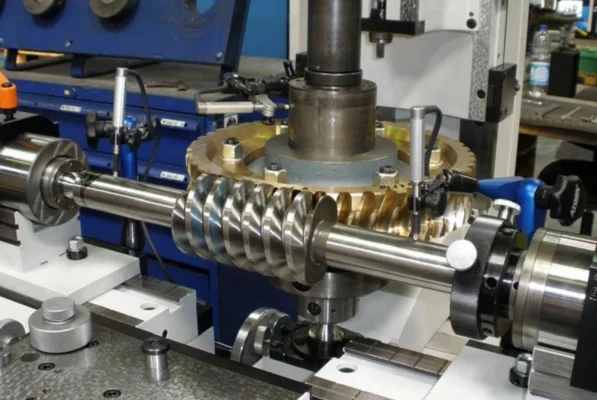
The cutting stage determines the base geometry of the worm and wheel. CNC-controlled hobbing or shaping routes help improve repeatability, but machine capability alone does not guarantee a good result. Tool wear, setup consistency, and how the wheel is generated relative to the worm geometry all matter. If the tooth form is only “close enough,” later finishing and assembly may not fully rescue the running behavior.
Material and heat treatment
Material choice is especially important in worm drives because the contact includes heavy sliding. A harder worm combined with a suitable wheel material is common because it helps balance strength and wear behavior. Heat treatment then raises another issue: hardness is useful, but distortion must be controlled. A hard part that shifts too far from intended geometry can still create noise, friction, and local overload.
Finishing and inspection
Finishing is where many projects separate “can rotate” from “can run well.” A better worm finish can reduce friction and help lubrication work more effectively. Inspection then needs to look beyond simple outer dimensions. A worm gearset should be judged by geometry, surface condition, and whether the pair is likely to run with stable contact in the real application.
What good manufacturing improves
| Goal | What improves | Why it helps |
| Smoother running | Better tooth contact and surface finish | Lower vibration and more stable motion |
| Better efficiency | Lower sliding loss and better lubrication behavior | Less heat and reduced energy loss |
| Longer service life | Better wear control and more stable load distribution | Fewer early failures and lower maintenance risk |
| More stable batch quality | Better process repeatability | Less variation between prototypes and production lots |
| Easier troubleshooting | Clearer link between process route and field behavior | Faster root-cause analysis when issues appear |
Good worm gear manufacturing is not about chasing a premium process at any cost. It is about choosing a route that matches the duty cycle and then controlling it well enough to make the result repeatable.
Supplier selection tips
- Ask about the material pair, not just the gear ratio.
In worm gear projects, material compatibility often matters more than buyers expect. - Ask how surface finish is achieved and verified.
Sliding contact makes finish quality especially important for heat and wear behavior. - Check whether the supplier treats lubrication as part of the engineering discussion.
If oil type, viscosity, and duty cycle are ignored, the manufacturing discussion is incomplete. - Look for evidence of process stability, not just one acceptable sample.
A good prototype does not automatically prove good batch control. - Ask what is inspected beyond basic dimensions.
Geometry, finish, and practical running behavior should all be part of the review logic.
Why Choose Us
Wenlio Gear shares transmission knowledge with a practical engineering focus: what affects performance in production, what drives risk in service, and what buyers should clarify before a project moves forward.
For gear projects that involve high-ratio or right-angle transmission decisions, the most useful discussion usually starts with application reality rather than generic product language. That means looking at layout, duty cycle, lubrication, process route, and inspection expectations together, instead of treating manufacturing as a single isolated step.
This kind of structured review makes technical communication clearer and helps reduce the gap between a drawing that looks acceptable and a gearset that performs reliably in real use.
FAQ
Q1: Why are worm gears more sensitive to lubrication than many other gear types?
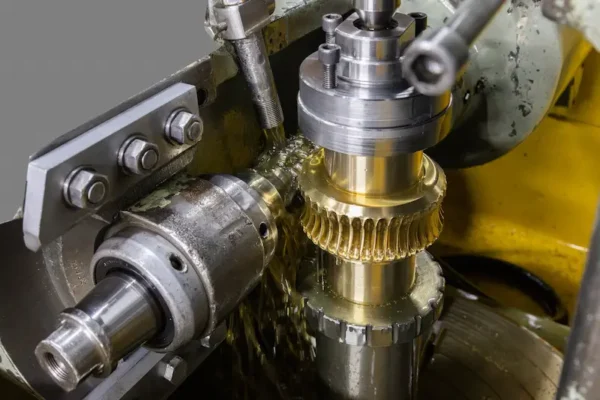
Because they operate with significant sliding, which increases frictional heat and wear risk if lubrication is not well matched.
Q2: Is grinding always necessary in worm gear manufacturing?
Not always. It depends on the required accuracy, running smoothness, and service expectations.
Q3: Does a harder gear always mean a better worm gear set?
No. Hardness helps, but material pairing, distortion control, and finish are just as important.
Q4: What is the biggest mistake buyers make with worm gears?
Focusing only on ratio and price while overlooking material, finish, lubrication, and inspection logic.
Q5: What should be clarified early in a worm gear RFQ?
Ratio, duty cycle, load, lubrication conditions, material expectations, finish level, and inspection requirements.
Conclusion
Worm gear manufacturing is not just about cutting teeth accurately. It is about building a gearset that can handle sliding contact, heat, lubrication, and long-term wear in a predictable way. Once the process is viewed through that lens, the most important decisions become clearer: material pairing, finishing route, inspection depth, and process stability.
If you are comparing worm gear options, reviewing a reducer design, or preparing an RFQ for a transmission project, you are welcome to Contact Us with your drawings and operating conditions so the technical discussion can start from the real working requirements.
