
Blogs, Bevel Gear
Why Do Bevel Gears Need Lapping After Cutting
Jul
Introduction
In bevel gear manufacturing, cutting the teeth does not always mean the part is ready for delivery. For straight bevel gears, spiral bevel gears, hypoid gears, and matched bevel gear sets, tooth contact, backlash, and assembly behavior may still need further review.
Bevel gear lapping is often used as a light finishing and running-in process after cutting. It is not required for every project, but it can help improve contact conditions and support gear-pair matching when the application requires smoother meshing or more careful pre-production review.
As a precision gear manufacturer and custom gear supplier, Wenlio reviews drawings, gear type, heat treatment, contact pattern, backlash, accuracy requirements, and application conditions before deciding whether lapping, grinding, or another finishing method is more suitable.
Quick Answer: Why Do Bevel Gears Need Lapping After Cutting?
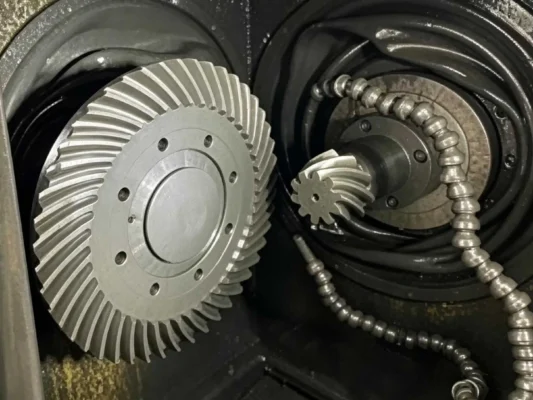
Bevel gears may need lapping after cutting to improve tooth contact, reduce minor surface marks, and help the mating gears run more smoothly.
Lapping does not recreate the tooth geometry. It is a light paired finishing process that helps the tooth surfaces settle into a more suitable meshing condition. For matched bevel gear sets, it can also support pair confirmation before shipment or mass production.
What Is Bevel Gear Lapping?
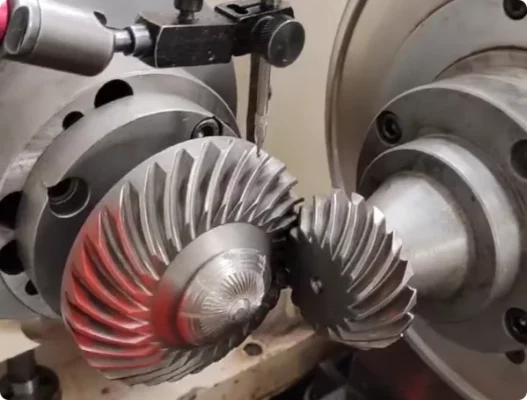
Bevel gear lapping is a finishing process where the pinion and gear run together on dedicated equipment with a lapping compound. The process lightly refines the tooth flanks and helps reveal how the pair contacts under test conditions.
It is commonly used to:
- Improve tooth contact
- Reduce minor cutting marks
- Support smoother meshing
- Check contact pattern
- Prepare the gear pair for further inspection or shipment
Lapping should not be treated as a universal repair method. If the gear has major issues with tooth design, mounting distance, machining accuracy, or heat treatment distortion, the root cause must be corrected first. Lapping is better suited for fine contact improvement, not for replacing correct design or process control.
.webp)
Why Lapping Is Used After Bevel Gear Cutting
After cutting, the basic tooth form has already been produced. However, bevel gears often work as pairs, so the final result depends not only on single-part dimensions but also on how the two gears mesh together.
It Helps Improve Contact Pattern
Contact pattern affects load distribution, wear behavior, and running stability. If the contact area is slightly uneven after cutting, lapping may help improve the meshing condition within a limited range.
This is especially useful for bevel gear sets, where checking one part alone cannot fully show how the pair will perform.
It Helps Reduce Minor Surface Marks
Cutting may leave small tool marks on the tooth surface. These marks may not prevent assembly, but they can affect the initial running condition.
Lapping can lightly smooth the tooth surface and make contact more consistent. However, it is not used for large material removal and should not be confused with precision gear grinding.
It Helps Verify the Gear Pair
If the pinion and gear are not checked together, the buyer may later find unstable contact, unsuitable backlash, or rough running during assembly.
The lapping process allows the supplier to observe paired meshing before delivery. It can also support pair marking, first-article approval, and shipment review.
Bevel Gear Lapping vs Grinding
Lapping and grinding may both appear in bevel gear production, but they solve different problems. Buyers should confirm which process is actually needed instead of simply asking for “finishing.”
| Item | Bevel Gear Lapping |
Gear Grinding |
| Main purpose | Improve paired contact and running-in condition | Improve tooth accuracy and dimensional control |
| Process method | Pinion and gear run together with lapping compound | Grinding wheel finishes the tooth surface |
| Best suited for | Matched gear sets, contact improvement, minor surface refinement | High accuracy, post-heat-treatment correction, tooth surface finishing |
| Material removal | Usually very small | Controlled according to process requirements |
| Inspection focus | Contact pattern, backlash, pair relationship | Tooth profile, lead, surface finish, accuracy grade |
| Buyer attention | Pair marking should stay clear after lapping | Grinding usually increases cost and lead time |
If the project mainly focuses on paired contact and meshing behavior, lapping may be enough. If strict tooth accuracy, heat-treatment correction, or a higher accuracy grade is required, grinding may be the better choice.
When Should Buyers Consider Bevel Gear Lapping?
Not every bevel gear needs lapping. The decision should depend on gear type, application, accuracy requirement, and assembly risk.
Buyers may consider lapping for:
- Matched bevel gear sets
- Spiral bevel gears or hypoid gears
- Projects with contact pattern requirements
- Sample approval before mass production
- Replacement gears with visible wear on old parts
- High-load applications
- Orders requiring first-article or pre-shipment pair checking
For low-risk projects, cutting, basic dimensional inspection, and surface review may already be enough. Adding unnecessary finishing steps can increase cost and extend lead time. It is better to clarify the application and acceptance standard during the RFQ stage.
What Buyers Should Confirm Before Requesting Lapping
Before asking for lapping, buyers should clarify whether the gears are used as a pair, whether contact pattern or backlash needs to be checked, and whether samples or assembly data are available.
| Information Buyers Should Confirm |
Why It Matters |
| Gear type | Different bevel gear types may have different lapping needs |
| Pinion and gear relationship | Determines whether paired running and pair marking are needed |
| Drawings and key tolerances | Helps define cutting, finishing, and inspection scope |
| Mounting distance | Affects actual contact position |
| Backlash requirement | Affects assembly and running condition |
| Contact pattern requirement | Helps decide whether pair checking is needed |
| Material and heat treatment | Affects hardness, distortion, and later processing |
| Application conditions | Load, speed, and lubrication affect process judgment |
| Inspection report needs | Clarifies whether contact or backlash records are required |
| Lead time and quantity | Lapping may affect production planning and cost evaluation |
If the buyer only has an old sample, photos, wear marks, mating gear details, and equipment information are still useful. The supplier can then decide whether more measurement or assembly data is needed.
Common Mistakes When Buyers Ask About Lapping
Some buyers assume lapping automatically makes every bevel gear better. In reality, it is a process choice, not a fixed step for all projects.
The first common mistake is confusing lapping with grinding. Grinding is used for precision tooth finishing and dimensional correction, while lapping mainly supports paired meshing and contact improvement. Their purposes, costs, and lead times are different.
The second mistake is sending only one gear while asking the supplier to confirm how the pair will run. One part cannot fully show the real meshing condition. If the project includes both a pinion and a gear, matched information should be provided together.
The third mistake is ignoring pair marking. Gears that have been lapped together should keep a clear matched relationship. If parts are mixed after shipment or pair numbers are unclear, assembly results may change.
The fourth mistake is requesting lapping only after production is completed. This may require rework, extra inspection, or schedule changes. Contact pattern, backlash, and report needs should be discussed during quotation.
How Wenlio Reviews Lapping Needs for Bevel Gear Projects
Wenlio does not judge lapping needs by the process name alone. The team reviews the full project condition before making a manufacturing suggestion.
For a standard straight bevel gear with simple drawing and assembly requirements, lapping may not be necessary. If the project involves spiral bevel gears, hypoid gears, matched bevel gear sets, or clear requirements for contact pattern and backlash, Wenlio may suggest paired running or contact checking.
Sample-based projects need extra care. If an old part already shows uneven wear or abnormal contact marks, copying the worn geometry may not restore the original meshing condition. In this case, mating parts, assembly information, and inspection requirements become more important.
The goal is not to make every bevel gear project more complicated. Wenlio chooses the manufacturing and inspection path based on actual project risk, helping control cost while reducing avoidable production issues.
FAQ
Q1: What is bevel gear lapping?
Bevel gear lapping is a paired finishing process used after cutting. The pinion and gear run together with lapping compound to improve tooth contact and pair matching.
Q2: Do all bevel gears need lapping after cutting?
No. Standard projects may only need cutting, dimensional inspection, and surface review. Matched bevel gear sets, high-load gears, projects with contact pattern requirements, and sample-based orders are more likely to need lapping.
Q3: Is lapping the same as gear grinding?
No. Lapping focuses on paired meshing and contact improvement, while grinding focuses on tooth accuracy, heat-treatment correction, and dimensional control.
Q4: Can lapping fix a bad contact pattern?
Lapping can improve minor contact issues, but it cannot fix major problems caused by incorrect tooth design, wrong mounting distance, machining error, or serious heat treatment distortion.
Q5: What should buyers provide before asking for lapping?
Buyers should provide drawings, mating gear information, mounting distance, backlash requirements, contact pattern requirements, material, heat treatment, application conditions, sample photos, and inspection report needs.
Conclusion
Bevel gear lapping is not just an extra finishing step after cutting. For suitable projects, it can improve tooth contact, support gear-pair review, and reduce assembly risk before shipment or mass production.
For straight bevel gears, spiral bevel gears, hypoid gears, and matched bevel gear sets, lapping should be discussed together with drawings, samples, backlash, mounting distance, contact pattern, material, heat treatment, and inspection requirements.
If you are developing or replacing bevel gears, Contact us,We can review your drawing, sample photos, mating gear information, and application details to decide whether lapping, grinding, or another manufacturing step is more suitable for your project.
