
Blogs, Bevel Gear
How to Choose Materials for Bevel Gears
Jul
Choosing material for a bevel gear is rarely a single-line decision. A gear used in agricultural machinery may face shock loads and dust, while one used in an electric drive system may have different speed, lubrication, and durability requirements. These working conditions usually decide whether a standard steel, alloy steel, or a heat-treated material route is more suitable.
For bevel gears, material choice can affect wear resistance, core strength, heat treatment distortion, machining difficulty, cost, and lead time. Before giving a material suggestion, Wenlio usually reviews the drawing, sample condition, hardness target, heat treatment needs, application details, and inspection requirements together.
Quick Answer: How Should Buyers Choose Materials for Bevel Gears?
Bevel gear materials should be selected based on load, wear resistance, heat treatment, hardness, machining accuracy, cost, and working conditions.
Buyers should not judge a material only by its grade or hardness value. A better approach is to review material, heat treatment, tooth finishing, accuracy requirements, and application conditions together. For high-load or matched bevel gear sets, contact pattern, backlash, heat treatment distortion, and inspection scope should also be considered.
What Are Common Materials for Bevel Gears?
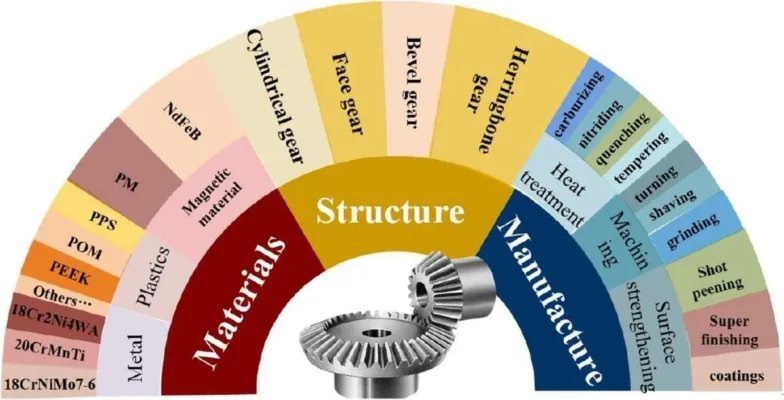
Bevel gear materials commonly include carbon steel, alloy steel, carburizing steel, stainless steel, and powder metallurgy materials. There is no single “best” material for every bevel gear. The right choice depends on the project.
| Material Type | Common Features | Suitable Applications | What Buyers Should Check |
| Carbon Steel | Cost-controlled and relatively easy to machine | Medium or low-load transmission, cost-sensitive projects | Wear resistance and load capacity should be reviewed with heat treatment |
| Alloy Steel | Better strength, toughness, and heat treatment response | Heavy load, impact load, long service operation | Cost and machining difficulty are usually higher than carbon steel |
| Carburizing Steel | Hard surface with tougher core | High-wear and high-load bevel gears | Case depth, hardness, and distortion control should be defined |
| Stainless Steel | Better corrosion resistance | Humid or special environments with anti-rust requirements | Strength, cost, and machinability should be reviewed together |
| Powder Metallurgy | Suitable for some stable batch production and specific structures | Small gears or selected volume production projects | Not suitable for all high-load bevel gear applications |
This table is only a starting point. Final selection should also consider gear size, face width, ratio, load direction, heat treatment requirements, and acceptance standards.
Why Material Selection Matters for Bevel Gears
Bevel gears usually work with a mating gear, not as isolated parts. A material choice that looks acceptable during quotation may still cause problems during machining, heat treatment, assembly, or long-term operation.
How does material affect load capacity?
Material strength affects how well a gear can handle load and impact. In heavy-duty equipment, insufficient strength may increase the risk of pitting, tooth wear, or root fatigue, but the highest-grade steel is not always the best answer. The material should match the application instead of only looking stronger on paper.
How does material affect wear resistance?
The tooth surface of a bevel gear is in repeated contact during operation, so wear resistance matters. For spiral bevel gears, hypoid gears, and matched bevel gear sets, final wear performance depends not only on the steel grade, but also on heat treatment, tooth surface quality, and contact condition.
How does material affect heat treatment distortion?
Heat treatment can improve hardness and wear resistance, but it may also cause distortion. For precision bevel gears, dimensional change, tooth surface deviation, and contact pattern shift after heat treatment should be considered together with the selected material.
How does material affect cost and lead time?
Material affects purchasing cost, machining efficiency, heat treatment time, inspection needs, and availability. For overseas buyers, annual demand, sample quantity, and target lead time should be shared early so the supplier can suggest a realistic material route.
How Heat Treatment Works With Bevel Gear Materials
Material and heat treatment work together to define gear performance. Providing only a material grade without hardness, case depth, or heat treatment requirements is often not enough for accurate quotation or production planning.
Why should buyers confirm hardness requirements?
Hardness affects heat treatment method, testing position, and wear resistance. Instead of writing only “hardened,” buyers should define surface hardness, core hardness, or the required standard so quotation and production planning can be more precise.
Why does case depth matter?
For carburized bevel gears, case depth affects surface wear resistance and load capacity. If the gear has a known working condition or previous failure problem, this should be explained during RFQ so the supplier can judge whether stricter heat treatment control is needed.
Should heat treatment reports be requested?
For simple projects, basic hardness confirmation may be enough. For high-load gears, repeat production, or orders with traceability requirements, buyers may request hardness reports, heat treatment records, or material certificates during RFQ.

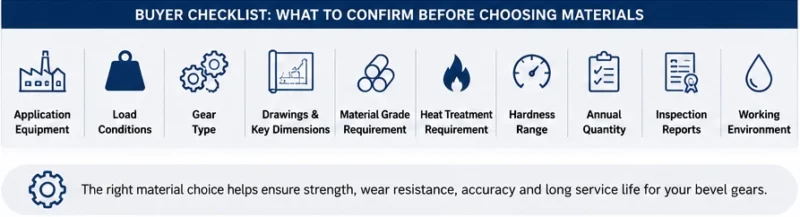
Buyer Checklist: What to Confirm Before Choosing Materials
Before selecting bevel gear materials, buyers should prepare the following information. It helps the supplier review material, heat treatment, and inspection needs more accurately.
| What Buyers Should Confirm | Why It Matters |
| Application equipment | Different machines have different load, speed, and impact conditions |
| Load condition | Defines material strength and heat treatment needs |
| Gear type | Straight, spiral, and hypoid bevel gears may need different process routes |
| Drawings and key dimensions | Help review machining difficulty and tolerance requirements |
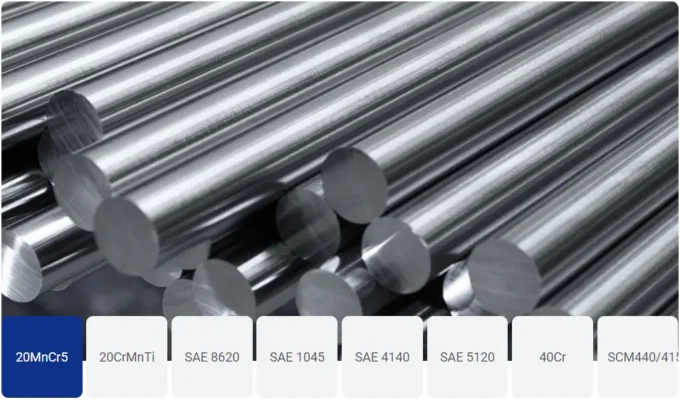
| Material grade requirement | Avoids different interpretations of the same project |
| Heat treatment requirement | Affects hardness, wear resistance, and distortion control |
| Hardness range | Surface hardness and core hardness should be defined when needed |
| Annual demand | Affects material sourcing and cost evaluation |
| Inspection reports | Determines whether certificates, hardness records, or heat treatment records are needed |
| Working environment | Lubrication, temperature, humidity, and corrosion risk affect material choice |
If drawings are not complete, buyers can still provide samples, photos, wear marks, and application details. Wenlio can review the available information first and suggest whether material standards, heat treatment data, or inspection requirements need to be clarified.
Common Mistakes When Choosing Bevel Gear Materials
Material problems often start early, not because buyers know nothing about gears, but because only one factor is considered.
Mistake 1: Choosing material only by price
A lower-cost material may be fine for a simple application, but for high-load or long-running equipment, later wear, rework, or downtime can become more expensive than the initial saving. Material cost should be reviewed together with heat treatment, accuracy, inspection, and service life.
Mistake 2: Looking only at hardness
Hardness matters, but it does not represent the whole gear performance. A safer review should also consider core strength, case depth, heat treatment distortion, the process route, and inspection requirements.
Mistake 3: Separating material from heat treatment
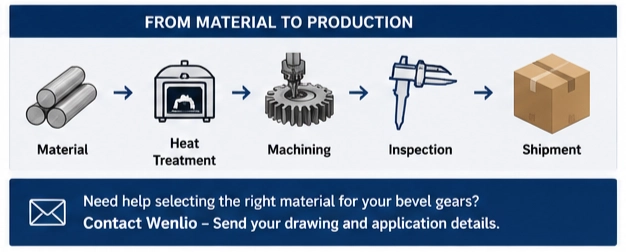
For precision bevel gears, material, heat treatment, tooth finishing, and inspection should be treated as one manufacturing plan. A material grade alone does not give the supplier enough information to judge production risk.
Mistake 4: Not explaining the working conditions
The same bevel gear may need different materials in a low-speed heavy-load unit and a higher-speed transmission system. Without working conditions, the supplier can only give a general suggestion.
When Should Buyers Consider Alloy Steel or Carburizing Steel?
If the gear must handle higher load, impact, or continuous operation, alloy steel or carburizing steel is often worth considering. These materials are commonly used when strength, wear resistance, and service life are more demanding.
When is alloy steel a better choice?
Alloy steel is often a better option for bevel gears used under higher load, impact, or complex working conditions because it usually offers better strength, toughness, and heat treatment response. For low-load or cost-sensitive projects, carbon steel with suitable heat treatment may still be enough.
When is carburizing steel needed?
Carburizing steel is suitable when the gear needs a hard wear-resistant surface and a tougher core. Buyers should also define case depth, hardness range, distortion control, and whether tooth finishing is needed after heat treatment.
When should buyers avoid over-specifying materials?
Not every project benefits from a higher-grade material. A more practical method is to define the application risk first, then let the supplier review the material route based on drawings, samples, working conditions, and acceptance needs.
Why Choose Wenlio for Bevel Gear Material Review?
Wenlio does not judge a custom bevel gear project by material name alone. The team reviews material together with drawings, samples, gear type, heat treatment, hardness, accuracy, contact pattern, and inspection requirements.
For standard projects, buyers may provide a target material and basic drawing for confirmation. For high-load gears, replacement parts, sample-based projects, or matched bevel gear sets, Wenlio pays closer attention to whether the material is suitable for heat treatment, whether distortion can be controlled, and whether additional inspection or first-article review is needed.
The purpose is not to make the project more complicated. A clear material decision helps reduce uncertainty before quotation and makes later machining, heat treatment, inspection, and assembly review easier to manage.
FAQ
Q1: What materials are commonly used for bevel gears?
Common bevel gear materials include carbon steel, alloy steel, carburizing steel, stainless steel, and powder metallurgy materials. The choice depends on load, heat treatment, cost, and working environment.
Q2: Is alloy steel always better for bevel gears?
No. Alloy steel usually offers better strength and heat treatment response, but it also costs more. For low-load applications, a lower-grade material with suitable heat treatment may be enough.
Q3: Why is heat treatment important for bevel gear materials?
Heat treatment affects surface hardness, core strength, wear resistance, and distortion control. For high-load or precision bevel gears, material and heat treatment should be reviewed together.
Q4: Can Wenlio suggest materials if the buyer only has a sample?
Yes, Wenlio can make an initial suggestion from a sample. For a better review, buyers should also provide sample photos, application equipment, wear condition, mating gear information, and target working requirements.
Q5: What should buyers provide before asking for material selection advice?
Buyers should provide drawings, samples, working conditions, load information, material requirements, heat treatment requirements, hardness range, report needs, quantity, and target lead time.
Conclusion
Choosing materials for bevel gears is not only about selecting a steel grade. A practical decision should consider load, wear resistance, heat treatment, hardness, machining accuracy, cost, lead time, and working conditions together.
For straight bevel gears, spiral bevel gears, hypoid gears, and matched bevel gear sets, material selection should be discussed together with drawings, samples, heat treatment, contact pattern, backlash, and inspection requirements.
If you are developing or replacing bevel gears, Contact us, we can review your drawing, sample photos, application details, and material requirements to help evaluate a suitable manufacturing route before production.
