
Blogs, Gear Shaft
How is the input shaft manufactured?
Oct
1.Introduction
At Wenlio Gear we specialize in bevel and right-angle gearing—spiral bevel, straight bevel, and hypoid pairs that demand precise shaft interfaces. To unlock quiet, durable performance, the input shaft feeding those bevel gearsets must be engineered just as carefully: correct datums, tight runout, the right heat-treat stack, stable bearings, and clean oil delivery.
This guide distills Wenlio’s best practices for input-shaft design, materials, heat treatment, machining, QA, and application tuning across agriculture, truck, construction, EV, and industrial automation.
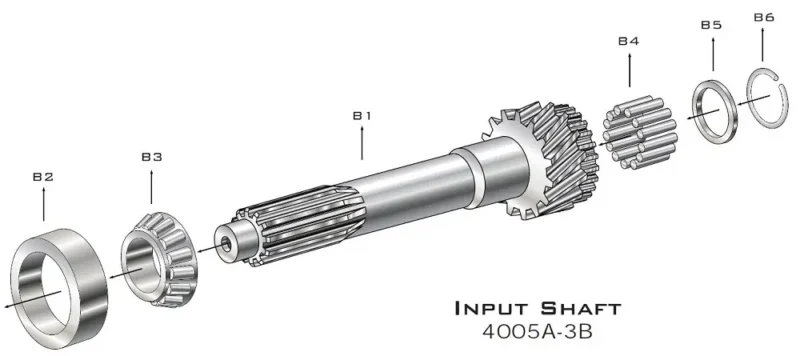
2.What an input shaft actually does
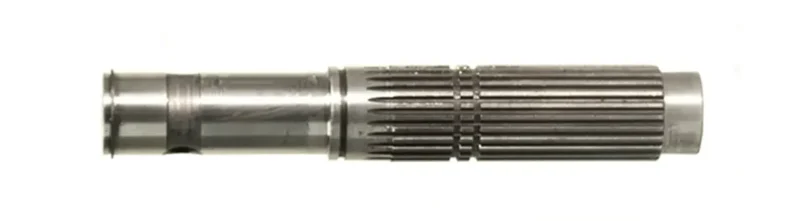
The input shaft couples the prime mover—ICE, e-motor, PTO, or a hydraulic motor—to the gearbox. On paper its role looks simple, but in practice it carries several precision-critical jobs:
-
First, it transmits torque and speed into the first gearset or synchronizer.
-
At the same time, it establishes the key datums for coaxial alignment—bearing seats, spline datums, and pilot diameters.
-
In addition, it routes lubrication through oil holes or helical grooves to feed bearings and gear meshes.
-
Finally, it helps control NVH via runout, balance, surface finish, and the local micro-geometry of splines and journals.
Because the input shaft sits at the entrance of a right-angle gearbox, any eccentricity, chatter, or surface defect is then amplified through the bevel mesh. So the input shaft should be treated as a precision component—not “just a bar with splines.”
3.Load cases and design drivers
Torsion: steady + transient torque (start-up, shifts, shock).
Bending: from bevel mesh forces, belt/chain loads, or clutch-release loads.
Axial thrust: from helical stages or clutch actuation. For right-angle bevel sets, thrust management at the shaft bearings is critical for noise stability.
Dynamics: critical-speed margin, torsional modes, and balance.
Thermal growth & fits: bearing preload/clearance drifts with temperature.
Wenlio rule of thumb: freeze the bearing arrangement and clutch/gear interfaces early, then back-solve diameters and fillets for fatigue life and deflection limits.
4.Materials & heat-treat stacks
| Duty / Sector | Typical Material | Heat Treat | Why it’s chosen |
| Heavy truck, high torque | 42CrMo4 / 4140, 18CrNiMo7-6 | Q&T + induction on journals or carburize + grind | Tough core, hard wear surfaces; deep case for spline life |
| Agriculture, mixed shock | 40Cr / 5140, 20CrMnTi | Q&T + local induction, or carburize where splines see dirt | Impact tolerance, easy service |
| Construction, large modules | 42CrMo / 4340 | Q&T; selective induction | Robust, repairable, good tooth-seat hardness |
| EV, high speed & NVH | 16MnCr5 / 20MnCr5 | Low-pressure carburize (LPC) + gas quench + grind/superfinish | Low distortion, tight scatter for bevel-mesh NVH |
| Industrial automation, precision | 38CrMoAlA | Nitriding | Minimal distortion; ideal when geometry is finished before hardening |
Tips from Wenlio:
Carburize for long spline life and contact strength (EV & truck).
Induction when you want selective hardening and simpler finishing (ag & construction).
Nitriding if distortion budgets are tight (automation).
On the drawing, specify: surface hardness, Effective case depth (Eht), core hardness, and finishing stock.
5.Geometry that saves programs
-
Fillets – Start with generous undercut fillets at spline shoulders and gear seats to reduce peak stress. Then call out controlled radii and matching reliefs in the mating parts.
-
Chamfers & lead-ins – Next, add lead-ins on splines and press fits to prevent galling during assembly.
-
Spline class & fit – In parallel, choose an involute spline class that balances torque capacity, backlash, and NVH, and specify spline runout to the primary journal datum.
-
Bearing seats – Meanwhile, control hardness, roundness, and waviness; a typical Ra ≤ 0.2–0.4 μm helps keep preload stable.
-
Oil logistics – Also, design for flow, not just “oil present”: use axial cross-drills, annular grooves, and metering orifices, then verify metered flow at temperature.
-
Balance features – After that, place shallow drill plugs or flats away from stress hot spots, and hit the rotor balance spec (ISO G grade or the OEM target).
-
Bevel gear seat control – Finally, if the shaft carries a bevel gear seat, specify shoulder perpendicularity and seat runout to the primary journal datum so the bevel contact pattern stays centered at mounting distance.
6.Manufacturing flow we trust
Blanking & pre-machining – Start with forged/rolled bar; stress-relieve or normalize if cold-worked. Then turn datums and reference centers early.
Rough machining – Next, turn shoulders/diameters, mill key features, pilot-drill oilways, and leave spline stock. Keep residual-stress conditions consistent.
Heat treatment – Then apply the chosen stack: carburize/quench/temper, Q&T + induction, or nitriding. For each furnace load, run coupons and verify surface hardness and Eht.
Finish machining / grinding – After heat treat, OD-grind bearing seats and journals. If a gear seat is integral, form-grind as needed. If a separate bevel gear mounts on the seat, control roundness and shoulder perpendicularity, and record seat runout to the journal datum. For splines, hob/shape then roll/brush deburr; and grind or shave to class where required. Finally, superfinish critical journals for high-speed/NVH duty.
Deburr & clean – Meanwhile, use thermal or brush deburr plus ultrasonic cleaning, then confirm oilways are clear (airflow or borescope).
Balance & verification – Next, perform single- or two-plane balance, mark corrections, and document residual unbalance.
Final QA – Finally, verify spline profile/lead/pitch, runout to the primary datum, surface roughness, and a hardness map. If a bevel gear is assembled, add a contact-pattern check at design mounting distance, plus airflow/leak checks for lubrication drillings.
7.Tolerances that keep NVH down
TIR of primary journal to spline datum: ≤ 0.01–0.02 mm (application-dependent). For right-angle drives, tighter TIR directly lowers bevel-mesh whine.
Roundness / waviness (bearing seats): ≤ 0.003–0.005 mm; Ra ≤ 0.2–0.4 μm.
Spline concentricity/parallelism to datum A: ≤ 0.02 mm.
Oilway burrs: none permitted; 100% borescope or airflow check on critical lines.
Residual unbalance: meet system rotor spec (e.g., ≤ ISO G2.5 for high-speed EV inputs).
8.Surface finishing & coatings
Superfinishing (stone or vibratory) on journals reduces bearing temperature and tonal noise.
Phosphate / thin-film coatings on splines where corrosion or fretting is a risk.
Shot peening at fillets boosts bending fatigue (verify Almen intensity).
Dry-film lubricants (selective) for press fits or sliding assembly.
9.Failure modes & how to avoid them
| Failure | Likely Root Cause | Prevention |
| Spline wear / fretting | Shallow case, low hardness, misalignment, dry interface | Deeper case; tighter runout; anti-fretting coating; defined lube path |
| Bearing blueing | Rough journal, imbalance, poor oil feed | Superfinish; balance; verify oilway flow |
| Torsional fatigue | Sharp fillets, inclusions, under-spec core hardness | Generous fillets; clean steel; confirm core hardness |
| Scuffing/galling (assembly) | No chamfer/lead-in, tight interference, poor lube | Add lead-ins; controlled fits; assembly lubricant |
| Gear whine at input orders | Runout, spline error, bevel seat/mounting miss, micro-geometry | Tighten TIR; higher-class spline; verify bevel seat runout & mounting distance; confirm mating bevel micro-geometry |
10.Applications we serve
10.1 Agriculture
Shock + dirt. Prioritize deep case on splines, robust seals, and oilway sizing. Q&T + induction is cost-effective on large shafts; superfinish key journals to cool bearings.
10.2 Heavy truck
Long mileage + strict NVH. Vacuum carburizing + gas quench for low distortion; hard grind and balance to suppress driveline harmonics; document Eht and retained austenite.
10.3 Construction equipment
Transient peaks and heat. Q&T cores with selective induction on journals; generous fillets and shot peening to sustain bending fatigue; verify contact pattern if shaft ships with a mating bevel gear.
10.4 Electric vehicle (EV)
High RPM + silence. Low-scatter LPC carburize, tight runout, superfinished journals, and stringent balance. Validate critical speeds and torsional modes across temperature.
10.5 Industrial automation
Tight backlash, frequent start-stop. Nitrided journals/splines for minimal distortion; finish-first strategy with Ra ≤ 0.4 μm; airflow-verified oil metering for compact housings.
11.Fast selection checklist
Fix bearing arrangement & clutch/gear interfaces.
Choose material + heat-treat by duty (case depth, core hardness).
Set fillets, chamfers, spline class; design oilways for measured flow.
Allocate grind stock and tolerance chain for runout.
Plan balance method and residual target early.
Lock QA artifacts and acceptance criteria (profile/lead charts, hardness traverse, Eht, runout, airflow).
12.Validation & QA artifacts Wenlio delivers
Geometry: runout/concentricity to datum, bearing-seat charts, spline inspection (profile/lead/pitch).
Metallurgy: surface hardness, Eht (if case-hardened), microhardness traverse, retained austenite (as required).
Surface state: roughness (Ra/Rz), superfinish records, peening certifications.
Function: oilway airflow/leak test, balance report, contact-pattern at mounting distance (if assembled).
Traceability: material heat, furnace load logs, tool IDs, gage R&R references. PPAP/FAI formatting available by default for automotive-grade programs.
13.Conclusion
Get the input shaft right, and the rest of the right-angle gearbox gets easier: lower NVH, cooler bearings, longer gear life, and fewer surprises in validation. Wenlio Gear can co-engineer your shaft—blank → heat treat → grind → superfinish → balance → verify—and deliver the documentation your program needs.
Have a drawing or target spec? Let’s review it together,Contact us.

Pingback: Gears and Shafts: How They Work Together - wenlio.com