
Blogs, Bevel Gear
How Does Bevel Gear Contact Pattern Affect Performance
Jul
When buyers evaluate a bevel gear project, they usually check tooth count, module, material, heat treatment, accuracy grade, and price first. These details are important, but they do not always show how the gear pair will actually mesh after assembly. One detail that should not be overlooked is bevel gear contact pattern, because it shows where mating gear teeth touch during operation.
For matched bevel gear sets, contact pattern can affect load distribution, wear behavior, running stability, and assembly risk. As a precision gear manufacturer and custom gear supplier, Wenlio reviews contact pattern together with drawings, samples, mounting distance, backlash, heat treatment, mating gear condition, and inspection requirements before production.
Quick Answer
Bevel gear contact pattern shows where mating gear teeth actually touch during meshing. A proper pattern helps distribute load, reduce edge loading, and lower the risk of abnormal wear or assembly problems, while contact too close to the tooth tip, root, heel, toe, or edge may indicate issues with mounting position, tooth geometry, heat treatment distortion, backlash, or gear pairing.
What Is Bevel Gear Contact Pattern
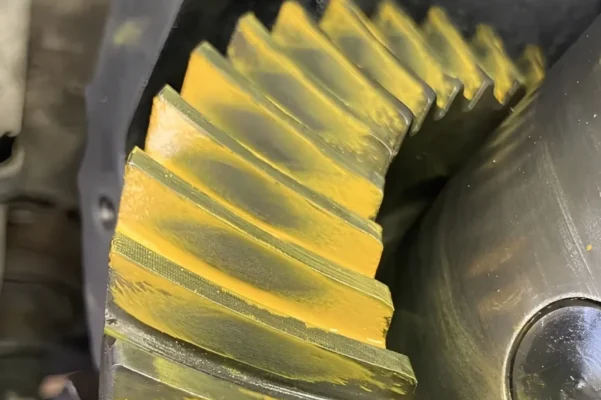
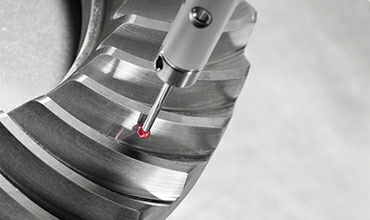
Bevel gear contact pattern refers to the visible contact area on the tooth surface after two bevel gears mesh under light load or test conditions. It is commonly checked with marking compound, running tests, contact impressions, or dedicated inspection equipment.
Unlike a single dimension, contact pattern reflects the combined result of several factors. Tooth geometry, machining accuracy, mounting distance, backlash, heat treatment, and assembly conditions all influence where the gear teeth actually touch.
This is why contact pattern is useful before sample approval or mass production. It does not replace dimensional inspection, hardness testing, or tooth profile measurement. Instead, it gives buyers and suppliers another way to judge whether the gear pair is likely to perform as expected after installation.
Why Bevel Gear Contact Pattern Matters
Bevel gears are often used in intersecting or offset shaft transmission. Their meshing condition is more sensitive than many cylindrical gears because small changes in mounting position or gear geometry can move the contact area across the tooth surface.
1. It Affects Load Distribution
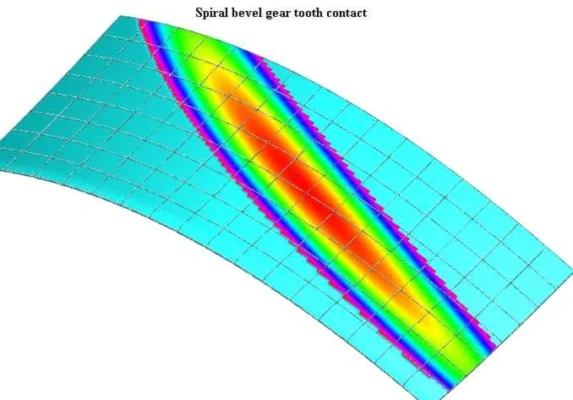
A suitable contact pattern allows load to spread across a designed area of the tooth surface. When contact is too narrow or too close to the edge, pressure becomes concentrated in a smaller area.
Over time, this can lead to pitting, scuffing, uneven wear, or higher fatigue risk. In agricultural machinery, heavy-duty equipment, electric drive systems, and industrial automation, load conditions are often not perfectly steady. A poor contact pattern can make these applications less forgiving.
2. It Affects Wear and Service Life
Gear life is not decided by hardness alone. Material, heat treatment, surface finish, lubrication, backlash, and contact pattern all affect how the tooth surface wears.
For replacement gear projects, this is especially important. Old samples may already have worn contact marks. If a new gear is copied only from a worn part without checking the mating gear or assembly position, the original meshing condition may not be accurately restored.
3. It Affects Running Stability
A shifted or uneven contact pattern can cause rough meshing, higher temperature, unusual running noise, or difficult adjustment during assembly.
However, these symptoms are not always caused by the gear itself. Housing rigidity, bearing condition, lubrication, shaft alignment, and load direction can also change the final running result. Contact pattern should therefore be reviewed as part of the whole transmission system, not as a single isolated sign.
Common Types of Bevel Gear Contact Pattern Issues
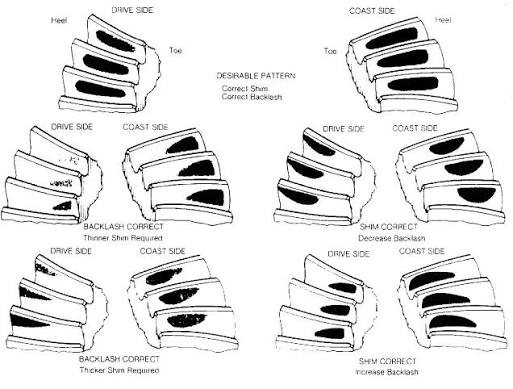
Different bevel gear designs and applications may require different contact positions. In general, the contact area should not be concentrated near the tooth edge, tip, or root. The table below gives common situations and what buyers may need to check.
| Contact Pattern Condition | Possible Meaning | What Buyers Should Check |
| Relatively centered contact area | Meshing condition is generally more stable | Check backlash and key dimensions |
| Contact near the tooth tip | Mounting distance or tooth form may need review | Check mounting distance, tooth geometry, and machining accuracy |
| Contact near the tooth root | Meshing smoothness may be affected | Check backlash, tooth form, and mating gear condition |
| Contact shifted toward heel or toe | Axial position may be incorrect | Check assembly position and mounting reference |
| Contact near the edge | Edge loading risk may increase | Check housing, bearings, and tooth surface modification |
| Very small contact area | Local pressure may be too high | Check heat treatment distortion and tooth surface accuracy |
This table is only a practical reference. Final judgment should still be based on the gear design, load direction, assembly structure, and application requirements.
Who Should Pay Attention to Bevel Gear Contact Pattern
Contact pattern is not only an engineering topic. It also matters to buyers, quality teams, repair companies, and OEM project managers.
Procurement teams can use it to understand why two quotations for the same bevel gear may not include the same technical scope. A lower price may leave out gear pair checking, heat treatment control, or inspection steps needed for more demanding applications.
Engineers usually review contact pattern together with mounting distance, backlash, load direction, and mating gear data. Without these details, the supplier may be able to quote the part, but not fully evaluate the meshing risk.
In repair and replacement projects, the risk is different. A worn sample may no longer show the original geometry clearly. When only one gear from a pair is provided, it becomes harder to confirm whether the new part will match the existing mating gear.
Key Factors That Affect Bevel Gear Contact Pattern
Bevel gear contact pattern is usually the result of several technical conditions working together.
| Factor | Impact on Contact Pattern |
| Tooth geometry | Defines the theoretical meshing position and load path |
| Machining accuracy | Affects tooth surface form and contact consistency |
| Heat treatment distortion | May change tooth surface or key dimensions slightly |
| Mounting distance | Directly moves the contact area on the tooth surface |
| Backlash setting | Influences clearance, temperature, and running behavior |
| Mating gear condition | One qualified gear does not guarantee a stable gear pair |
| Housing and bearing condition | Changes contact position under real load |
For example, heat treatment improves surface hardness and wear resistance, but it can also introduce small distortion. For precision bevel gears, post-heat-treatment correction, first-article inspection, or contact checking may be needed depending on the project.
Benefits of Reviewing Contact Pattern Before Production
Reviewing contact pattern before mass production can reduce later adjustment and rework.
First, it helps identify possible edge loading before the gear enters actual service. If the mark is clearly shifted toward the edge, the gear pair may need adjustment before production continues.
Second, it helps confirm whether backlash and mounting distance are suitable. Bevel gear pairs are sensitive to installation position, so even a small deviation can change the contact result.
Third, it shows whether the supplier is only checking single-part dimensions or also considering how the gear pair will mesh. This is especially relevant for spiral bevel gears, hypoid gears, and matched bevel gear sets.
For buyers, the value is practical: problems found during sample or first-article review are usually easier to correct than problems found after a full production batch.
Supplier Tips: What Buyers Should Send for Contact Pattern Review
For a more accurate review, buyers should prepare as much of the following information as possible:
- 2D or 3D drawings
- Pinion and gear information
- Old samples or sample photos
- Tooth number, module, pressure angle, and shaft angle
- Mounting distance and backlash requirements
- Material, heat treatment, and hardness requirements
- Application equipment and operating conditions
- Rotation direction, load direction, and lubrication condition
- Contact impression, tooth inspection, or report requirements
- Sample quantity, annual demand, and target lead time
When complete data is not available, buyers can start with sample photos, key dimensions, application details, and a short description of the problem. Wenlio can then suggest what additional information is needed for the next review step.
Why Choose Wenlio for Custom Bevel Gear Projects
Wenlio works on custom bevel gears and related precision transmission components, including straight bevel gears, spiral bevel gears, hypoid gears, miter bevel gears, crown bevel gears, matched bevel gear sets, and custom gear shafts.
During project evaluation, Wenlio looks beyond whether a part can be machined. The team reviews drawing completeness, sample condition, material, heat treatment, tooth surface process, backlash, mounting distance, and inspection requirements before recommending a suitable production route.
For standard projects, drawing confirmation and dimensional inspection may be enough. For high-load applications, matched gear sets, replacement parts, or projects with higher running stability requirements, contact pattern review or gear-pair checking may be recommended. This helps keep the inspection scope practical while reducing avoidable production risk.
FAQ
Q1: What is bevel gear contact pattern?
Bevel gear contact pattern is the actual contact position and shape on the tooth surface during meshing. It helps show how a bevel gear pair distributes load.
Q2: Why is contact pattern important for bevel gears?
It affects load distribution, wear behavior, temperature, and running stability. If the contact area shifts too far from the expected position, local wear or early failure risk may increase.
Q3: Can a bevel gear pass dimension inspection but still have poor contact pattern?
Yes. Dimensional inspection confirms many key features, but it does not always prove that the gear pair will mesh correctly. Mounting distance, backlash, heat treatment distortion, mating gear condition, and assembly structure can all affect the final contact pattern.
Q4: Should every bevel gear project request contact pattern inspection?
Not always. For standard projects, drawing confirmation and dimensional inspection may be enough. For high-load gears, matched bevel gear sets, replacement parts, and sample-based projects, contact pattern checking is more useful.
Q5: What should buyers provide for a better contact pattern review?
Buyers should provide drawings, samples, mating gear information, mounting distance, backlash, material, heat treatment requirements, application conditions, and inspection needs.
Conclusion
Bevel gear contact pattern is more than an inspection mark. It helps show how a bevel gear pair actually meshes, whether the load is properly distributed, and whether there may be risks such as edge loading, abnormal wear, or assembly problems.
For custom bevel gears, matched bevel gear sets, buyers should discuss contact pattern together with drawings, samples, backlash, mounting distance, material, heat treatment, and inspection requirements. If you are developing or replacing bevel gears,Contact us to send your drawing, sample photos, mating gear information, and application details for a practical manufacturing review.

Pingback: Bevel Gear Inspection Checklist Before Shipment - wenlio.com
Pingback: Why Do Bevel Gears Need Lapping After Cutting - wenlio.com
Pingback: Bevel Gear Accuracy Grades: What to Specify in an RFQ - wenlio.com