
Blogs, Bevel Gear
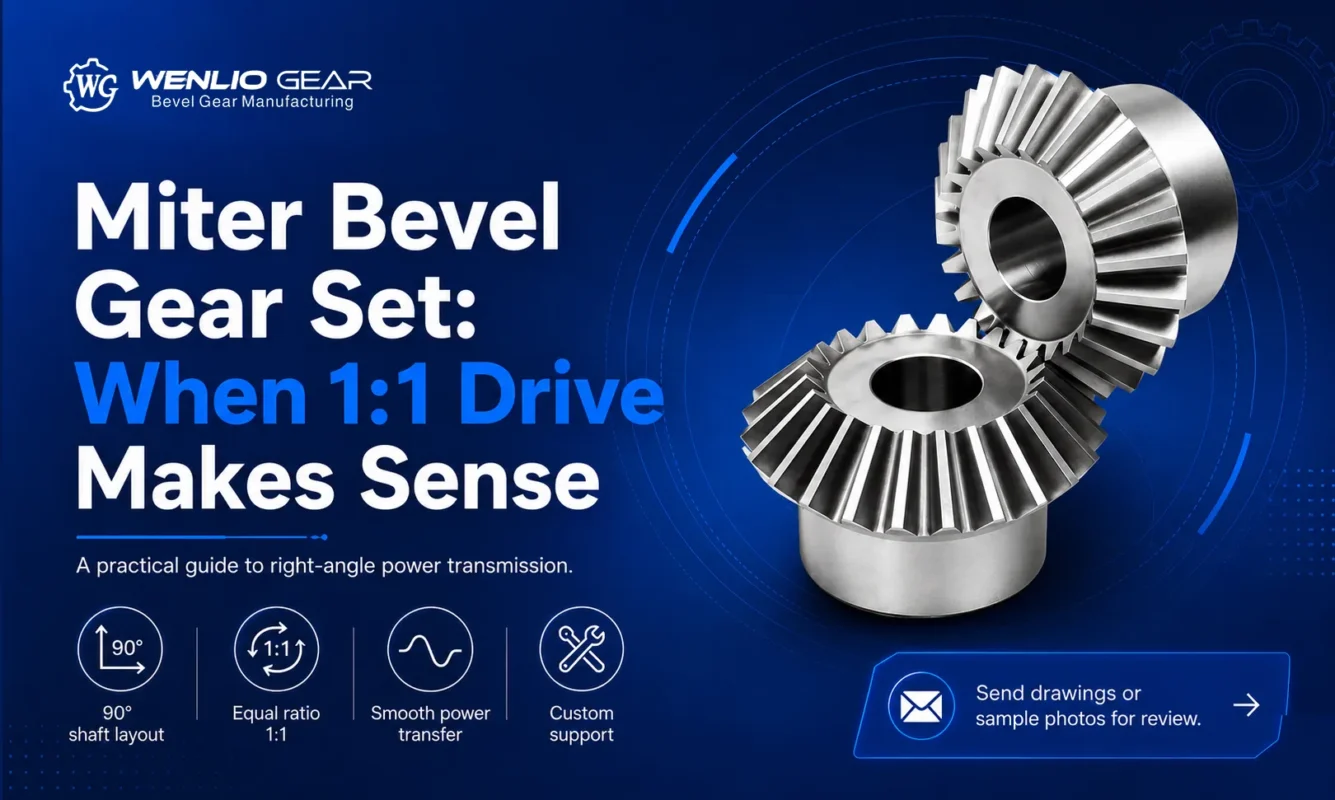
Miter Bevel Gear Set: When 1:1 Drive Makes Sense
Jun
Introduction
A miter bevel gear set is not used when buyers need speed reduction. It is used when the main goal is to turn power at an angle while keeping a 1:1 ratio between the input and output shafts.
This makes miter bevel gears useful in compact right-angle transmission layouts, especially when the machine needs direction change without changing shaft speed. However, a miter gear set is not the right choice for every bevel gear project. Buyers still need to confirm shaft angle, ratio, load, mounting distance, material, heat treatment, backlash, and inspection requirements before requesting a quote.
What a miter bevel gear set is
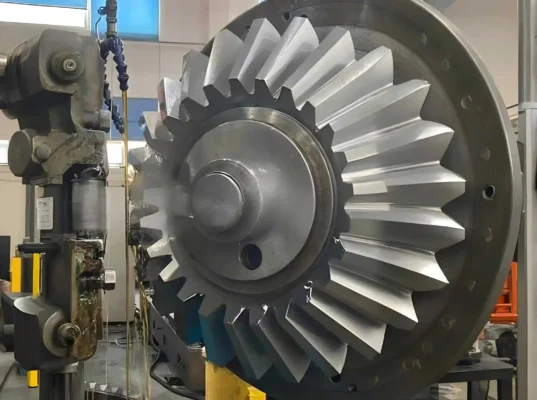
A miter bevel gear set is a pair of bevel gears with the same number of teeth. In a standard design, the two shafts usually intersect at 90 degrees, and the gear ratio is 1:1. This means the output shaft turns at the same speed as the input shaft, but the direction of rotation is changed.
Because the two gears work as a pair, the supplier should not only check the size of each gear. The relationship between the two gears is also important. Backlash, contact pattern, bore position, mounting distance, and assembly reference surfaces can all affect how the set runs after installation.
For buyers, the key question is simple: do you need to change direction only, or do you also need to change speed and torque? If the project needs a 1:1 right-angle drive, a miter bevel gear set may be suitable. If the project needs speed reduction, a different bevel gear ratio should be reviewed.
When a Miter Bevel Gear Set Makes Sense
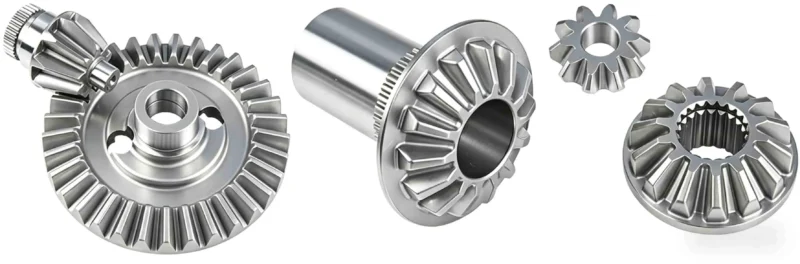
A miter bevel gear set makes sense when the design needs a compact right-angle layout without changing the speed ratio. It is often used in systems where two shafts need to meet at an angle, but the machine should keep the same input and output speed.
This type of gear set can be useful in agricultural machinery, food and beverage equipment, industrial robots, robotic dogs, packaging equipment, and other mechanical systems where layout space is limited. In these cases, the gear set is not selected only because it is a bevel gear. It is selected because the 1:1 ratio and right-angle layout match the design requirement.
| Project Requirement | Is a Miter Bevel Gear Set Suitable? | Reason |
|---|---|---|
| 90-degree shaft direction change | Usually suitable | It redirects motion at a right angle |
| 1:1 speed ratio | Suitable | Both gears have the same tooth count |
| Speed reduction or multiplication | Usually not suitable | A different gear ratio is needed |
| Compact transmission layout | Often suitable | It helps save space in right-angle assemblies |
| High load with strict contact requirements | Possible, but needs review | Material, heat treatment, backlash, and contact pattern must be checked |
| One worn gear replaced alone | Risky | The mating gear condition may affect final meshing |
| Unknown shaft angle or mounting distance | Not ready for quotation | Key assembly information is missing |
This table should be used as a first check, not as a final engineering decision. The actual choice depends on drawing requirements, load, speed, lubrication, and assembly conditions.
When Buyers Should Not Use Miter Bevel Gears
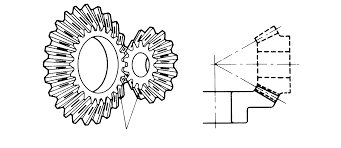
A miter bevel gear set is not the best option when the machine needs speed reduction. Since the standard ratio is 1:1, it does not slow down or speed up the output shaft. If the project requires a different ratio, buyers should review another bevel gear design instead.
It may also be unsuitable when the shaft angle is not confirmed. Although miter gears are commonly used for 90-degree shaft layouts, custom shaft angles need careful design review. If the housing, shaft position, or bearing arrangement is not clear, the supplier may not be able to confirm the contact pattern and backlash correctly.
Another risk appears in replacement projects. If only one gear is sent for copying, but the mating gear is worn or damaged, the new gear may not run smoothly with the old one. In this situation, buyers should consider sending the full set or at least provide clear information about the mating part.
What Buyers Should Confirm Before RFQ
For a miter bevel gear quotation, buyers should provide more than a product name or a photo. A useful RFQ should help the supplier understand both the gear geometry and the assembly condition.
| RFQ Information | What Buyers Should Provide | Why It Matters |
| Ratio | Confirm 1:1 or another required ratio | Determines whether miter gears are the right choice |
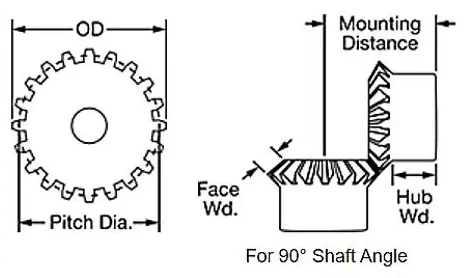
| Shaft angle | Usually 90 degrees, or custom angle if required | Affects tooth geometry and mounting |
| Drawings or samples | 2D drawings, 3D models, or old gear samples | Helps review dimensions and manufacturing route |
| Gear data | Tooth count, module/DP, pressure angle, face width, bore, keyway or spline | Prevents wrong assumptions during quotation |
| Material and heat treatment | Steel grade, hardness, case depth, or approved alternatives | Affects strength, wear resistance, and cost |
| Backlash requirement | Drawing value or acceptable range | Helps control assembly feel and meshing |
| Application details | Load, speed, lubrication, machine type, and failure symptoms | Helps judge risk and suitable process |
| Inspection needs | Dimensional report, hardness report, contact check, or tooth geometry report | Defines the quality evidence required before shipment |
On the miter page, we list typical standard alloys such as 20CrMnTi and SCM420, AGMA 10–14 / ISO 5 flank accuracy, standard and high-precision grinding capability, and process routes including carburizing, nitriding, carbonitriding, matched lapping, and profile grinding. Those are exactly the kinds of variables that should be clear before the supplier prices the job.
Supplier selection tips for miter bevel gear sets
- Check whether the supplier treats the gears as a pair.
For miter sets, a supplier that only talks about one gear at a time is usually not reviewing the real running condition. - Ask how axial thrust is handled.
On our miter page, we point out that miter gears generate dual axial thrust and that tooth and cone geometry need to direct that force into the bearings properly. That issue should not be ignored in quotation. - Confirm the finishing route before approving price.
A standard cut-and-lap route is not the same as high-precision grinding. Wenlio’s capabilities page for miter gears shows different ranges for standard offering and higher-precision grinding, which means the quote must match the real target. - Ask what inspection proves the pair is ready.
We use rolling tests with the companion gear to verify contact area, backlash, and running behavior before shipping. Buyers should know whether their supplier has an equivalent pair-based check. - Make prototype and production expectations clear.
A good supplier should explain how the first approved set becomes the basis for later batch production, inspection, anti-rust treatment, and packaging. Wenlio’s published workflow makes that transition explicit.
How Wenlio Reviews a Custom Miter Bevel Gear Project
Wenlio reviews a miter bevel gear project from the transmission requirement first. We need to understand whether the buyer needs a true 1:1 right-angle drive, a custom shaft angle, a replacement set, or a new design made to drawing.
After that, we check the gear data, material, heat treatment, bore or spline details, mounting references, backlash target, and inspection needs. If the buyer provides old samples, we also review whether the sample is still suitable as a reference or whether the mating part needs to be checked.
For custom projects, Wenlio can support drawing-based manufacturing, sample review, heat treatment, finishing processes, and inspection according to project requirements. The goal is to help buyers receive a gear set that is easier to assemble, verify, and use in the intended application.
FAQ
Q1: Is every 1:1 bevel gear pair a miter bevel gear set?
Not automatically. In practice, a true miter set is defined by equal ratio and right-angle motion transfer, usually with both gears sharing the same geometry basis.
Q2: Can miter bevel gears use shaft angles other than 90 degrees?
Yes. Wenlio notes that 90° is standard, but custom shaft-angle options are possible when the housing or transmission layout requires them.
Q3: Should buyers replace both gears as a pair?
In many projects, yes. Wenlio explicitly recommends matched-pair replacement because the two gears share the same wear relationship and one-part replacement can increase backlash and vibration risk.
Q4: What materials are common for custom miter bevel gears?
Wenlio lists 20CrMnTi and SCM420 as standard alloys on the miter page, while the broader custom-gear workflow also includes materials such as 42CrMo and 8620H depending on the project.
Q5: What should buyers send first for a quote?
The best starting package is the drawing, shaft-angle requirement, bore or key details, quantity, application notes, and any inspection expectations. If the project is replacement-based, sending the mating gear or sample pair is even better.
Conclusion
A miter bevel gear set is often selected because the application needs one specific thing done well: turning motion through 90 degrees without changing speed. But in real sourcing work, the set only performs well when the pair is reviewed correctly, the thrust behavior is understood, the backlash target is realistic, and the finishing and inspection route match the running requirement. Those are the details that turn a simple 1:1 gear idea into a reliable transmission project.
If you are preparing a new miter bevel gear RFQ, replacing an existing matched pair, or trying to compare suppliers beyond just price, Contact Us with your drawing, sample, shaft-angle requirement, and application details. That is the fastest way to move from a basic 1:1 concept to a manufacturable miter bevel gear set with the right quotation and approval path.
